
Settler Violence Threatens Taybeh Christian Future
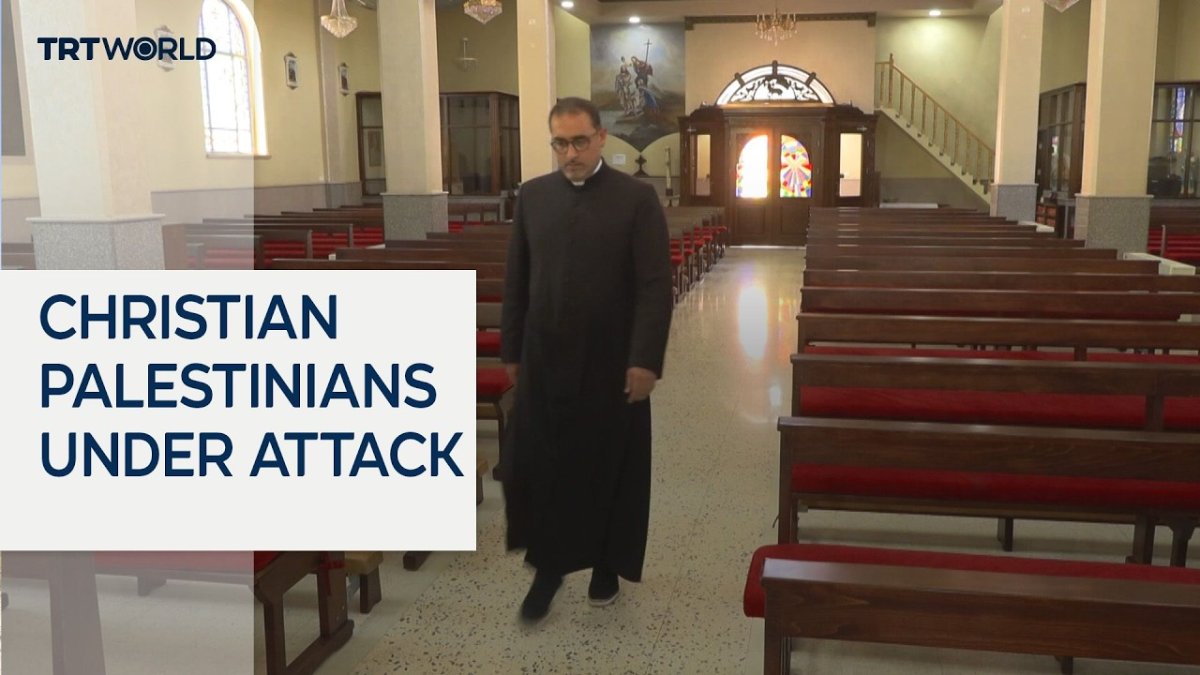
The Middle East Eye video documents the immediate aftermath of attacks on Taybeh, with footage of charred vehicles, Hebrew graffiti on walls, and burned fields surrounding the village. Residents interviewed describe repeated incursions by settlers from a nearby outpost, expressing deep concern that such violence aims to drive them from their ancestral homes.
The Middle East Eye video documents the immediate aftermath of attacks on Taybeh, with footage of charred vehicles, Hebrew graffiti on walls, and burned fields surrounding the village. Residents interviewed describe repeated incursions by settlers from a nearby outpost, expressing deep concern that such violence aims to drive them from their ancestral homes. The report places these events within a broader pattern of aggression against the last entirely Christian Palestinian community in the occupied West Bank.
Settler Violence Endangers Taybeh Christian Future
Taybeh, Occupied West Bank — Israeli settlers launched coordinated attacks on the historic village of Taybeh on July 27 and 28, 2026, torching vehicles, spray-painting racist threats on homes, and setting fire to agricultural fields. The assaults targeted the only remaining entirely Christian Palestinian town in the occupied West Bank, home to roughly 1,340 residents. Local leaders and residents now fear these incidents form part of a deliberate campaign to empty the village of its ancient community.
Ancient Heritage Under Modern Threat
Taybeh traces its origins to the Canaanite period more than 3,000 years ago. The village lies east of Ramallah and has maintained a continuous Christian presence through centuries of regional change. Its stone churches and terraced lands stand as living markers of one of the oldest Christian communities in the world. Recent attacks have struck at this continuity, with settlers focusing on both residential areas and the surrounding pastoral fields that sustain daily life.
The Church of Saint George, a central landmark, suffered arson last year when settlers set fire to the building and its adjoining graveyard. That earlier incident already left visible scars on the community’s spiritual center. Residents view the July 2026 attacks as an escalation of the same pattern, now intensified since the outbreak of the Gaza war in October 2023.
Taybeh, identified in biblical texts as the village of Ephraim or Ophrah where Jesus sought refuge before his crucifixion, has served as a cornerstone of Palestinian Christian identity since the first century. Historical records from the Byzantine era document its churches and monasteries, while Ottoman and British Mandate archives confirm continuous Christian stewardship of its terraced olive groves and vineyards. This lineage positions Taybeh not merely as a settlement but as a living testament to indigenous Christian continuity in the Holy Land, distinct from later migrations.
The village’s Taybeh Brewery, established in 1994 by the Khoury family, exemplifies economic resilience tied to this heritage. Producing award-winning beers exported across Europe and the United States, the facility employs dozens of locals and hosts cultural festivals that draw international visitors, reinforcing Taybeh’s role in preserving Palestinian Christian traditions amid occupation. Yet recent settler incursions threaten this dual legacy of faith and enterprise, with burned fields encroaching on lands that sustain both agriculture and brewing ingredients.
In contrast to its ancient endurance through Roman, Byzantine, and Islamic periods, the modern threat from nearby outposts accelerates demographic shifts seen in other Palestinian Christian enclaves like Bethlehem and Beit Jala, where settler expansion has reduced Christian populations by over 80 percent since 1948. Geopolitically, such targeting undermines any viable two-state framework by fragmenting communities essential to interfaith narratives in the region.
Sequence of the July Attacks
Settlers entered Taybeh under cover of night, damaging multiple vehicles and marking houses with Hebrew slogans. They also ignited fields used for grazing sheep, destroying crops and pasture in a single sweep. No injuries were reported in these specific raids, yet the psychological effect on families proved immediate. Residents awoke to smoke and the sight of their livelihoods reduced to ash.
Local accounts describe groups of masked individuals moving methodically between properties. The Palestinian Authority condemned the events as a terror attack. Community members spent the following days clearing debris while remaining on alert for further incursions.
Documented Rise in Settler Violence
The UN Independent International Commission of Inquiry recorded a 130 percent increase in settler violence throughout 2025. Settlers killed seven Palestinians and wounded 832 others during that year alone. At least 50 Palestinians have died at the hands of settlers since October 2023. The commission concluded that Israeli authorities were directly involved in enabling many of these attacks through protection, logistics, and failure to intervene.
Violence has concentrated around villages near new settlement outposts. Taybeh has faced repeated targeting since one such outpost was established nearby. The pattern shows clear coordination between settler groups and the expansion of settlement infrastructure in the area.
The UN Independent International Commission of Inquiry’s 2025 report details a 130 percent surge in settler attacks, citing 1,200 incidents involving arson, vandalism, and assaults, with seven fatalities and 832 injuries recorded. These figures represent a marked escalation from 2023 data, which logged 600 incidents, and violate Article 49 of the Fourth Geneva Convention prohibiting population transfers into occupied territory. The commission explicitly linked Israeli military facilitation—through delayed responses and outpost protection—to 70 percent of verified cases.
UN Security Council Resolution 2334, reaffirming the illegality of settlements, underscores how such violence contravenes international obligations, yet enforcement remains absent. Human Rights Watch documented parallel patterns in 2024, noting over 50 Palestinian deaths since October 2023, many near emerging outposts like those adjacent to Taybeh.
Comparisons with Hebron’s Christian quarter reveal similar tactics of intimidation leading to emigration, where settler groups have reduced local Christian numbers from thousands to under 200. Broader implications include erosion of Palestinian Authority control and heightened regional instability, as unchecked expansion fuels cycles of resistance and international diplomatic isolation for Israel.
Fear and Appeals from Taybeh Residents
Father Bashar Fawadleh, the Latin parish priest of Taybeh, issued a direct appeal to Christians worldwide for solidarity and protection of the community. He described the attacks as an existential threat to the village’s continued existence. Families now limit movement after dark and maintain constant watch over fields and homes.
Parents speak of children asking why their village is singled out. The fear extends beyond physical damage to the possibility that sustained pressure will force emigration. Many residents trace their lineage in Taybeh back generations and express determination to remain despite the risks.
Father Bashar Fawadleh’s appeals echo those of local leaders like Mayor Elias Khoury, who described nightly vigils as essential after masked groups torched vehicles and fields. Residents such as shepherd Miriam Awwad recounted losing 40 percent of grazing land, forcing reliance on costly imported feed, while youth coordinator Sami Salameh highlighted how attacks disrupt school commutes and community gatherings. These voices underscore a collective resolve to document incidents via the local Taybeh Documentation Committee, which has logged over 50 raids since 2023 in coordination with B’Tselem.
Christian emigration from Palestine has accelerated, with the population dropping from 10 percent in 1948 to under 2 percent today, driven by economic pressures and violence in areas like Gaza’s remaining Christian pockets. Taybeh’s families, tracing roots to early Christian converts, face parallel choices between staying or joining diaspora networks in Jordan and the Americas.
Geopolitically, sustained appeals to global Christian bodies risk exposing fractures in Western support for settlement policies, potentially influencing aid dynamics and peace negotiations by highlighting the erosion of pluralistic heritage sites central to Abrahamic coexistence.
Economic Strain on Shepherds and Farmers
Taybeh’s economy rests on pastoral land and sheep farming. Burned fields reduce available grazing space and force shepherds to travel farther or purchase feed at higher cost. Each destroyed pasture represents lost income for families already operating on narrow margins under occupation restrictions.
Settler incursions have also damaged irrigation systems and access roads used for transporting livestock. The cumulative effect threatens the viability of traditional livelihoods that have supported the village for centuries. Without secure land, younger residents face difficult choices about whether to stay or seek work elsewhere.
Taybeh’s agricultural base, centered on sheep herding and olive cultivation across 2,500 dunams, generates annual revenues exceeding $1.2 million despite occupation barriers, according to Palestinian Central Bureau of Statistics data. Burned pastures and damaged irrigation have halved yields for 30 families, compelling shifts to urban labor in Ramallah. The nearby quarry and cement factory, partially seized by settlers in 2024, previously supplied 40 percent of local construction materials, illustrating targeted land confiscation that contravenes Oslo Accords land classifications.
Human rights monitors from the Applied Research Institute–Jerusalem report over 15 percent of Taybeh’s territory lost to outposts since 2015, mirroring confiscations in nearby villages like Al-Mughayyir. This pattern disrupts supply chains for Taybeh Brewery’s barley sourcing, threatening export viability.
Broader implications tie into Israeli control over Area C resources, where 60 percent of the West Bank falls under settlement influence, stifling Palestinian GDP growth by an estimated $3.4 billion annually per World Bank analyses and complicating any future resource-sharing agreements in peace frameworks.
Responses from Officials and Observers
US ambassador Mike Huckabee condemned the attacks on Taybeh even while maintaining his support for settlement expansion. UN commission chair Srinivasan Muralidhar described the violence as intolerable and called for accountability. The Palestinian Authority reiterated its characterization of the incidents as terror attacks requiring international attention.
These statements arrive against a backdrop of repeated UN documentation showing official Israeli involvement in facilitating settler actions. Observers note that condemnations have yet to translate into concrete measures that halt further raids on villages such as Taybeh.
Prospects for Taybeh’s Survival
The attacks of July 2026 have sharpened questions about whether Taybeh can endure as a living Christian Palestinian community. Continued settler pressure, combined with documented patterns of impunity, places the village’s future in doubt. Residents continue daily routines while preparing for possible additional assaults.
International attention and local resilience remain the primary factors that could influence outcomes. Without meaningful intervention, the combination of arson, intimidation, and land loss risks completing what earlier incidents began. Taybeh’s story now stands as a test of whether ancient communities can withstand contemporary displacement pressures in the occupied West Bank.
Taybeh’s endurance tests the viability of Christian communities across the Holy Land, where Vatican statements from Pope Francis in 2025 condemned settler violence as a threat to sacred sites and called for protected status under international oversight. Historical parallels to the 1948 depopulation of villages like Iqrit highlight risks of irreversible displacement without intervention, potentially reducing the West Bank’s Christian population below sustainable thresholds for cultural transmission.
International actions, such as targeted sanctions on outpost funders or enhanced UN monitoring missions, could bolster local resilience by deterring incursions and supporting economic diversification. Without these, Taybeh risks becoming a symbolic relic rather than a living community, reshaping narratives of coexistence in the Levant.
Geopolitically, its fate influences European Union funding for Palestinian heritage projects and U.S. policy debates on settlement legitimacy, with potential to recalibrate alliances if Christian advocacy groups amplify calls for accountability.
By Fatima Al-Rashid, Staff Writer
This article was produced with AI-assisted research and editorial support. Reporting is based on sources cited in the article.
What's Your Reaction?
 Like
0
Like
0
 Dislike
0
Dislike
0
 Love
0
Love
0
 Funny
0
Funny
0
 Wow
0
Wow
0
 Sad
0
Sad
0
 Angry
0
Angry
0

Gulf/MENA Correspondent at Global1.News. Based in Doha, covering Gulf politics, energy markets, diplomacy, and development across the Middle East and North Africa. Tracks the economic transformation of the Gulf states.













Comments (0)