
Chinese Industrial Robots Gain Ground in Japanese Factories
**Keywords:** Chinese robots, Japanese factories, industrial automation, Fanuc, Yaskawa, labor shortages, METI, robotics market, Siasun, Pudu Robotics, Society 5.0, Japan Robot Association, SME manufacturing, economic security Chinese Industrial Robots Gain Ground in Japanese Factories Tokyo, Japan – June 19, 2026 — NHK WORLD-JAPAN has reported that Japan is proving to be a pri
Chinese Industrial Robots Gain Ground in Japanese Factories
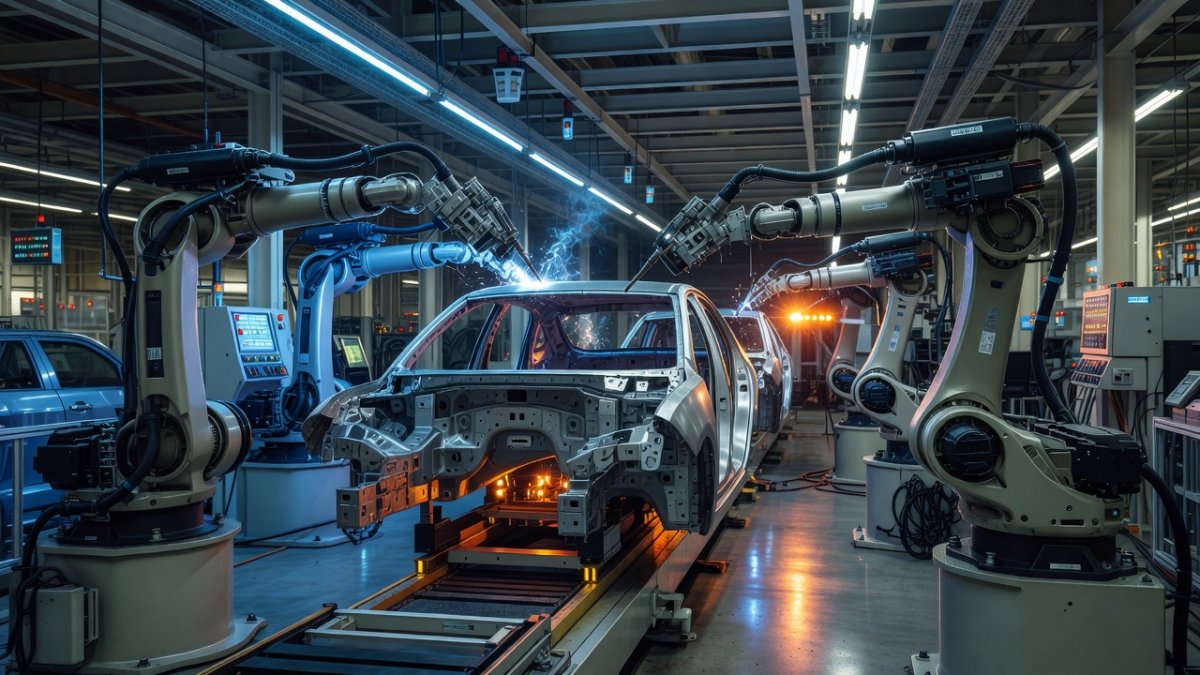
Tokyo, Japan – June 19, 2026 — NHK WORLD-JAPAN has reported that Japan is proving to be a prime market for cutting-edge, low-cost industrial robots from Chinese manufacturers. The coverage highlights how Chinese robotics firms are securing orders in Japanese factories, particularly where cost pressures and structural labor shortages intersect. This development signals a shift in the competitive dynamics of one of the world's most advanced robotics markets.
Japan's Industrial Robot Market in Numbers
Japan remains the world’s second-largest industrial robot market. International Federation of Robotics data show 44,500 units installed in 2024 and an operational stock of 450,500 robots. The automotive sector alone took 13,000 units, an 11 percent year-on-year increase. Record orders worth ¥324.5 billion were booked in the first quarter of 2025, underscoring sustained capital expenditure despite demographic headwinds.
China, by comparison, installed 295,000 units in the same period, equal to 54 percent of global demand. This scale gives Chinese manufacturers unmatched production volumes and component cost advantages that are now reaching Japanese buyers. Japanese end-users, especially small and medium-sized enterprises, are examining total cost of ownership calculations that increasingly favor imported machines priced 30 to 50 percent below domestic equivalents.
Market analysts note that Japan’s high installed base creates replacement and upgrade opportunities. Yet the combination of record order values and China’s dominant global share illustrates how price competition is entering even the most sophisticated automation markets. Japanese factories that once specified only domestic brands are now conducting side-by-side trials, signaling a pragmatic shift driven by measurable cost differentials rather than brand loyalty alone.
Chinese Robot Makers: From Domestic Dominance to Export Ambition
Chinese manufacturers captured 44 percent of their domestic market in the first half of 2024. Companies such as Siasun, Eft and Borunte are leveraging this base to expand globally. Their strategy aligns directly with Beijing’s industrial policy, which subsidizes automation exports and encourages overseas market penetration. In Japan, these firms offer robots at 30 to 50 percent lower prices than comparable Japanese models while providing increasing customization options.
Pudu Robotics has already entered Japan’s service sector, demonstrating that Chinese platforms can meet local integration requirements outside traditional heavy industry. Early adopters report that Chinese machines perform adequately for repetitive tasks in food processing and logistics, where the reliability gap is narrowing. Nevertheless, Japanese engineers still cite occasional differences in long-term component durability and after-sales documentation as areas requiring continued monitoring.
The export push is not merely price-driven. Chinese makers are adapting software interfaces and safety certifications to Japanese standards, shortening commissioning times. This combination of cost, policy support and incremental technical improvements is allowing them to move from domestic dominance toward credible competition in Japan’s demanding factory environment, where buyers prioritize both economics and compliance.
Japan's Incumbents: Fanuc and Yaskawa Under Pressure
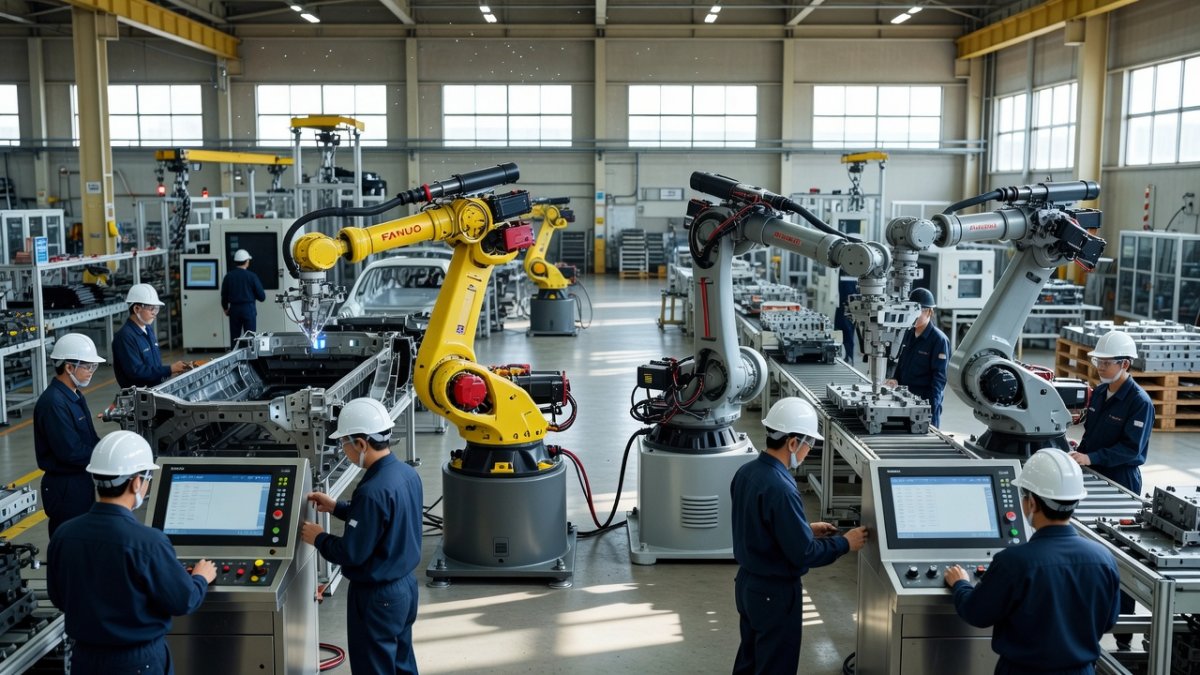
Fanuc and Yaskawa retain global leadership through decades of application engineering and dense domestic service networks. Their robots are embedded in automotive and electronics production lines where uptime and precision are non-negotiable. Yet labor shortages are making small and medium-sized enterprises increasingly price-sensitive, eroding the incumbents’ traditional advantage in these segments.
Both companies have responded with modular robot designs and simplified programming interfaces that reduce integration costs. Fanuc has introduced standardized cells that can be deployed faster, while Yaskawa has expanded leasing programs to lower upfront capital requirements. These measures aim to retain customers who might otherwise evaluate Chinese alternatives on cost alone.
Accelerated research and development spending continues, alongside selective price adjustments on mature product lines. The incumbents emphasize that their ecosystem of certified integrators and predictive-maintenance software delivers lower lifetime costs despite higher initial prices. Whether these value propositions will suffice against aggressive Chinese pricing remains a central question for the next 18 to 24 months.

Labor Shortages: The Structural Driver
Japan’s demographic decline is the fundamental driver behind shifting procurement patterns. METI projects that the working-age population will shrink by more than four million people by 2030. Small and medium-sized enterprises, which account for over 70 percent of manufacturing employment, face the most acute shortages and have limited resources to attract domestic workers.
Sectors such as food processing, plastics molding and warehouse logistics have become early adopters of lower-cost Chinese robots. These industries operate on thin margins where the total cost of ownership calculation favors machines that can be deployed quickly and maintained with minimal specialized staff. Chinese suppliers’ willingness to customize payloads and end-effectors for niche applications further accelerates adoption.
The structural nature of the labor shortfall means that even improved domestic robot affordability may not fully close the gap. METI workforce surveys consistently show unfilled positions in regional factories, reinforcing the economic logic for Japanese SMEs to consider Chinese equipment that delivers acceptable performance at significantly reduced capital outlay.
METI Policy and Technology Competition
METI’s Society 5.0 and GX strategies promote advanced automation, including precision systems for semiconductor equipment. At the same time, economic security considerations are influencing procurement discussions. Although no formal restrictions exist on Chinese robots, METI has issued guidance encouraging supply-chain diversification and risk assessment for critical production lines.
Policy makers are simultaneously pushing open standards and interoperability requirements. This approach aims to prevent vendor lock-in while allowing Japanese factories to integrate best-available technology regardless of origin. The tension between cost competitiveness and geopolitical risk is therefore managed through transparency rather than prohibition.
Industry participants report that METI briefings now routinely include scenario planning around potential export controls or technology access limitations. Companies are documenting dual-sourcing strategies and maintaining relationships with both Japanese and Chinese suppliers to preserve operational flexibility under evolving security guidelines.
What to Watch: The Evolving Landscape
Quarterly order statistics from the Japan Robot Association will provide the clearest near-term signal of market share shifts. METI workforce surveys will continue to quantify labor gaps that underpin demand. Broader US-China technology tensions may indirectly affect component availability and pricing, adding volatility to 18-to-24-month forecasts.
The central dynamic remains the speed at which Chinese reliability improves relative to Japanese cost compression. If the performance gap narrows further while price differentials persist, Chinese machines could capture additional segments beyond early-adopter industries. Conversely, accelerated domestic innovation or policy incentives could stabilize Japanese incumbents’ positions.
Ultimately, the trajectory will shape not only Japan’s industrial automation landscape but also the global balance of robotics technology competition. Observers will track whether Japanese factories maintain technological leadership through differentiation or gradually cede volume segments to lower-cost international suppliers amid persistent demographic constraints.
By Kenji Tanaka, Staff Writer
This article was produced with AI-assisted research and editorial support. Reporting is based on sources cited in the article.
What's Your Reaction?
 Like
0
Like
0
 Dislike
0
Dislike
0
 Love
0
Love
0
 Funny
0
Funny
0
 Wow
0
Wow
0
 Sad
0
Sad
0
 Angry
0
Angry
0

Japan Correspondent at Global1.News. Tokyo-based voice covering Japanese politics, technology, economy, and culture. Tracks the intersection of tradition and innovation in one of the world's most dynamic societies.















Comments (0)