
Xi's Pyongyang Gambit: Leverage, Loyalty, and the Limits of the China-North Korea Alliance
Xi's Pyongyang Gambit: Leverage, Loyalty, and the Limits of the China-North Korea Alliance Geopolitical framing — what this visit means strategically Xi Jinping's journey to Pyongyang represents a calculated effort by Beijing to reassert influence over a neighbour it can neither fully control nor afford to lose. The Chinese president described the relationship as one he is will
Geopolitical framing — what this visit means strategically
Xi Jinping's journey to Pyongyang represents a calculated effort by Beijing to reassert influence over a neighbour it can neither fully control nor afford to lose. The Chinese president described the relationship as one he is willing to guide to new heights, underscoring North Korea's position as a strategically vital yet unpredictable partner on China's border. This framing aligns with Beijing's broader objectives of maintaining stability along its periphery while advancing technological self-sufficiency and regional influence without external entanglements.
The visit occurs against a backdrop of shifting dynamics in Northeast Asia. China seeks to prevent crises stemming from North Korea's nuclear ambitions from drawing it into direct confrontation, even as it preserves its unique position as Pyongyang's primary political and economic partner. By prioritising high-level engagement, Beijing signals its intent to shape outcomes on the Korean Peninsula in ways that support its doctrine of multilateral institution-building and avoidance of over-reliance on any single theatre.
The Xi-Kim summit details
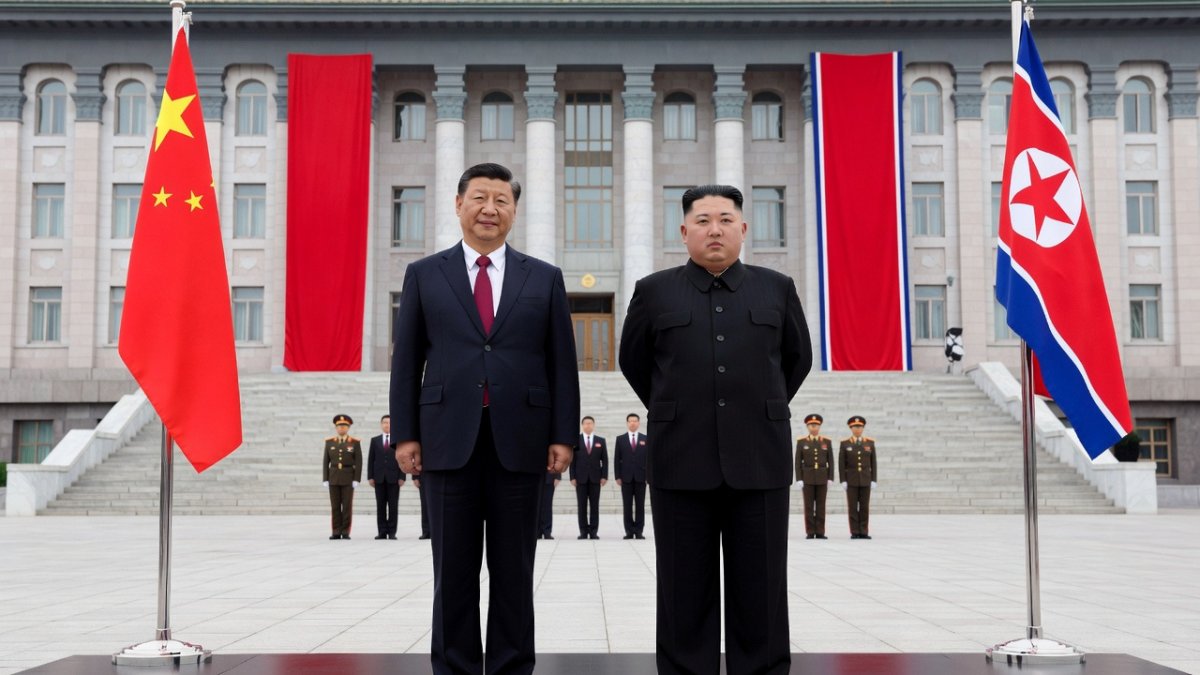
During the two-day visit, the first official trip by Xi Jinping to North Korea since 2019, Kim Jong Un extended elaborate welcomes including red-carpet ceremonies, cheering crowds, and acrobatic performances. The two leaders held talks at the Kumsusan State Guest House and later visited the Friendship Tower commemorating Chinese soldiers from the Korean War, as well as a Pyongyang cadre school where they planted a fir tree. These symbolic acts reinforced the narrative of an enduring bond forged in blood during the Korean War.
At an evening banquet, Xi emphasised that the two countries are linked by mountains and rivers and share a common destiny. Kim responded by affirming that North Korea would uphold its friendship with China as a top priority and reiterated support for Beijing's One China principle. The leaders reached an important consensus to grasp the trend of the times, deepen high-level exchanges, and strengthen people-to-people bonds. Notably, this year marks the 65th anniversary of their defence pact, the only formal defence treaty China maintains with any nation. No concrete deals emerged from the summit, and state media readouts omitted any reference to denuclearisation.
The Russia factor — Pyongyang-Moscow convergence and Beijing's concern
Beijing has grown increasingly concerned about the expanding partnership between Pyongyang and Moscow. After Russia's invasion of Ukraine, North Korea deepened military cooperation with Vladimir Putin, including a mutual defence pact signed during Putin's 2024 visit to Pyongyang. Reports indicate that approximately 2,300 North Korean soldiers have died fighting for Russia against Ukraine, while Pyongyang has supplied ammunition in exchange for oil and aid. This development has quietly rattled China even as it alarms Washington and its allies.
The cooling in Beijing-Pyongyang ties was evident prior to the visit. The 75th anniversary of diplomatic relations in October 2024 received muted public messaging, China's ambassador skipped North Korea's founding celebrations, and senior-level exchanges were absent throughout the year. In contrast, Pyongyang's relationship with Moscow warmed considerably. Xi's recent meetings with both Putin and the US leader Donald Trump add context to the timing, as Beijing seeks to ensure its interests vis-a-vis North Korea remain protected amid rapid convergence between Moscow and Pyongyang.
China's strategic calculus — leverage, defence treaty, economic ties
China's sole formal defence treaty is with North Korea, making any scenario in which Russia becomes the dominant influence in Pyongyang unwelcome in Beijing. A more confident and less dependent Kim Jong Un would reduce Chinese leverage. To counter this, Beijing has pursued a reset: Xi invited Kim to a military parade in Beijing late last year, keeping him prominently alongside Putin in their first formal summit in six years. Public statements praised the two as good neighbours, good friends, and good comrades bound by a shared destiny and called for closer strategic coordination, though any mention of North Korea's nuclear arsenal was absent.
Economic measures have accompanied the diplomatic outreach. China's exports to North Korea reached around $2.3bn last year, the highest level in six years. Passenger train services between Beijing and Pyongyang restarted earlier this year after a six-year hiatus. These steps represent a deliberate effort to pull North Korea back into China's orbit. At the same time, Beijing has mixed feelings about the Moscow-Pyongyang partnership: while it distracts Washington and complicates US strategy across multiple theatres, expanding military cooperation risks provoking a stronger trilateral response from the United States, Japan, and South Korea.
Broader implications for regional stability and US-ROK-Japan trilateral dynamics
China deliberately avoids endorsing Pyongyang's nuclear programme, recognising that such a stance would increase US involvement and strengthen alliances in the region. Yet Beijing also refrains from confronting the issue directly, having joined Russia in vetoing a US-led UN resolution in 2022 that sought new sanctions over North Korea's missile tests. A strong Chinese stance against the programme, analysts note, would only push North Korea further toward Putin. Kim, for his part, cannot afford to alienate his largest source of aid, creating a delicate balance that limits Beijing's options.
The visit carries second-order effects for ASEAN, the EU, and the Global South. By reminding Kim that China remains his main benefactor, Xi seeks to maintain influence without being drawn into crises. However, the absence of any public discussion of denuclearisation or North Korea adopting elements of China's developmental model highlights persistent differences. Beijing has long encouraged market-oriented reforms alongside one-party rule, yet North Korea continues to resist this path. The result is a relationship defined more by leverage than unqualified friendship, with implications for how Washington, Seoul, and Tokyo coordinate responses to future North Korean actions.
Ultimately, the summit underscores Beijing's strategic preference for managed stability over dramatic breakthroughs. As high-level exchanges resume and economic linkages strengthen, China positions itself to shape developments on the Korean Peninsula in line with its wider foreign policy goals, even while acknowledging the limits imposed by North Korea's independent course and its growing ties with Russia.
By Prof. Marcus Chen, Staff WriterThis article was produced with AI-assisted research and editorial support. Reporting is based on sources cited in the article.
What's Your Reaction?
 Like
0
Like
0
 Dislike
0
Dislike
0
 Love
0
Love
0
 Funny
0
Funny
0
 Wow
0
Wow
0
 Sad
0
Sad
0
 Angry
0
Angry
0

World Politics Analyst at Global1.News. Based in Beijing, covering US-China relations, global trade, and geopolitical strategy. Brings deep analytical perspective to the power dynamics shaping international affairs.















Comments (0)