
AI Data Centers Drank 264 Billion Gallons Last Year — and "Closed Loop" Won't Fix What's Already Built
AI data centers consumed 264 billion gallons of water in 2025 — enough for 1.8 million Americans. The UN warns it triples by 2030. Closed-loop cooling only helps new builds, not the thousands already running. Water is the next AI infrastructure bottleneck.
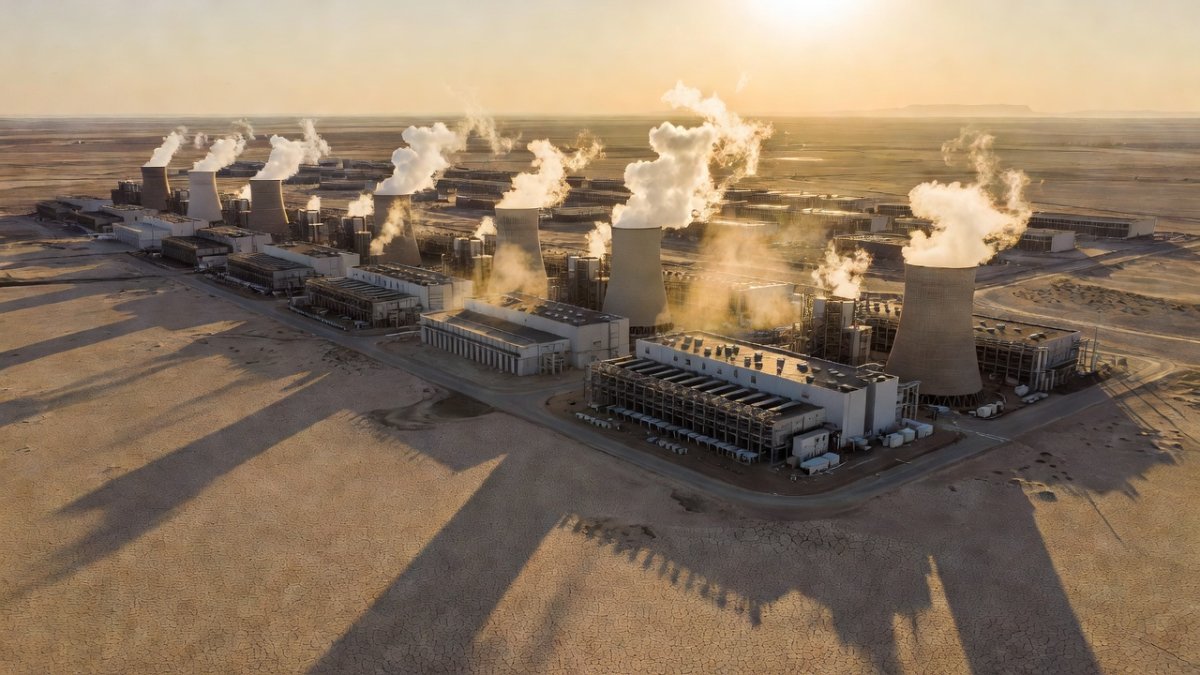
AI Data Centers Drank 264 Billion Gallons Last Year — and "Closed Loop" Won't Fix What's Already Built
Let me tell you something that's been sitting wrong with me all week. Actually, longer than that — I've been watching this one unfold for months, and every time I think I've got my head around the numbers, a new report comes out that makes them look even worse.
AI data centers consumed 264 billion gallons of water in 2025. Let me put that number in terms that actually mean something: that's the annual domestic water use of 1.8 million Americans. In one year. For cooling computers. And the UN says by 2030, that number triples to nearly 2.5 trillion gallons — enough water to meet the basic needs of every person in Sub-Saharan Africa.
But here's the part that really gets me. Every time this comes up in the news, the hyperscalers roll out the same talking point: "Don't worry, we're building closed-loop cooling now. Zero water consumption. Problem solved."
And I'm sitting here looking at the 5,000-plus data centers already running on evaporative cooling towers, each one guzzling 2.6 million gallons per megawatt per year — and I have to ask: solved for who, exactly?
The Number That Should Scare You — 264 Billion Gallons in One Year
Let's start with the scale because I don't think most people — including a lot of people in this industry — actually understand how much water we're talking about.
The Lawrence Berkeley National Laboratory estimated that US data centers directly consumed roughly 17 billion gallons of water in 2023 for on-site cooling alone. That number alone was enough to raise eyebrows. Fast forward to 2025, and the total across all AI data centers globally hit 264 billion gallons — a fifteen-fold increase in two years. That's 550 million gallons per day. Every single day.
Microsoft's water consumption tells the story in microcosm. The company's water use spiked 25% in 2025 alone as it rushed to stand up AI capacity. Google reported consuming over 6 billion gallons in 2023 across its global data center fleet — and that number has only gone up as Gemini workloads exploded. Google's Council Bluffs, Iowa facility alone burned through nearly 1 billion gallons of potable water in 2023. Drinking water. To cool servers.
Meta consumed 813 million gallons in 2023. Amazon doesn't even fully disclose its water footprint at the facility level. And these are the numbers the companies are willing to share publicly — which, as we'll get to, is far from the full picture.
The physics is straightforward: a traditional data center using evaporative cooling towers consumes roughly 2.6 million gallons of water per megawatt of IT load per year. A 500 MW AI data center — and there are dozens being built at that scale — drinks 1.3 billion gallons annually just for cooling. That's not a data center. That's a small city's water budget.
The UN's Warning — 9.3 Trillion Liters by 2030
In June 2026, the United Nations University Institute for Water, Environment and Health published a report that should have been front-page news everywhere. Instead, it got a few tech-news cycles and disappeared.
The headline: AI data centers could consume 9.3 trillion liters of water by 2030 — roughly 2.45 trillion gallons. That is equivalent to the basic annual domestic water needs of every single person in Sub-Saharan Africa. All 1.3 billion of them.
The UN report projected that AI data center electricity consumption would nearly double to 945 TWh by 2030. CO2 emissions would hit 399 million tons. The land footprint would more than double from 6,900 square kilometers to over 14,500. But the water number is the one that keeps me up at night, because water is the bottleneck you can't engineer your way around. You can build more power plants. You can't build more water.
And here's the kicker — the UN's numbers only count direct water consumption. They don't fully account for the indirect water embedded in the electricity generation that powers these facilities. When you add that in, the real water footprint of AI data centers is significantly larger than the direct cooling numbers suggest.
The "Closed Loop" Mirage — What Nvidia, Microsoft, and Oracle Aren't Telling You
Now let me address the counter-argument, because I know it's coming. Nvidia announced in June that its Rubin generation AI servers can use 45°C liquid cooling in a fan-free closed loop, reducing cooling water consumption from 2.6 million gallons per megawatt per year to near zero. Microsoft debuted a zero-water-evaporation data center design in 2024 that uses closed-loop direct-to-chip cooling. Oracle has its own closed-loop system. Satya Nadella himself stood on a stage and said, "The cooling loop is filled once, and the data center can operate effectively with zero water consumption."
Sounds great, right? Problem solved. Except it's not.
First problem: these designs apply to NEW data centers. The ones breaking ground today, maybe 2027 or 2028. What about the thousands of data centers already running evaporative cooling towers right now? What about the facilities that went online in 2022, 2023, 2024, 2025 — built at a pace unprecedented in human history? Those aren't getting retrofitted with closed-loop cooling anytime soon. Retrofitting a 100 MW facility from evaporative to closed-loop liquid cooling isn't a weekend project. It's a multi-year, multi-million-dollar capital undertaking that most operators have no incentive to pursue when their facilities are already running at 95% utilization.
Second problem: the People's Tribune published an investigation in April 2026 bluntly titled "There's No Such Thing as a Closed Loop Water Cooling System for Data Centers." The argument is straightforward — even closed-loop systems lose water to evaporation, bleed-off, and maintenance. The "filled once and never refilled" claim is aspirational, not operational. These systems still need periodic top-ups. And the water used in power generation for these facilities — thermoelectric cooling, hydroelectric forebay losses — dwarfs the direct cooling numbers by an order of magnitude.
Third problem: Prime Data Centers states their closed-loop design uses "less than one percent of the water consumed by traditional systems" — a 99% reduction. That's genuinely impressive. But 1% of 2.6 million gallons per megawatt per year is still 26,000 gallons per megawatt per year. At 500 MW, that's 13 million gallons annually. Better, yes. Zero, no.
And the biggest problem of all: the UN report wasn't arguing about cooling technology. It was arguing about total water footprint, including the water embedded in supply chains, chip manufacturing, and electricity generation. A closed-loop cooling system doesn't change the fact that fabricating a single advanced GPU wafer consumes thousands of gallons of ultra-pure water. It doesn't change the fact that every gigawatt-hour of grid power consumed by a data center has a water cost at the power plant.
The Transparency Crisis — Google's The Dalles and What They're Hiding
If the numbers were bad but fully transparent, we could at least have an honest conversation about trade-offs. But they're not transparent. The industry fights water disclosure at every turn.
Take The Dalles, Oregon — a city of 16,000 people where Google operates a massive data center campus. In 2021, Google's facility consumed 355 million gallons of water. Roughly a quarter of the entire city's water supply. When The Oregonian newspaper tried to get the actual numbers, the city refused to disclose them. Google itself wouldn't confirm how much water its existing campus uses, let alone what the new facilities would consume.
It took a legal settlement for The Oregonian to get Google's water usage data. A lawsuit. To find out how much water a private company was taking from a public resource.
That's not a data center problem. That's a governance problem. And it's everywhere. In drought-prone Arizona, new AI data center facilities are demanding millions of gallons daily in a state where the Colorado River is running at historic lows, snowpack in the Rockies hit record lows, and reservoirs are dropping. In Nevada. In Utah. In Texas, where data centers are sprouting across a state that knows water scarcity intimately.
The secrecy isn't accidental. If communities knew exactly how much water their local data center was consuming — and how much of that was drinking-quality potable water — the NIMBY backlash that's already spreading across 42 states around power and noise would get a whole new dimension. Water cuts deeper than watts. People understand water in their bones. You can't spin your way out of "you're drinking less so a chatbot can answer faster."
Where This Collides With Reality — Drought, the West, and the Coming Water Fights
Here's what keeps me up about this. The AI industry is planning to double or triple data center capacity by 2030. The grid interconnection crisis is already a 7 GW bottleneck. And now water is emerging as a constraint that's even harder to solve than power.
You can build a natural gas plant to generate more electricity. You can build solar farms. You can even, as we're seeing, push for nuclear. But you cannot manufacture more fresh water. The Colorado River Basin — which serves 40 million people and supports a trillion-dollar agricultural economy — is already overallocated. The snowpack that feeds it is declining. The reservoirs are dropping.
And the AI industry is planning to drop data centers in Arizona, Nevada, and Utah that each demand millions of gallons a day.
On July 18, 2026, opponents staged protests at 125+ locations across the US against rapid AI data center deployment. Water was a central grievance alongside energy and transparency. This isn't a fringe movement — it's growing faster than the data centers themselves.
The math doesn't work. The national anti-data-center movement has already blocked $130 billion in projects in Q1 2026 across 69+ local moratoriums. Add water scarcity to the list of reasons communities are saying no, and that blocked number only goes up.
And unlike power — where there are technical solutions (more generation, better grid infrastructure, on-site power) — water doesn't have an easy substitute. You can't truck in enough water to run a 500 MW data center. Desalination is energy-intensive and expensive. Water rights are fought over in courts that move slower than any data center construction timeline.
What This Actually Means for Independent Hosting Providers
First — understand that water constraints will hit your power costs before they hit your water bill. Data center operators facing water scarcity will shift to closed-loop cooling or dry cooling, both of which increase electrical load (pumps, fans, chillers run harder). That means higher PUE, higher power costs, and those costs get passed to you as colocation customers. If you're in a drought-prone region, expect your colo provider's power pricing to creep up 10-15% over the next 12-18 months as they invest in waterless cooling infrastructure.
Second — the water transparency fight is going to create regulatory risk for data center development in exactly the regions where independent hosting providers have traditionally thrived: secondary markets with cheap land and available resources. Arizona, Utah, Nevada, Texas — these are prime colo markets. If even one of them passes a data center water disclosure law or consumption cap, the supply of new colocation space in that state tightens, and existing space gets more expensive. Lock in your colo contracts now, and favor providers who can show you their WUE (Water Usage Effectiveness) numbers.
Third — this is a competitive advantage for independent operators who invest in efficient cooling early. If you're running a 50 kW or 100 kW colo operation, you can switch to closed-loop or direct-to-chip cooling faster than a hyperscaler can retrofit a 100 MW campus. Small operators have faster decision cycles. If your facility is in a water-stressed region, invest the capital now — the ROI window on water-efficient cooling is closing as regulatory pressure builds. Your customers will care about water footprint sooner than you think.
Fourth — the water bottleneck is going to accelerate the hyperscaler migration toward nuclear and on-site power, which means longer lead times for new capacity. Every data center that gets delayed by a water rights hearing or an environmental review is capacity that isn't coming online to meet demand. That keeps utilization high on existing facilities — and that keeps colo pricing firm for the foreseeable future. It's bad for the hyperscalers' growth plans, but it's stabilizing for anyone who already has operational capacity with good water access.
The Structural Reality — Water Is the Next Power Grid Crisis
The grid interconnection crisis took everyone by surprise because nobody was tracking the queue backlog until it hit 7 GW. The water crisis is following the same playbook: a slow-burn problem that everyone knows about but nobody has priced into their growth projections.
The UN report projects that AI's water footprint triples by 2030. The industry's response is "we're building closed-loop now" — which, even if fully effective, only applies to a fraction of the capacity that will exist in 2030. The installed base of evaporative-cooled facilities built between 2022 and 2026 will still be running for another decade at least. That's hundreds of billions of gallons locked in.
And the technology fix is partial at best. Nvidia's 45°C liquid cooling works in "suitable climates." Not everywhere. Microsoft's zero-water design works in new facilities, not retrofits. The closed-loop vs. evaporative debate misses the bigger point: the total water footprint of AI — including chip manufacturing, electricity generation, and supply chains — is an order of magnitude larger than the direct cooling numbers that make the headlines.
Water is also fundamentally local in a way that power isn't. A power plant in West Virginia can serve a data center in Virginia through the grid. Water has to come from the local watershed. You can't import the Colorado River to The Dalles. You can't pipe desalinated ocean water to Phoenix at any realistic cost. Every AI data center built in a water-stressed region is making a local trade-off that the community didn't sign up for and can't easily reverse.
The Bottom Line
The hyperscalers are telling you water is solved. They're pointing at closed-loop cooling like it's a magic wand that makes 264 billion gallons of annual consumption disappear overnight. It's not. Closed-loop is a solution for the next generation of facilities, not the last one. And even then, the "zero water" claim is aspirational, not operational.
I've been running infrastructure long enough to know that the problems everyone ignores are the ones that come back to bite you hardest. Power was ignored for years — until PJM's capacity auction shortfall became a front-page crisis. Water is being ignored right now. The UN report was published June 4, 2026. It's been six weeks. How many AI infrastructure announcements have you seen since then that mention water consumption even once?
Exactly.
Don't let the closed-loop marketing fool you. The water bill is coming due, and it's going to change where and how AI infrastructure gets built — whether the hyperscalers are ready for it or not.
-- Allan Ali, Founder
This article was produced with AI-assisted research and editorial support. Reporting is based on sources cited in the article.
What's Your Reaction?
 Like
0
Like
0
 Dislike
0
Dislike
0
 Love
0
Love
0
 Funny
0
Funny
0
 Wow
0
Wow
0
 Sad
0
Sad
0
 Angry
0
Angry
0

Publisher of Global1.News. Automation architect, systems builder, and the guy making sure the truth gets published.











Comments (0)