
Global South Media Leaders Converge in Chongqing to Challenge Narrative Imbalances
Global South Media Leaders Converge in Chongqing to Challenge Narrative Imbalances In a recent CGTN report on the 5th China Media Group Forum held in Chongqing, Pakistani official Raisa Adil highlighted the urgent need for Global South nations to control their own storytelling rather than accept frames imposed by external outlets. The June 10, 2026, gathering, co-organized by C
The Chongqing Forum as Institutional Infrastructure
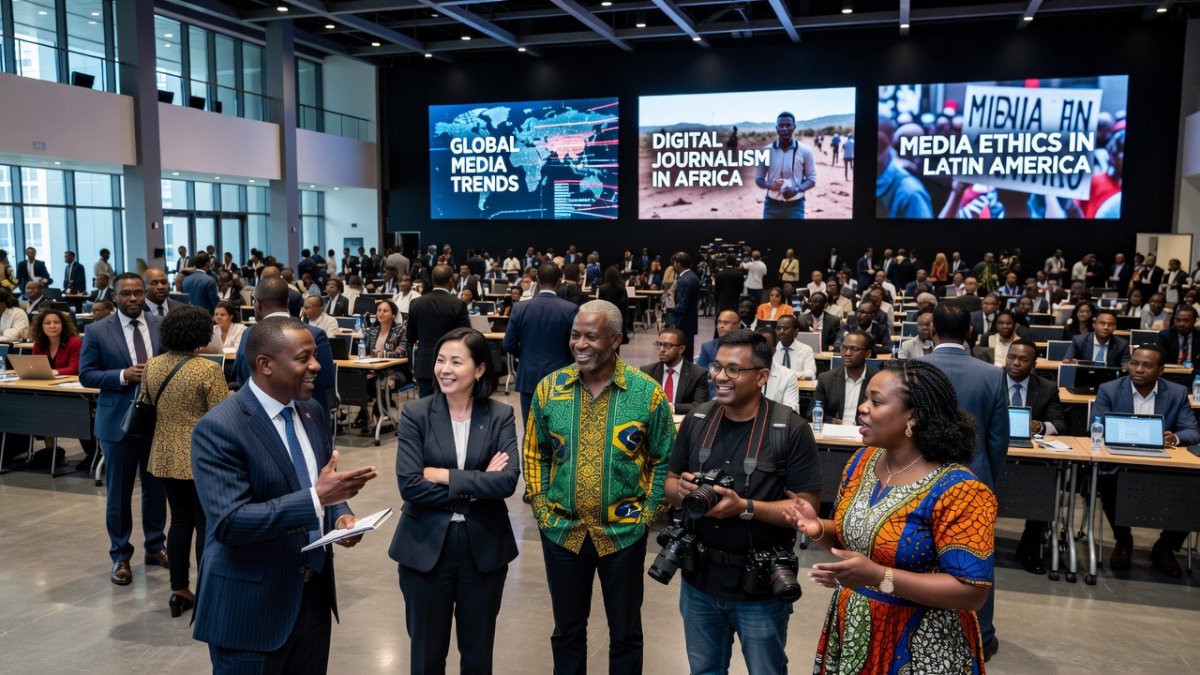
The 5th CMG Forum built directly on prior editions by convening actors from across Asia, Africa, and Latin America under the theme of upholding and reshaping media responsibilities. Co-hosting by Chongqing authorities signaled municipal-level support for national media diplomacy, aligning with the 14th Five-Year Plan's emphasis on cultural soft power projection. Several AI-based media initiatives were demonstrated, ranging from automated content translation tools to data analytics platforms designed for resource-constrained outlets. These showcases illustrated concrete mechanisms through which developing nations could reduce reliance on legacy international broadcasters.
Raisa Adil's Intervention and Narrative Sovereignty
Raisa Adil, Executive Director General of Pakistan's External Publicity Wing, argued that Global South countries must produce and disseminate their own accounts of development, security, and governance. Her remarks at the forum echoed longstanding concerns that Western media organizations apply selective lenses to events in the Global South, often emphasizing instability while downplaying policy successes. Adil's position reflects Islamabad's broader interest in leveraging multilateral platforms to counterbalance external portrayals, particularly amid domestic economic initiatives tied to regional connectivity projects. This stance aligns with Beijing's encouragement of peer-to-peer media exchanges that prioritize endogenous perspectives.
China's Media Architecture and CGTN Expansion
China Media Group and CGTN function as central instruments in Beijing's effort to construct parallel information channels. Through forums such as this one, CMG facilitates training programs, content-sharing agreements, and technological transfers that strengthen partner outlets in the Global South. These activities support the Dual Circulation strategy by extending China's narrative reach while fostering technological self-sufficiency among collaborators. Unlike direct state-to-state broadcasting, the model emphasizes joint production and capacity building, allowing recipient countries to retain editorial agency while gaining access to advanced tools previously concentrated in Western capitals.
Artificial Intelligence and Media Capacity in Developing Nations
AI demonstrations at the forum addressed practical bottlenecks faced by media organizations in lower-income settings, including limited staffing and language barriers. Tools for automated subtitling, sentiment analysis, and audience targeting offer pathways to scale operations without proportional increases in budgets. For Global South governments, such technologies reduce dependence on foreign platforms whose algorithms often amplify sensational content. China's provision of these systems carries strategic implications: it positions Beijing as a supplier of digital infrastructure at a moment when Western technology export controls have tightened. Second-order effects include greater data sovereignty for participating states and potential shifts in how international stories are sourced and verified.
Pressure on Western Information Dominance
Western media organizations have long maintained structural advantages through established wire services, language dominance, and distribution networks. The Chongqing forum signals incremental erosion of that position as alternative platforms gain traction among audiences in Asia and Africa. Each new content-sharing agreement or AI deployment incrementally diversifies the information ecosystem, complicating efforts by any single bloc to set global agendas. European and American outlets now face competition not only in reach but also in framing authority, particularly on topics such as infrastructure development and regional security where Chinese and Global South perspectives diverge from conventional narratives.
Strategic Calculus and Regional Ripple Effects
Beijing seeks expanded influence without direct confrontation, using media cooperation to cultivate goodwill and policy alignment across the Global South. Participating states gain leverage to negotiate better terms in technology transfers and narrative space, while ASEAN and African Union members may accelerate their own regional media initiatives in response. The EU and United States confront the need to recalibrate engagement strategies, potentially through increased investment in local-language programming or partnerships that acknowledge multipolar information realities. Over time, these shifts could alter how multilateral institutions such as the United Nations or World Bank are covered, with greater weight given to voices from the developing world. The forum thus represents one node in a longer process of narrative rebalancing rather than an abrupt rupture. By Prof. Marcus Chen, Staff Writer
This article was produced with AI-assisted research and editorial support. Reporting is based on sources cited in the article.
What's Your Reaction?
 Like
0
Like
0
 Dislike
0
Dislike
0
 Love
0
Love
0
 Funny
0
Funny
0
 Wow
0
Wow
0
 Sad
0
Sad
0
 Angry
0
Angry
0
World Politics Analyst at Global1.News. Based in Beijing, covering US-China relations, global trade, and geopolitical strategy. Brings deep analytical perspective to the power dynamics shaping international affairs.















Comments (0)