
Xi Jinping's 2026 Visit to Pyongyang: Strategic Realignment in Northeast Asia
Xi Jinping's 2026 Visit to Pyongyang: Strategic Realignment in Northeast Asia Historical Context of the Sino-DPRK Alliance The bilateral relationship between China and North Korea rests on a foundation established during the Korean War and formalised through the 1961 Sino-North Korean Mutual Aid and Cooperation Friendship Treaty. This year marks the 65th anniversary of that def
Historical Context of the Sino-DPRK Alliance
The bilateral relationship between China and North Korea rests on a foundation established during the Korean War and formalised through the 1961 Sino-North Korean Mutual Aid and Cooperation Friendship Treaty. This year marks the 65th anniversary of that defence pact, the only such agreement China maintains with any country. The treaty underscores a shared history of military cooperation that continues to shape Beijing's approach to its neighbour despite decades of international sanctions on Pyongyang's nuclear programme.
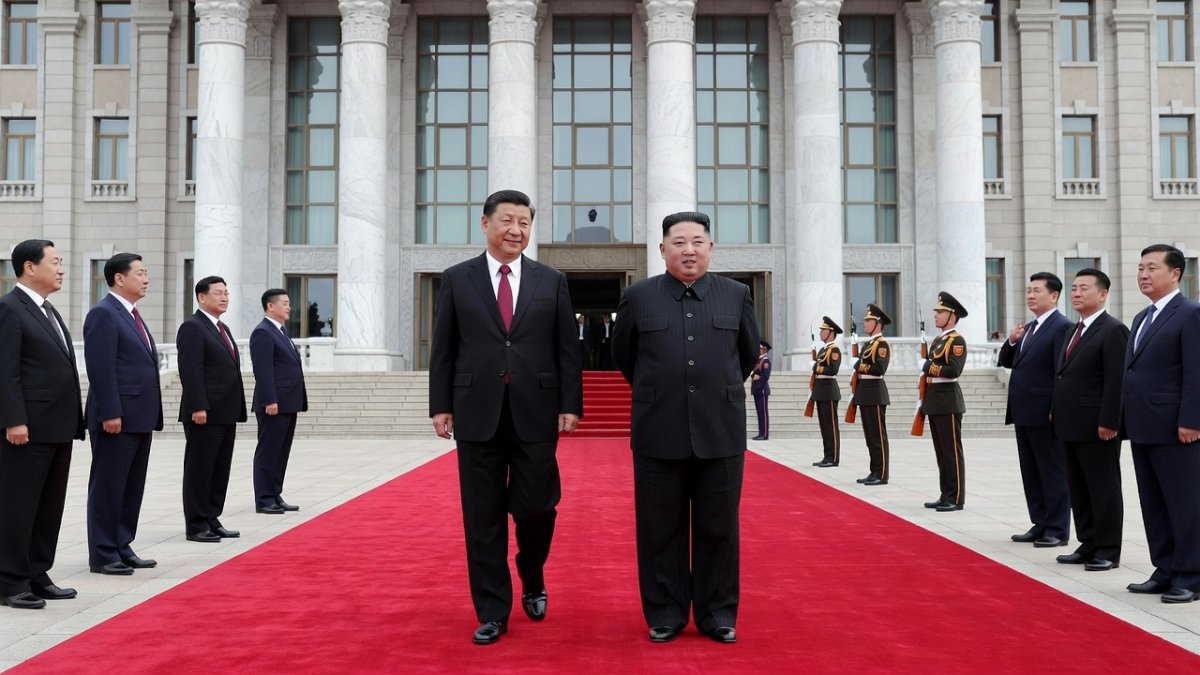
President Xi Jinping's two-day visit to Pyongyang represents his first official trip since 2019. North Korean leader Kim Jong Un organised an elaborate welcome, including red-carpet ceremonies and acrobatic performances. State media reports from both sides emphasised continuity in ties, with Kim describing the choice of Pyongyang as Xi's first state visit of the year as evidence of the "utmost importance" placed on the relationship.
Strategic Significance of the June 2026 Trip
Beijing views North Korea as a strategically vital buffer on its northeastern border. The visit occurs at a moment when Pyongyang has drawn closer to Russia, prompting Chinese officials to reassert influence. Xi was accompanied by key figures including his de facto chief of staff Cai Qi, Defence Minister Dong Jun, Foreign Minister Wang Yi and Commerce Minister Wang Wentao. Their presence signals the comprehensive nature of the engagement, spanning political, military and economic dimensions.
At the evening banquet, Xi described the two countries as "linked by mountains and rivers and share a common destiny." Kim responded by reaffirming North Korea's commitment to the friendship as a top priority and reiterating support for Beijing's "One China" principle. These statements reflect Beijing's interest in maintaining stability on the Korean Peninsula while reminding Pyongyang of its primary economic lifeline amid heavy sanctions.
Key Discussions and Notable Absences
State media readouts from the talks highlighted an "important consensus" to deepen high-level exchanges and people-to-people bonds. Both leaders visited the Friendship Tower commemorating Chinese soldiers from the Korean War and planted a fir tree at Pyongyang's top cadre school, symbolising enduring ties. Xi stayed at the Kumsusan State Guest House, constructed in 2019 specifically to host his earlier visit.
Discussions on North Korea's denuclearisation were absent from official summaries. This omission aligns with China's recent practice of toning down public calls for denuclearisation of the peninsula. Kim appeared to secure this framing, while Xi expressed hope that the visit would "jointly open up a brighter future for the socialist cause of both countries." Observers note that North Korea has continued to resist adopting elements of China's market-oriented reforms, creating underlying friction despite the public displays of unity.
Implications for Regional Geopolitics in Northeast Asia
The timing of the visit, shortly after Xi's meetings with US President Donald Trump and Russian President Vladimir Putin, allows Kim to project diplomatic relevance despite sanctions. For Beijing, the engagement serves to counterbalance Russian influence and remind Pyongyang of its dependence on Chinese trade and political cover. Second-order effects extend to ASEAN states monitoring Peninsula stability and to the EU, which tracks sanctions enforcement and proliferation risks.
China's leverage stems from its position as North Korea's dominant economic partner. Yet the relationship remains asymmetric: Pyongyang retains autonomy in its nuclear and missile programmes. This dynamic limits Beijing's ability to dictate outcomes while still providing sufficient incentive for Kim to maintain the alliance as his primary external relationship.
China's Broader Objectives and Leverage Dynamics
Beijing's approach reflects its Dual Circulation strategy and emphasis on technological self-sufficiency, both of which benefit from a stable northern border. The visit reinforces multilateral institution-building efforts by demonstrating China's capacity to manage relations with difficult partners without external mediation. At the same time, the absence of concrete deals indicates that influence operates through sustained engagement rather than transactional breakthroughs.
Regional actors in Northeast Asia will assess whether this renewed high-level contact translates into reduced tensions or merely preserves the status quo. For the Global South, the episode illustrates how major powers balance security interests with economic interdependence. Future developments will depend on whether Beijing can encourage modest economic opening in Pyongyang while navigating its own domestic priorities and relations with Washington and Moscow.
By Prof. Marcus Chen, Staff WriterThis article was produced with AI-assisted research and editorial support. Reporting is based on sources cited in the article.
What's Your Reaction?
 Like
0
Like
0
 Dislike
0
Dislike
0
 Love
0
Love
0
 Funny
0
Funny
0
 Wow
0
Wow
0
 Sad
0
Sad
0
 Angry
0
Angry
0

World Politics Analyst at Global1.News. Based in Beijing, covering US-China relations, global trade, and geopolitical strategy. Brings deep analytical perspective to the power dynamics shaping international affairs.















Comments (0)