
Tnuva Shortage Spreads from Cottage Cheese to White Cheese
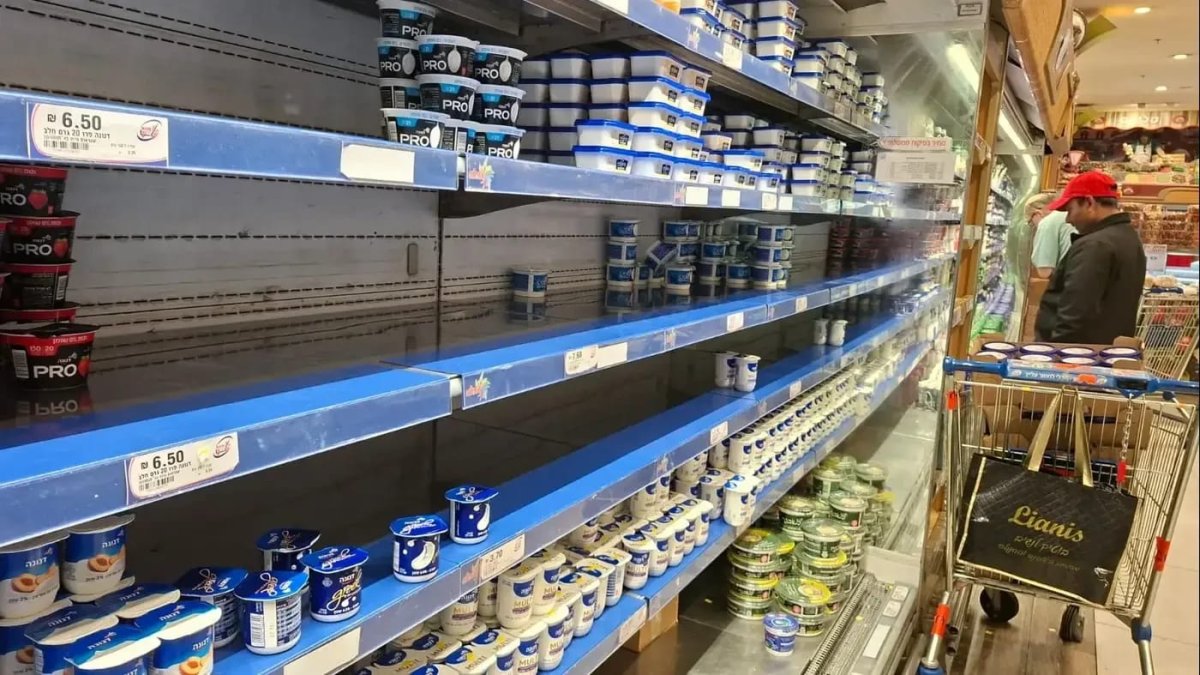
Shoppers across Israel have grown accustomed in recent days to empty dairy shelves, but the latest shortfall has widened the inconvenience from a single staple into a broader gap in everyday products. The Tnuva cottage cheese crisis has now expanded to white cheese after a malfunction at the company’s Alon Tavor plant disrupted production lines for both items.
Tnuva Shortage Spreads from Cottage Cheese to White Cheese
Shoppers across Israel have grown accustomed in recent days to empty dairy shelves, but the latest shortfall has widened the inconvenience from a single staple into a broader gap in everyday products. The Tnuva cottage cheese crisis has now expanded to white cheese after a malfunction at the company’s Alon Tavor plant disrupted production lines for both items. German experts who would normally fly in to diagnose and repair the specialized equipment have refused to travel because of the security situation, leaving local teams improvising while inventories dwindle.
Tnuva informed outlets this week that supplies of its 250-gram white cheese containers are expected to return to normal distribution in the coming days. Yet consumers in Petah Tikva, Tel Aviv and smaller communities continue to report spot shortages of Tnuva yogurt and sour cream as well. For many households the absence of these basic dairy products is the first tangible sign that industrial bottlenecks far from the supermarket aisle are beginning to shape daily life.
Alon Tavor, a key food-production hub in the north, relies on sophisticated European machinery that Israeli technicians can operate but often cannot fully overhaul without manufacturer support. The current episode underscores how a single plant-level failure can cascade into national supply gaps when foreign specialists stay away.
The Broader Crisis of Foreign Technicians Refusing Travel
What began as an isolated dairy disruption is in fact one visible symptom of a much wider problem gripping Israeli industry. Foreign technicians across multiple sectors are declining to travel to Israel for the installation, maintenance or repair of industrial machinery. Steel mills, plastics factories, food processors and pharmaceutical plants—nearly every branch of manufacturing—have felt the impact in recent weeks.
Some companies report that insurers now classify Israel as a war zone and will not cover employees who enter the country. Italian labor unions have gone further, explicitly refusing to allow their members to accept assignments here. The result is a quiet but mounting paralysis: new production lines sit idle, existing equipment waits for critical spare parts or calibration, and managers scramble for work-arounds that would have been unthinkable two years ago.
Israel produces little of the advanced machinery its factories depend on. Decades of integration into global supply chains mean that German, Italian and other European vendors supply the presses, extruders, filling lines and precision tools that keep plants running. When those vendors’ technicians will not board a plane, the entire manufacturing base feels the strain.
Dr. Ron Tomer’s Experience at Unipharm
Dr. Ron Tomer, former president of the Manufacturers Association of Israel and owner of the pharmaceutical firm Unipharm, has lived the crisis in concrete terms. “We had a new machine worth 20 million shekels, but with no technicians willing to come, we spent two months installing it remotely with guidance from Germany,” he recounted. Unipharm’s engineering team erected an elaborate camera system so that European specialists could direct every step over Zoom.
The remote installation eventually succeeded, yet the episode consumed time and resources that would normally have been devoted to production. Tomer later located a technician who happened to be married to an Israeli; the company paid for the couple to stay two months so the work could be finished on site. Such improvised solutions are becoming common, but they are neither scalable nor sustainable for an economy that runs on continuous industrial output.
Tomer’s warning is blunt: “For now, everyone is improvising. The public notices only when cottage cheese disappears from supermarket shelves, not when a factory lacks a specialized blade for precision machining. This is an insane crisis that the Foreign Ministry must address.” His dual perspective—as both a manufacturer and a former industry-association leader—gives the assessment particular weight inside boardrooms from the center of the country to the periphery.
Rav-Bariach Group’s Struggles with Idle Lines
Shmuel Donnerstein, owner of the Rav-Bariach Group, faces a parallel headache. The company is building a new glass-processing plant that requires Italian technicians for commissioning. Those technicians are not coming. Attempts to bring in Colombian specialists were blocked by the Population and Immigration Authority. An Italian labor union has also refused to clear its members for travel, leaving a door-frame production line idle for a full month.
For a firm whose products are embedded in Israeli construction and security infrastructure, the delay is more than an accounting inconvenience. Every week the line stands still means postponed deliveries to building sites and added pressure on already tight project schedules. Donnerstein’s experience illustrates how the technician shortage reaches beyond food and pharmaceuticals into the materials that shape the physical environment Israelis inhabit.
Rav-Bariach’s predicament also highlights the bureaucratic layer that compounds the security-driven refusals. Even when alternative technicians from third countries can be identified, immigration procedures can halt the workaround before it begins. The combination of union bans, insurance exclusions and administrative friction has created a multi-front obstacle for manufacturers.
Economy Ministry Response and Diplomatic Limits
When pressed on the issue, the Economy Ministry offered a carefully bounded reply: “The classification of Israel as a war zone is a diplomatic matter and does not fall under the ministry’s authority.” The statement effectively shifts responsibility toward the Foreign Ministry and the broader diplomatic apparatus, underscoring that industrial policy tools alone cannot reopen the flow of foreign experts.
Officials acknowledge the damage but emphasize that reclassification or insurance negotiations lie outside their direct remit. Manufacturers counter that waiting for high-level diplomacy leaves factories exposed in the interim. The ministry’s posture has therefore become a focal point of quiet frustration among plant managers who need practical relief measured in days and weeks, not diplomatic cycles.
In the absence of a swift governmental bridge, companies continue to rely on ad-hoc measures—remote video guidance, dual-citizen technicians, or simply running equipment until the next unavoidable breakdown. Each of these stopgaps carries its own risks of error, delay and elevated cost.
Impact on Israeli Manufacturing and Supply Chains
The cumulative effect is a slow erosion of operational tempo across the manufacturing base. Food plants such as Tnuva’s Alon Tavor facility cannot guarantee steady output of cottage cheese, white cheese, yogurt or sour cream. Pharmaceutical producers like Unipharm face postponed validation of new lines. Steel and plastics operations report similar bottlenecks whenever a critical machine requires manufacturer-certified intervention.
Because Israeli industry is tightly linked to both domestic retail and export markets, the disruptions ripple outward. Supermarket chains including Shufersal must adjust allocations and sometimes substitute imported alternatives at higher cost. Downstream customers in construction, packaging and healthcare encounter longer lead times. The public may first notice the missing dairy tub on the shelf, yet the same constraint is quietly raising costs and reducing flexibility throughout the economy.
Security concerns that keep technicians away also reinforce Israel’s long-standing strategic vulnerability: heavy dependence on foreign capital equipment and the specialized human capital that services it. Decades of successful integration into European and global supply chains have delivered efficiency; the current environment reveals the fragility that accompanies that efficiency.
Comparison with the Pre-War Situation
Before the present security situation intensified, the arrival of a German or Italian technician was a routine commercial transaction. Machines were installed on schedule, preventive maintenance occurred at planned intervals, and spare-part logistics functioned without geopolitical overlays. Insurers issued standard travel policies; labor unions raised no objections grounded in conflict-zone designations.
That earlier normalcy allowed Israeli manufacturers to treat foreign technical support as an invisible utility—always available when needed. The contrast with today’s reality could scarcely be sharper. What was once a phone call and a flight booking has become a negotiation involving unions, underwriters, immigration officials and, ultimately, diplomats. The change has forced a rapid cultural adjustment inside factories that previously optimized for just-in-time efficiency rather than contingency planning.
Veterans of the sector note that even during earlier periods of regional tension, technical visits usually continued under enhanced security protocols. The current breadth of refusals—spanning multiple nationalities and industrial branches—marks a qualitative shift that few had anticipated would last this long.
What the Government Can Do
Industry voices, led by figures such as Dr. Ron Tomer, argue that the Foreign Ministry must treat the technician ban as a priority diplomatic file. Possible avenues include bilateral discussions with European governments to carve out exemptions for essential industrial personnel, engagement with insurers to restore coverage under defined security arrangements, and streamlined visa pathways for third-country technicians who are willing to travel.
At the same time, the Population and Immigration Authority could examine whether existing procedures inadvertently block useful work-arounds, as occurred with the Colombian specialists sought by Rav-Bariach. Coordination between the Economy Ministry and the Foreign Ministry would help ensure that industrial needs are translated into concrete diplomatic asks rather than remaining stranded in jurisdictional limbo.
Longer-term options include accelerated programs to train larger cadres of Israeli technicians on the most common European platforms, and incentives for manufacturers to dual-source critical equipment where feasible. None of these steps will restore the pre-crisis ease of access overnight, yet each can reduce the severity of the next breakdown.
Outlook: Improvisation Continues While Shelves Slowly Refill
For the immediate future, improvisation remains the order of the day. Tnuva expects its 250-gram white cheese containers to regain normal distribution this week, offering shoppers partial relief. Cottage cheese availability will hinge on how quickly the Alon Tavor malfunction can be resolved without on-site German support. Other dairy lines—yogurt and sour cream—may continue to show spot shortages in various localities.
Deeper in the industrial stack, companies such as Unipharm and Rav-Bariach will keep relying on remote guidance, personal networks and whatever technicians can be persuaded to come. The public will notice the dairy gaps first; the quieter costs—delayed pharmaceutical capacity, idle door-frame lines, postponed glass-plant commissioning—will surface later in higher prices or constrained supply of finished goods.
Whether the Foreign Ministry can negotiate meaningful relief, and whether European unions and insurers soften their stance, will determine how long Israeli manufacturing must operate in this constrained mode. Until then, the cottage-cheese aisle serves as an everyday reminder that global technical networks, once taken for granted, now run through the filter of security perceptions and diplomatic capacity. Manufacturers will continue to adapt; households will continue to check the dairy case; and the gap between the two realities will remain a live issue for policymakers in Jerusalem and plant managers from Alon Tavor to the industrial zones surrounding Tel Aviv and Petah Tikva.
By Hannah Berg, Staff Writer
This article was produced with AI-assisted research and editorial support. Reporting is based on sources cited in the article.
What's Your Reaction?
 Like
0
Like
0
 Dislike
0
Dislike
0
 Love
0
Love
0
 Funny
0
Funny
0
 Wow
0
Wow
0
 Sad
0
Sad
0
 Angry
0
Angry
0

Israel Correspondent at Global1.News. Based in Tel Aviv, covering Israeli politics, security, technology, and society. Provides balanced, deeply-sourced reporting on one of the most closely-watched regions in the world.















Comments (0)