
Italy Apologises to Thailand After Teen Tourists Disrupt Bangkok BTS Skytrain
A video of a group of Italian teenagers causing a commotion on a Bangkok BTS Skytrain has sparked a diplomatic apology and a nationwide conversation about respect, tourism, and how visitors should behave in the Land of Smiles. What began as a quiet Friday evening commute turned into a viral moment that reached millions — and prompted the Embassy of Italy to bow its head to the Thai people. Italy Apologises to Thailand After Teen Tourists Disrupt Bangkok BTS Skytrain Bangkok, Thailand – Saturday
A video of a group of Italian teenagers causing a commotion on a Bangkok BTS Skytrain has sparked a diplomatic apology and a nationwide conversation about respect, tourism, and how visitors should behave in the Land of Smiles. What began as a quiet Friday evening commute turned into a viral moment that reached millions — and prompted the Embassy of Italy to bow its head to the Thai people.
Italy Apologises to Thailand After Teen Tourists Disrupt Bangkok BTS Skytrain
Bangkok, Thailand – Saturday — The Embassy of Italy in Bangkok has issued a formal trilingual apology to the Thai public after a group of Italian underage tourists behaved inappropriately aboard a BTS Skytrain, generating heated conversations online and prompting the mission to strongly condemn their actions.
What Happened on the BTS
The incident unfolded on Friday when a Thai woman, riding the elevated train that millions of Bangkok residents rely on each day, asked a group of foreign teenage passengers to lower their voices. Instead of a polite response, she was met with profanity. A video of the confrontation spread rapidly across social media — the original post drew roughly 160,000 views on TikTok, while a repost on X surpassed 2 million views by Friday. The footage shows a tense exchange between the commuter and the student group, with the youths responding rudely to her request for quiet.
The Bangkok Mass Transit System, known affectionately as the BTS or Skytrain, is more than transit in Thailand — it is a shared public space governed by an unspoken etiquette of calm. For many Thais, the sight of visitors disregarding that quiet courtesy struck a nerve, tapping into deeper questions about how the kingdom welcomes the world as it races toward a record year for tourism.
The Embassy Responds
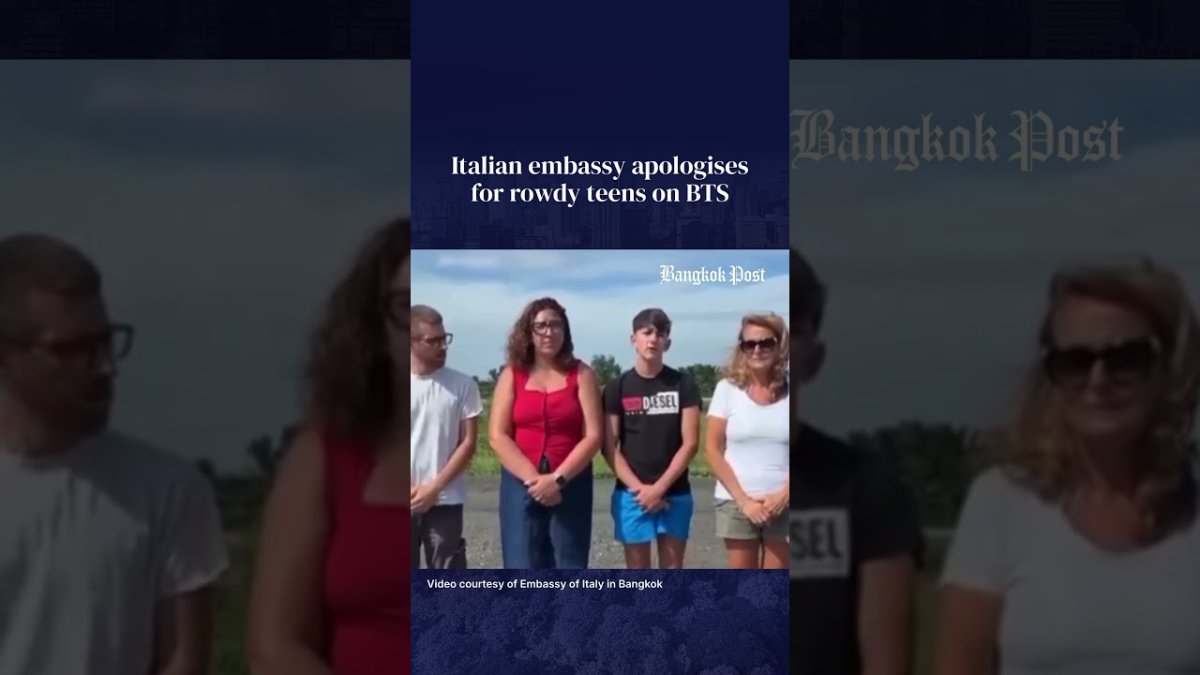
On Saturday, the Embassy of Italy posted a trilingual statement — in English, Thai, and Italian — on its official Facebook page, apologising to the Thai people "over the inappropriate behaviour of a group of Italian underage tourists." The embassy strongly condemned the actions and shared a video in which four of the Italians appeared before the camera to apologise directly to the Thai public and ask for forgiveness.
The social media backlash was swift and intense. Commenters flooded the embassy's page, and the volume of criticism grew so heavy that administrators disabled comments on the post — a rare public step that underscored just how personally Thais took the slight. An Italian study-tour operator linked to the group also issued its own apology, acknowledging that the behaviour did not reflect the values of the programmes it runs.
Thailand Context: Tourism, Face, and the Code of Public Spaces
The episode lands at a sensitive moment for the kingdom. Thailand is projecting a banner year for inbound travel, with the Ministry of Tourism and Sports betting on double-digit growth and the government rolling out visa facilitation for key European markets including Italy. Prime Minister Paetongtarn Shinawatra's administration has made "high-value, sustainable tourism" a centrepiece of its economic messaging.
For Thais, the reaction is also about kreng jai — the cultural instinct to avoid imposing on others — and the concept of saving face, central to social harmony across the Kingdom. A stranger asking for quiet is not confrontation; it is a gentle appeal to shared courtesy. When that appeal is answered with insults, it reads not merely as bad manners but as a breach of the social contract that holds crowded public spaces like the BTS together.
Bangkok's transport networks — the BTS, the MRT, and the Airport Rail Link — carry well over a million passengers on a typical weekday. They are where office workers in Silom, students in Siam, and monks in saffron robes share the same carriage. The expectation of stillness is part of what makes that coexistence work in a dense, humid, fast-moving city.
Implications for Southeast Asia's Tourism Recovery
The incident arrives as Southeast Asia collectively rebuilds its tourism sectors post-pandemic, with Thailand, Malaysia, Singapore, and Vietnam all competing for the same affluent European and long-haul travellers. ASEAN nations have increasingly coordinated on tourism promotion through frameworks like the ASEAN Tourism Strategic Plan, recognising that a single viral moment of visitor misbehaviour can colour perceptions of an entire region.
For Thai authorities, the episode is a reminder that the soft-power dividend of "Amazing Thailand" depends as much on how visitors are received and educated as on beaches and temples. The Tourism Authority of Thailand has in recent years leaned into campaigns that frame Thai hospitality as a two-way street — visitors are guests, and guests are expected to honour local norms. Incidents like this one test that narrative and hand critics ammunition about overtourism.
Expert and Community Perspectives
Thai social media commentators were near-unanimous that the issue was not the tourists' nationality but the breach of public decency. "It is not about being Italian or anything else," one widely shared post argued. "It is about a Thai woman asking politely for quiet and being disrespected in her own country." Others urged against broad generalisations, noting that millions of Italian and European visitors travel through Thailand each year without incident.
Hospitality professionals in Bangkok, speaking on the condition of anonymity, told local outlets that the real lesson is educational: tour groups — especially youth and school groups — should receive a clear briefing on local etiquette before they ever step onto a train platform. Several pointed to successful cultural-orientation programmes already used by exchange organisations in Chiang Mai and Phuket as models worth scaling nationally.
The Italian side, for its part, moved quickly to contain the damage. Diplomatic observers noted that the embassy's decision to issue a trilingual apology within a day of the video going viral reflected an awareness that, in the age of social media, silence is read as endorsement. By condemning the behaviour and amplifying the teenagers' own apology, Rome signalled respect for Thai sensibilities.
What to Watch For
In the coming days, watch for whether Thai tourism officials issue any formal guidance to inbound tour operators, and whether the Italian study-tour company faces further scrutiny from education-travel regulators in Europe. The embassy's Facebook page remains a focal point — with comments disabled, the next signal will likely come through official statements rather than public threads.
For travellers, the takeaway is simple and timeless: when a local asks for quiet on a packed Skytrain, the gracious answer is a smile and a lower voice. Thailand's famous warmth is reciprocal, and the Kingdom remembers both the guests who honour it and the ones who do not.
By Ann Srisawat, Staff Writer
This article was produced with AI-assisted research and editorial support. Reporting is based on sources cited in the article.
What's Your Reaction?
 Like
0
Like
0
 Dislike
0
Dislike
0
 Love
0
Love
0
 Funny
0
Funny
0
 Wow
0
Wow
0
 Sad
0
Sad
0
 Angry
0
Angry
0

Southeast Asia Correspondent at Global1.News. Based in Bangkok, covering Thai and Southeast Asian politics, economy, technology, and culture. Deep regional perspective on one of the world's most dynamic regions.














Comments (0)