
Russia's Black Sea Oil Terminal Halts Operations as Ukrainian Drones Reshape Energy War
Russian Black Sea oil terminal Sheskharis halts operations after Ukrainian drone strikes, disrupting 650,000 barrels per day - one-fifth of Russia's seaborne crude exports - as the broader fuel crisis hits 60+ regions.
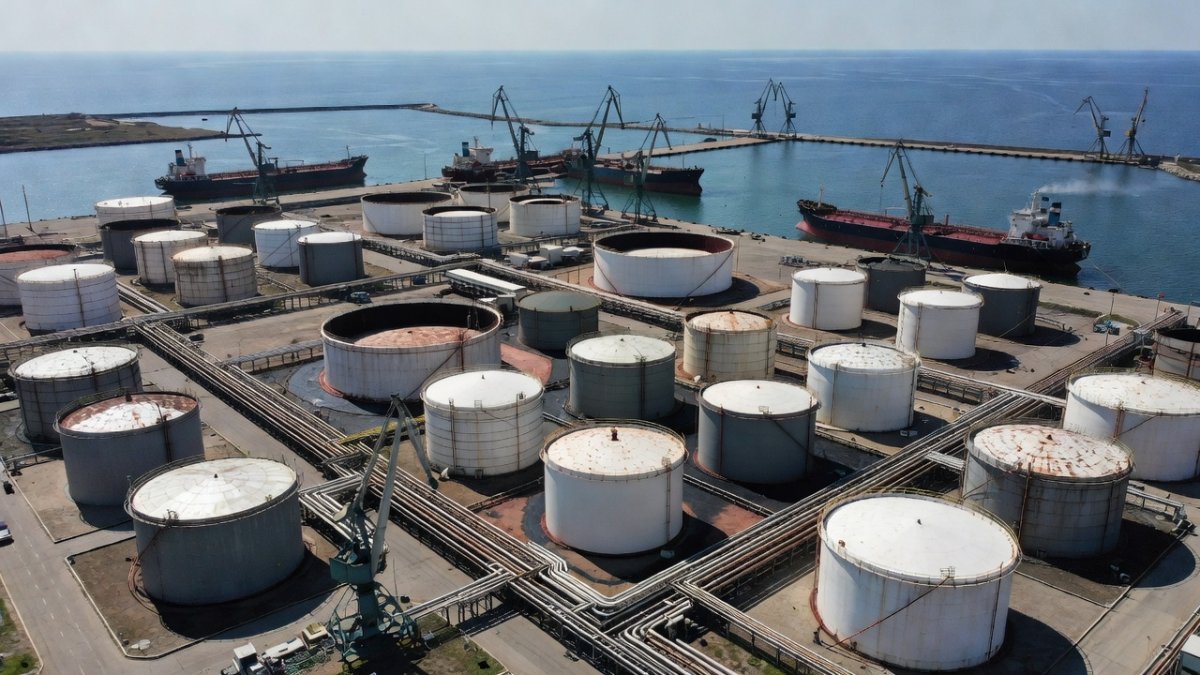
The Shutdown at Sheskharis Terminal
The Sheskharis terminal in Novorossiysk has not loaded any tankers since Tuesday, Bloomberg reported. This facility handles about 650,000 barrels per day — one-fifth of Russia's seaborne crude exports — with an annual capacity of up to 75 million tons. Transneft manages the pipeline flows that feed into the terminal. The interruption affects a critical node in the export chain that has operated since the Soviet era, when Black Sea ports were expanded to support large-scale crude movements.
The Sheskharis terminal occupies a pivotal position within the export architecture inherited from Soviet planning, when Black Sea outlets were deliberately expanded to channel inland production toward global markets. This concentration created enduring dependencies on a handful of coastal nodes, where pipeline infrastructure funnels crude from distant fields through a single administrative operator. Disruptions here therefore ripple outward through the entire centralized system, exposing how post-Soviet Russia retained and intensified the same geographic bottlenecks rather than diversifying exit routes.
Transneft’s oversight of the connecting pipelines underscores the institutional rigidity of this network, in which operational decisions at one point immediately constrain flows across multiple regions. Historical parallels with earlier terminal incidents reveal a recurring pattern: even temporary halts at these facilities have forced rapid reallocations of export volumes toward alternative ports, often at higher logistical cost. Such episodes illustrate the strategic trade-off embedded in the architecture itself—efficiency achieved through centralization at the price of concentrated vulnerability to both technical failure and external pressure.
Drone Threats Prompt Nighttime Restrictions
Russia has banned nighttime vessel movements at Novorossiysk between midnight and 5 a.m. due to drone security concerns. Three grain industry sources confirmed the measure, which Reuters reported on July 22. The restriction reflects an operational adjustment to the same security environment that has already halted tanker loadings at Sheskharis. In the broader post-Soviet energy system, Black Sea ports remain exposed because they concentrate export volumes in a limited number of locations that are reachable by long-range unmanned systems.
The nighttime navigation limits highlight gaps in Russian air defense coverage across the Black Sea, where long-range drones can reach concentrated maritime infrastructure. The restriction reflects recognition that existing defenses are insufficient for continuous port access under sustained threat, and signals how the conflict has shifted toward contesting rear-area logistics nodes. For commercial operators, the ban introduces scheduling uncertainty affecting insurance and vessel routing. Ports in Krasnodar Krai face reduced throughput as daylight-only movements lengthen turnaround times.
Ukraine's Strikes and Their Stated Objectives
Ukraine's General Staff confirmed strikes on Sheskharis and described the terminal as supplying fuel to the Russian army. The Kyiv Independent carried this statement, which aligns with the observed halt in loadings. Analysts suggest that targeting export terminals alongside refineries extends pressure on both military logistics and commercial revenues. This approach builds on the pattern of attacks that began in August 2025 and has since contributed to measurable constraints on domestic fuel distribution.
Fuel constraints at export terminals intersect with existing pressures on Russian military supply lines, particularly those running southward to sustain operations in Ukraine. The southern corridors have long served as critical arteries for moving refined products and equipment from interior bases to forward positions, yet they now operate under the shadow of both physical strikes and reduced processing capacity. This compounding effect illustrates how disruptions at commercial energy nodes can indirectly degrade the reliability of military logistics without direct engagement at the front.
Strategic planners face difficult trade-offs in prioritizing scarce fuel between export commitments and domestic military needs, revealing the institutional tension between revenue generation and operational sustainment. Prolonged pressure on these southern routes risks forcing reallocations that weaken either battlefield endurance or the broader economic foundation supporting the war effort. Historical parallels with earlier conflicts show that such rear-area constraints often prove more decisive over time than initial force concentrations.
Russia's Widespread Fuel Shortages
More than 60 of Russia's 83 regions are facing fuel shortages or rationing, according to CNN and Mediazona reporting. Crimea declared a state of emergency on June 21, 2026 and banned fuel sales to citizens. The fuel crisis is driven by Ukrainian drone attacks on refineries that have continued since August 2025. These shortages illustrate how repeated strikes on processing capacity can propagate through a distribution network originally designed under centralized Soviet planning, where regional supply depended on a smaller number of large refineries connected by pipelines and rail.
Russia’s current fuel distribution strains echo earlier crises in 1998, 2008, and 2022, each of which exposed the same underlying fragility of a refinery network designed under centralized Soviet planning. In that model, a limited number of large processing facilities supplied vast territories through fixed pipeline and rail linkages, leaving little redundancy when individual plants were impaired. Contemporary attacks on refineries therefore revive these structural vulnerabilities, demonstrating how the architecture continues to transmit localized damage across wide geographic areas.
Different economic sectors experience these shortages unevenly because of varying dependence on diesel versus gasoline and differing access to alternative supply channels. Agricultural and heavy transport operations, which rely heavily on uninterrupted diesel flows, encounter sharper constraints than urban passenger mobility. This uneven impact underscores the institutional challenge of managing scarcity within a system that historically prioritized aggregate output over flexible regional allocation.
Central Bank's Monetary Adjustment Amid Infrastructure Risks
The Russian Central Bank lowered its key rate from 15 percent to 14 percent on July 24, according to the Moscow Times, warning of higher inflation arising from attacks on oil infrastructure. The rate cut occurs against a backdrop in which energy facilities face ongoing physical risk, potentially amplifying price pressures in an economy still shaped by the legacy of post-Soviet energy export dependence. This policy move signals an attempt to balance growth objectives with the inflationary consequences of disrupted crude flows.
Additional Drone Incidents and Civilian Impacts
Wildberries logistics centers were hit by drone strikes on July 24, resulting in at least six deaths, as reported by the Moscow Times. Such strikes on commercial logistics infrastructure extend the reach of the conflict beyond energy assets and into civilian supply chains.
Putin's Focus on Domestic Aviation Production
Putin visited the Irkutsk Aviation Plant on July 24 to inspect MC-21 jet production. This trip took place on the same day as the Wildberries strikes and the Central Bank rate decision. The visit underscores continued state emphasis on substituting imported aircraft components with domestic output, a priority that has gained urgency amid sanctions and supply-chain constraints that predate the current wave of drone attacks.
Broader Geopolitical and Historical Context of Energy Vulnerabilities
Russia also banned Armenian dairy imports over alleged health violations, according to the Moscow Times. While this measure appears unrelated to energy, it occurs within the same period of heightened internal and external pressures. Historically, Soviet-era logistics concentrated export capacity at a few Black Sea and Baltic terminals, a structure that post-Soviet Russia inherited and expanded. The current combination of terminal closures, nighttime navigation bans, and refinery attacks exposes the enduring structural exposure of this centralized model to modern asymmetric threats. The development signals that sustained pressure on energy infrastructure can affect both export earnings and domestic stability without requiring direct confrontation at the front lines.
These developments extend the trajectory of Russia’s energy posture since 2014, when sanctions first prompted efforts to reroute exports while preserving the centralized infrastructure built during the Soviet period. The convergence of drone strikes, terminal closures, and refinery attacks demonstrates how asymmetric capabilities can exploit the same geographic concentrations that sanctions alone could not fully disrupt. This intersection reveals the limits of a strategy that continued to rely on a small number of high-volume outlets despite mounting external pressures.
A prolonged disruption would test Russia’s capacity to maintain its position as a major global supplier while simultaneously meeting domestic requirements. Institutional dynamics suggest that repeated shocks to this model could accelerate diversification attempts, yet the legacy pipeline and port architecture imposes high switching costs. Over time, sustained vulnerability at these nodes risks eroding both export reliability and the fiscal resilience that has underpinned Russia’s geopolitical posture.By Irina Volkov, Staff Writer
This article was produced with AI-assisted research and editorial support. Reporting is based on sources cited in the article.
What's Your Reaction?
 Like
0
Like
0
 Dislike
0
Dislike
0
 Love
0
Love
0
 Funny
0
Funny
0
 Wow
0
Wow
0
 Sad
0
Sad
0
 Angry
0
Angry
0
Russia/Eastern Europe Correspondent at Global1.News. Covering Russian politics, energy, security, and the shifting dynamics of the post-Soviet space. Provides clear-eyed analysis on one of the world's most opaque regions.













Comments (0)