
A Year On, Anutin Says There Is Nothing to Celebrate at the Thai-Cambodian Border
One year ago this week, the sound of gunfire along the Thai-Cambodian border was not history lessons from a textbook — it was the lived reality of families in Surin, Si Sa Ket, and the villages of the Isaan region who fled their homes in the middle of the night. Today, Prime Minister Anutin Charnvir
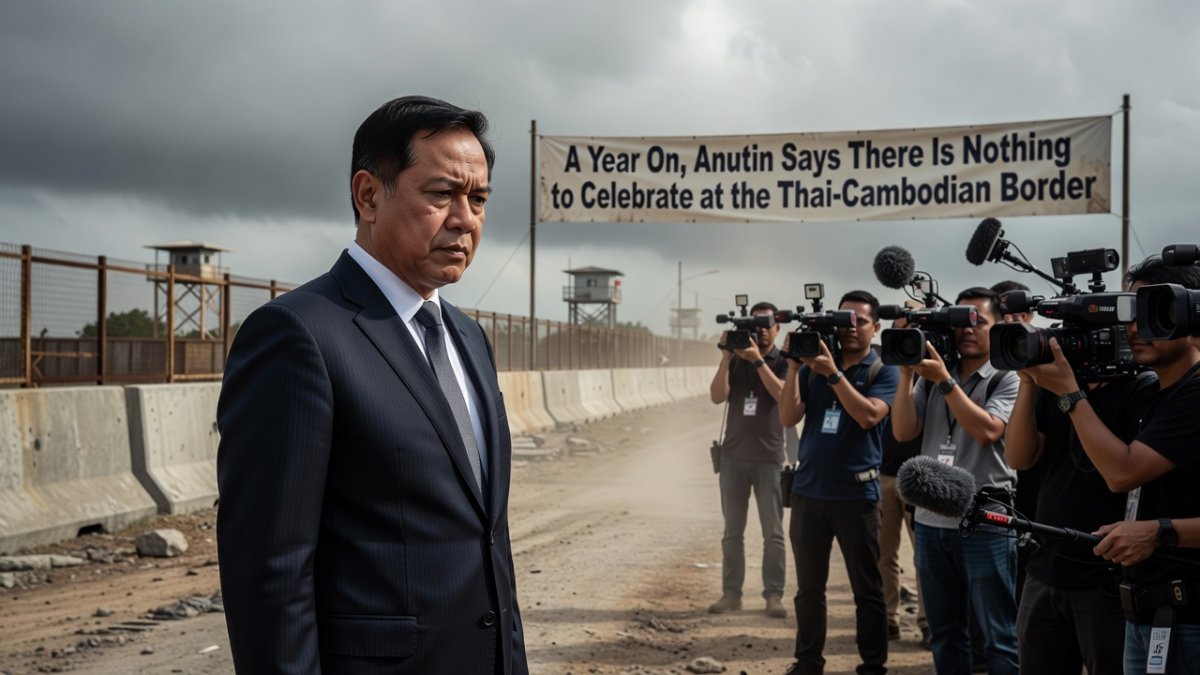
One year ago this week, the sound of gunfire along the Thai-Cambodian border was not history lessons from a textbook — it was the lived reality of families in Surin, Si Sa Ket, and the villages of the Isaan region who fled their homes in the middle of the night. Today, Prime Minister Anutin Charnvirakul stood at Government House and offered the nation a sober message: there is, in his words, “nothing to celebrate” on the first anniversary of that conflict.
A Year On, Anutin Says There Is Nothing to Celebrate at the Thai-Cambodian Border
Bangkok, Thailand — One year after the bloodiest fighting between Thailand and Cambodia in more than a decade, Prime Minister Anutin Charnvirakul has struck a careful, somber tone — honouring those who were displaced while insisting the security situation along the frontier has returned to normal. His words, spoken on Friday at Government House, land at a moment when the region is still learning how to trust a peace that has held but never fully healed.
A Conflict That Shook the Region
The fighting that began in late July 2025 was not a border skirmish in the old sense. For almost three weeks, artillery and airstrikes echoed across the frontier, forcing nearly one million people from their homes and claiming more than 100 lives on both sides. The Royal Thai Air Force deployed F-16 missions; Cambodian positions were struck. It was, as observers noted, the worst Thailand-Cambodia confrontation in over a decade — a sudden rupture in a dispute that traces back to colonial-era maps and the contested grounds around the Preah Vihear temple.
For Thai readers, the numbers were not abstractions. They were grandmothers in Surin packing a single bag, farmers in Si Sa Ket sleeping in school gymnasiums, and cross-border traders watching a lifetime of quiet commerce collapse overnight. The conflict did not stay in the hills — it reached into kitchens and temples across the Isaan heartland.
What the Prime Minister Said
Speaking on the anniversary, Anutin was measured. Thailand, he said, remains committed to protecting its sovereignty. But he was clear that the date carried no cause for public celebration — no fireworks, no triumphant parades. The security situation, he assured the public, has returned to normal. It was a leader’s attempt to honour memory without inflaming sentiment, to acknowledge resilience without pretending the wound has closed.
There is a Buddhist sensibility in that restraint. In a culture that prizes metta — loving-kindness — and the quiet dignity of remembrance, the Prime Minister’s refusal to turn tragedy into spectacle is its own form of respect. The anniversary is, for many Thai families, still raw.
The Long Road to Ceasefire
The path out of the fighting was neither straight nor swift. A first ceasefire took effect on 28 July 2025, halting the worst of the clashes. Then, on 26 October 2025, the Kuala Lumpur Peace Accord was signed under Malaysian facilitation — with then-US President Donald Trump present — expanding and formalising the earlier truce. A second ceasefire followed on 27 December 2025, backed by a 72-hour monitoring period to verify compliance.
Thailand later released 18 Cambodian soldiers who had been captured in the July clashes — a practical confidence-building step. Yet, as of mid-2026, the ceasefire holds only unevenly. Sporadic incidents and deep mutual mistrust remain. The 13-Point Ceasefire Implementation Agreement, hammered out by the Thai-Cambodian General Border Committee, forbids increasing troops along the border, bans provocative incursions into the other’s airspace, and prohibits new military infrastructure beyond either side’s own territory. The paper is sound. The trust is the harder part.
The China Question
No modern border story in Southeast Asia is complete without Beijing. In recent weeks, PM Anutin has sought reassurance from China that military equipment delivered to Cambodia — including Chinese-origin tanks — would not be turned against Thai interests. Thai Defence Minister Lieutenant General Adul met Chinese Defence Minister Dong Jun, who stressed that the equipment was supplied under a 2016 agreement and was not provided during the border clashes. Beijing reaffirmed its neutrality, describing both Thailand and Cambodia as close regional partners, and has offered to act as a mediator between Bangkok and Phnom Penh.
For ordinary Thais, the China angle is less about geopolitics and more about sleeping soundly. If the weapons next door come with Beijing’s quiet promise of restraint, that is a small but real comfort for the families of the Isaan border provinces who remember the sound of shells.
What It Means for ASEAN
Both Thailand and Cambodia are members of ASEAN, the association that has long promised that regional problems stay regional. The 2025 conflict tested that promise. The “ASEAN way” — consensus, non-interference, quiet diplomacy — was stretched as the fighting spilled into refugee flows and trade disruption. Malaysia’s facilitation of the Kuala Lumpur accord showed the bloc can still marshal its own solutions when the political will exists.
For Thailand, the lesson is that a stable Cambodia is not a threat but a neighbour with whom trade, labour, and tourism are deeply intertwined. The cost of conflict is not only measured in casualties but in the closed border markets, the stranded Cambodian workers, and the Thai tourists who thought twice before visiting the temples of Angkor.
The Human Cost Ordinary Thais Still Feel
Behind every ceasefire line is a human story. Cross-border families — Thai women married to Cambodian men, children with relatives on both sides — were divided by checkpoints and suspicion. Border provinces that depend on day trade with Cambodia watched incomes collapse. The Tourism Authority of Thailand, which had spent years inviting the world to “Amazing Thailand,” found a corner of the country suddenly flagged as a risk zone.
There is also a quieter cost: the psychological weight on children who spent nights in evacuation centres, and on the monks who opened temple grounds as shelters. In Thai Buddhist tradition, the temple is a refuge in every sense. Last year, that tradition was tested in the most literal way.
A Year Later, a Quiet Resolve
So what does this anniversary ask of us? Not celebration — the Prime Minister is right about that. But perhaps remembrance, and a clear-eyed commitment that diplomacy must outlast the guns. The ceasefire holds. The markets are reopening. The soldiers have gone home. These are fragile gifts, and they deserve protection.
For Thai readers, the border is not a distant headline. It is a part of the national family — Isaan’s dialects and Cambodia’s share more than a line on a map. Honouring the anniversary means honouring the resilience of the people who live there, and insisting that the next generation inherit peace rather than patrol posts.
As the rains return to the frontier this season, the hope in Bangkok and in Phnom Penh alike is simple: that the only crossings at the border are the ones carrying trade, not troops. That is a wish worth holding — even if, as the Prime Minister said, there is nothing yet to celebrate.
By Ann Srisawat, Staff Writer
This article was produced with AI-assisted research and editorial support. Reporting is based on sources cited in the article.
What's Your Reaction?
 Like
0
Like
0
 Dislike
0
Dislike
0
 Love
0
Love
0
 Funny
0
Funny
0
 Wow
0
Wow
0
 Sad
0
Sad
0
 Angry
0
Angry
0

Southeast Asia Correspondent at Global1.News. Based in Bangkok, covering Thai and Southeast Asian politics, economy, technology, and culture. Deep regional perspective on one of the world's most dynamic regions.













Comments (0)