
Xi Jinping's Pyongyang Summit Signals Enduring China-North Korea Strategic Partnership
Xi Jinping's Pyongyang Summit Signals Enduring China-North Korea Strategic Partnership Arrival and Ceremonial Welcome in Pyongyang Chinese President Xi Jinping concluded a two-day visit to Pyongyang in June 2026, marking his first official trip to North Korea since 2019. North Korean leader Kim Jong Un arranged an elaborate reception that included a red-carpet arrival and perfo
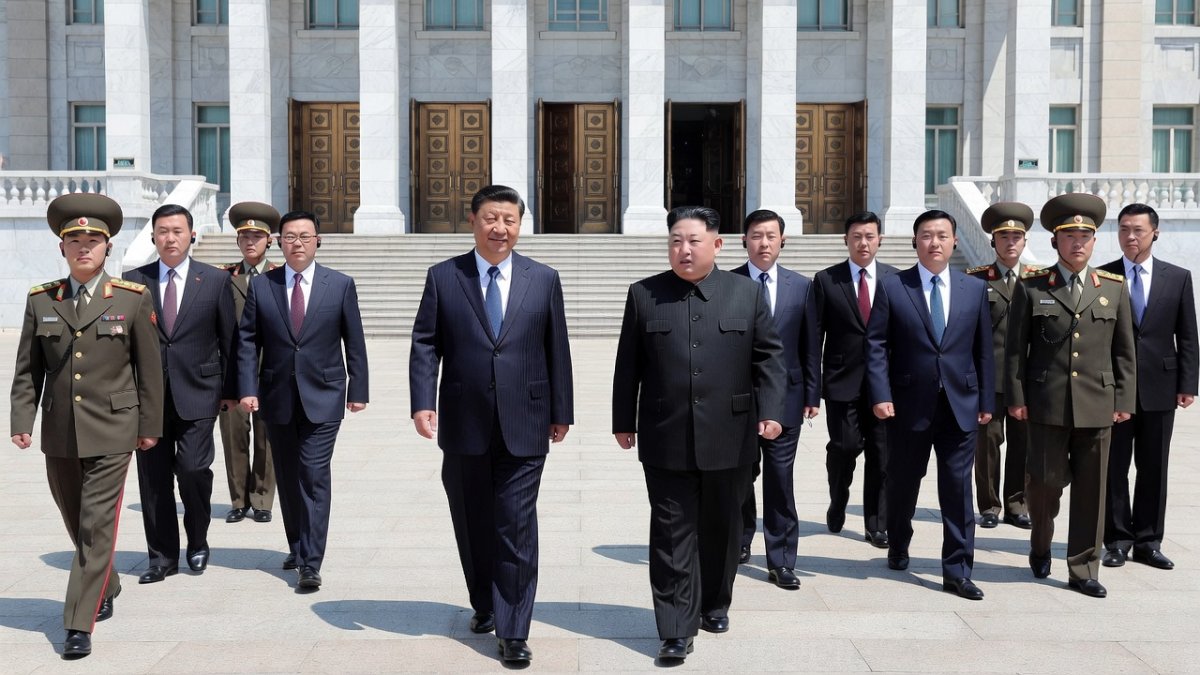
Arrival and Ceremonial Welcome in Pyongyang
Chinese President Xi Jinping concluded a two-day visit to Pyongyang in June 2026, marking his first official trip to North Korea since 2019. North Korean leader Kim Jong Un arranged an elaborate reception that included a red-carpet arrival and performances by acrobatic troupes. The scale of the welcome underscored the symbolic weight both sides attached to the engagement, particularly as Beijing seeks to maintain influence over a partner whose recent outreach to other powers has introduced new variables into the relationship.
State media reports from KCNA highlighted Kim's observation that Xi's selection of Pyongyang for his first state visit of the year reflected the "utmost importance" placed on bilateral ties. This framing aligned with China's broader diplomatic approach of prioritising high-level exchanges with longstanding allies. The visit occurred against a backdrop of recent meetings involving Xi and other major powers, allowing Pyongyang to project continued relevance on the international stage despite ongoing sanctions.
Accompanying Xi were key figures including his de facto chief of staff Cai Qi, Defence Minister Dong Jun, Foreign Minister Wang Yi and Commerce Minister Wang Wentao. Their presence signalled coordinated engagement across political, security and economic domains, consistent with the integrated approach favoured by the Ministry of Foreign Affairs and the Ministry of Commerce in managing relations with the Korean Peninsula.
Substance of the Bilateral Talks
During the summit discussions, Xi and Kim reached an "important consensus" to grasp the trend of the times and deepen both high-level exchanges and people-to-people bonds. Xi emphasised that China and North Korea are "linked by mountains and rivers and share a common destiny," language that echoes longstanding Chinese diplomatic phrasing on shared socialist heritage. No concrete agreements on trade volumes or investment projects were announced, reflecting the cautious pace that has characterised recent interactions.
Kim reaffirmed North Korea's commitment to treating friendship with China as a top priority and reiterated support for Beijing's "One China" principle. The leaders also noted that 2026 marks the 65th anniversary of the bilateral defence pact, China's only such formal arrangement with any country. This reference served to highlight institutional continuity in security cooperation without introducing new operational commitments.
Discussions on denuclearisation were absent from official readouts, consistent with China's recent practice of avoiding public emphasis on the issue in favour of broader stability objectives. The Ministry of Foreign Affairs has long calibrated its messaging to balance non-proliferation goals with the need to preserve channels of communication, recognising that abrupt pressure could reduce Beijing's leverage.
Commemorative Gestures and Symbolic Acts
On the second day, the two leaders visited the Friendship Tower, which honours Chinese soldiers who participated in the Korean War. They also stopped at Pyongyang's primary cadre training institution, where they planted a fir tree to represent the enduring nature of the relationship. These activities followed established diplomatic protocol for reinforcing historical narratives that underpin current cooperation.
Xi was hosted at the Kumsusan State Guest House, a facility constructed in 2019 specifically to accommodate his earlier visit and later used for other distinguished guests including Russian President Vladimir Putin. The choice of venue reinforced the exclusivity of the engagement and provided a controlled environment for extended discussions away from public scrutiny.
Such symbolic steps carry strategic weight in Chinese foreign policy doctrine, which values continuity and historical legitimacy when managing relations with immediate neighbours. By participating in these rituals, Xi reinforced the narrative that the partnership remains a cornerstone of regional stability, even as external pressures evolve.
Economic Lifeline and Sanctions Context
China remains North Korea's primary political and economic partner, supplying essential goods and maintaining trade corridors that mitigate the impact of international sanctions related to the nuclear programme. The Ministry of Commerce has overseen these flows through established mechanisms, ensuring that humanitarian and basic economic needs are addressed while adhering to multilateral restrictions.
During the visit, no new economic packages were unveiled, suggesting that both sides preferred to consolidate existing arrangements rather than announce initiatives that could draw additional scrutiny. This approach aligns with Beijing's preference for incremental engagement that avoids provoking secondary sanctions or complicating relations with other capitals.
Kim's ability to host such a high-profile visitor shortly after Xi's meetings with other leaders was presented domestically as evidence of continued diplomatic options. For China, the visit served as a reminder of its foundational role, even as Pyongyang explores parallel relationships that could dilute exclusive dependence.
Geopolitical Calculus and Regional Dynamics
The timing of the summit allowed Beijing to reassert its position as the indispensable interlocutor for Pyongyang at a moment when North Korea has drawn closer to Russia. Chinese strategic planners view the Korean Peninsula as a critical buffer zone, and the visit was calibrated to prevent any perception that influence was shifting elsewhere.
Second-order effects include potential adjustments in how other regional actors, particularly in Northeast Asia, interpret China's willingness to sustain high-level contact. The Ministry of Foreign Affairs has consistently argued that stable China-North Korea ties contribute to overall peninsula stability, even when progress on denuclearisation remains elusive.
Xi's participation also positioned China to shape narratives around socialist solidarity amid broader international changes. By emphasising shared destiny and the defence pact anniversary, Beijing signalled that ideological affinity continues to inform its approach, distinguishing its engagement from purely transactional models pursued by other powers.
Points of Divergence and Developmental Models
Despite the public warmth, differences persist over economic policy direction. Xi expressed hope that the visit would "jointly open up a brighter future for the socialist cause of both countries," a formulation that implicitly references China's own experience of combining one-party rule with market reforms and expanded foreign investment. North Korean state media did not echo this emphasis on developmental adaptation.
Analysts have noted that elements in Chinese reporting suggest quiet frustration that Pyongyang has not pursued similar market-oriented adjustments. Beijing has long encouraged such steps through quiet diplomacy, recognising that greater integration could reduce reliance on aid while enhancing long-term resilience, yet North Korea has maintained its distinct economic model.
These divergences have not disrupted the core alliance, which both sides continue to describe as strategically vital. The National Development and Reform Commission and other planning bodies monitor economic interactions closely, seeking opportunities for measured cooperation that respect Pyongyang's political constraints.
Outlook for Sustained Engagement
The visit demonstrated that high-level diplomacy between Beijing and Pyongyang remains functional and symbolically significant. With no major breakthroughs announced, the emphasis fell on reaffirming existing frameworks and preparing the ground for future exchanges. This measured outcome reflects the complex interplay of historical ties, economic realities and shifting regional alignments.
Looking ahead, China is likely to continue balancing support for North Korea with its wider diplomatic objectives, including management of relations with the United States and other stakeholders. The Ministry of Foreign Affairs will play a central role in sequencing subsequent contacts to maintain momentum without overcommitting resources.
Ultimately, the summit reinforced that the relationship, while asymmetrical, retains mutual utility. Both capitals appear prepared to navigate ongoing challenges through established channels rather than dramatic new initiatives, preserving the partnership as a steady element in an otherwise fluid Northeast Asian security environment.
By Prof. Marcus Chen, Staff WriterThis article was produced with AI-assisted research and editorial support. Reporting is based on sources cited in the article.
What's Your Reaction?
 Like
0
Like
0
 Dislike
0
Dislike
0
 Love
0
Love
0
 Funny
0
Funny
0
 Wow
0
Wow
0
 Sad
0
Sad
0
 Angry
0
Angry
0

World Politics Analyst at Global1.News. Based in Beijing, covering US-China relations, global trade, and geopolitical strategy. Brings deep analytical perspective to the power dynamics shaping international affairs.














Comments (0)