
South Korea’s Development Diplomacy in Africa: Lessons from KOICA’s Disability Vocational Training in Uganda
The Korea-Africa Summit Framework and Its Bipartisan Continuity In early June, foreign ministers and senior representatives from 50 African countries gathered in Seoul for the first Korea-Africa Foreign Ministers’ Meeting. This gathering served as the follow-up mechanism promised at the inaugural Korea-Africa Summit of 2024. At that summit, Seoul pledged to expand its official development assistance (ODA) to the continent to $10 billion by 2030, alongside $14 billion in expor
The Korea-Africa Summit Framework and Its Bipartisan Continuity
In early June, foreign ministers and senior representatives from 50 African countries gathered in Seoul for the first Korea-Africa Foreign Ministers’ Meeting. This gathering served as the follow-up mechanism promised at the inaugural Korea-Africa Summit of 2024. At that summit, Seoul pledged to expand its official development assistance (ODA) to the continent to $10 billion by 2030, alongside $14 billion in export financing. The June meeting closed with a joint statement reaffirming those commitments and a proposal to convene a second summit in 2029. The continuity of this initiative across South Korea’s most turbulent recent political transition is itself noteworthy. Conceived under the previous conservative government, the Africa pivot has been carried forward by the progressive administration that followed, which framed the June gathering as part of its pursuit of diplomatic diversification.
Two years on from the 2024 summit, the institutional architecture supporting Korea-Africa engagement is visibly taking shape, and it belongs to no single administration. The Ministry of Foreign Affairs (MOFA) has treated the foreign ministers’ meeting as a standing mechanism rather than a one-off event, while the Korea International Cooperation Agency (KOICA) has continued to operationalize project pipelines that predate the change in government. This bipartisan survival matters for middle-power diplomacy. South Korea’s foreign policy has often been vulnerable to abrupt rebranding when administrations change; the fact that the Africa agenda has not been discarded suggests a recognition, across the political spectrum, that diversification away from over-concentration on traditional partners in Northeast Asia and North America is a structural necessity rather than a partisan preference.
For Korean foreign policy planners, the Africa framework also reflects lessons drawn from the country’s own developmental trajectory. The so-called Han River Miracle was not solely a story of export-led industrialization; it rested on deliberate investments in human capital, including technical and vocational education that converted a war-devastated population into a skilled industrial workforce. When Seoul now speaks of sharing its development experience, that historical sequence—from poverty and destruction to high-income status within a single generation—remains the core of its soft-power narrative. The question is whether the summit architecture can translate that narrative into durable partnerships rather than episodic pledges.
Critique of Skepticism Versus the Ground-Level Reality
Skepticism has shadowed the Korea-Africa initiative from the outset, and it is not unfounded. Africa still accounts for a mere 1 to 2 percent of South Korea’s trade and investment, a shortfall acknowledged openly at the 2024 summit itself. The agenda at the foreign ministers’ meeting in June, which ranged from critical minerals to supply chain resilience, looked to many observers like an inventory of what South Korea seeks from the continent rather than what it offers. Critics have pointed out that South Korea is a latecomer replicating the summit diplomacy long practiced by China and Japan, and that pledges made at such gatherings have a well-documented tendency to outrun actual disbursement. Judged by communiqués alone, it remains an open question whether South Korea’s engagement with Africa amounts to anything more than resource diplomacy dressed in the language of development.
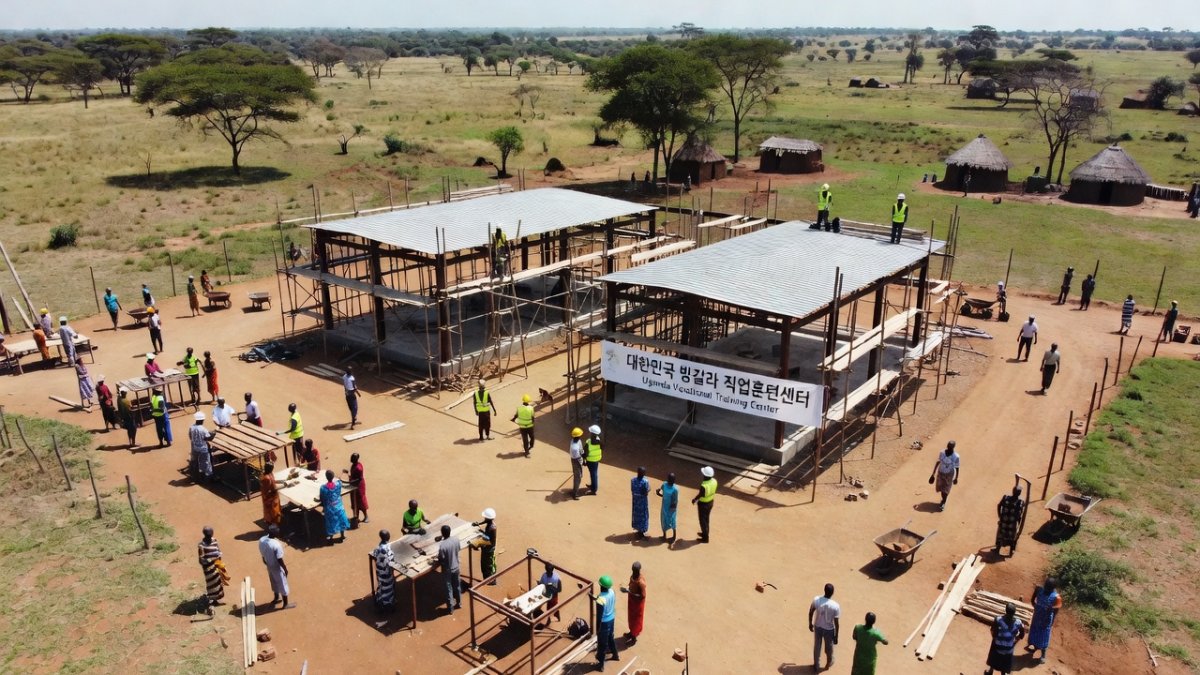
These critiques deserve serious engagement. China’s Forum on China-Africa Cooperation and Japan’s Tokyo International Conference on African Development have decades of institutional depth, large-scale infrastructure footprints, and, in China’s case, a clear linkage to resource security and geopolitical positioning. South Korea lacks comparable scale and cannot compete on volume of concessional lending or turnkey megaprojects. If the measure of seriousness is the size of the next headline pledge or the number of mining concessions secured, then Seoul will continue to appear as a secondary player. Yet summit halls are a poor vantage point from which to assess a development partnership. A more instructive view can be found some 10,000 kilometers from Seoul, in the districts of western Uganda, where a KOICA-funded project has spent the past two years testing what a distinctly South Korean contribution might look like.
The field is not minerals or megaprojects but one of the least contested and most neglected corners of the development agenda: vocational training for persons with disabilities. Disability-inclusive development generates no minerals, secures no shipping lanes, and produces few headlines; it is absent from the playbooks of the great-power competition now unfolding across the continent. Precisely because it sits outside the extractive logic that dominates much external engagement with Africa, the project offers a different metric for evaluating whether Korea’s partnership claims are substantive. In an environment where skepticism is warranted, ground-level evidence of patient, inclusive programming becomes disproportionately important as a signal of intent.
The KOICA Uganda Project as a Case Study
The project, implemented with a Ugandan partner organization and the National Council for Persons with Disabilities, supports students with disabilities at three vocational institutes across districts in western Uganda as they train in trades ranging from tailoring and carpentry to welding and hairdressing. The support itself is deliberately unglamorous: tuition, training materials, assistive devices, and preparation for Uganda’s government-certified trade examinations, which allow workers to earn a living in their chosen craft. In the first year, 146 students with disabilities enrolled across three technical institutes; 145 remained in training. The project’s second-year results exceeded most of its target indicators. The goal is that graduates will convert certification into employment or self-employment—and that surrounding communities will come to regard such an outcome for persons with disabilities as ordinary rather than exceptional.
Kim Hyo-je, deputy country director of KOICA’s Uganda office, has acknowledged the underlying reality in conversation: persons with disabilities are “the most marginalized among the marginalized,” a population overlooked not only by geopolitics but, all too often, by mainstream development programming itself. That double neglect, however, constitutes an opening. The project does not attempt to build parallel systems. It works through Uganda’s own statutory disability council and cultivates a coalition of local disability organizations intended to carry coordination and advocacy beyond the funding cycle. A small ICT hub nearing completion in Kasese illustrates the logic: the project financed the basic renovation, a local disability union furnished the space, and the national council secured the equipment. No single actor owns it, and therefore no single actor’s departure can close it.
The Ugandan policy context makes this approach particularly relevant. On paper, Uganda’s disability legislation is among the more progressive on the continent, but the gap between statute and implementation is wide and, in places, widening. The 2020 revision of the Persons with Disabilities Act quietly dropped the earlier requirement that no less than 10 percent of educational expenditure be committed to special needs education. Tax incentives for employers of persons with disabilities have been diluted from a 15 percent reduction under the 2006 Act to what amounts, under current tax law, to a 2 percent deduction. The statutory instrument required to operationalize the employment quota has never been issued. In such an environment, where implementation of existing policy is the need of the hour, patient, field-level cooperation can make a meaningful difference that high-level communiqués cannot.
Korea’s Comparative Advantage in Technical and Vocational Education and Training
If South Korea’s declared comparative advantage in Africa is its own development experience, then technical and vocational education and training (TVET), which served as an engine of the country’s postwar transformation, is arguably where that experience translates most credibly—especially when extended to the population most systematically excluded from opportunity. In the decades after the Korean War, South Korea built a dense network of vocational high schools and technical institutes that fed skilled labor into light manufacturing, then heavy industry, and eventually into higher-value sectors. The state did not treat vocational training as a residual category for those who failed academically; it treated it as a strategic instrument of industrial policy. That historical sequence remains one of the more transferable elements of the Korean development model.
Extending TVET to persons with disabilities sharpens rather than dilutes this comparative advantage. It signals, in a way that no critical minerals dialogue can, that the partnership is not organized solely around extraction. Great-power competition on the continent has tended to prioritize infrastructure corridors, port access, and mineral offtake agreements. By contrast, investing in the productive capacity of a marginalized group demonstrates a different theory of partnership—one centered on human capital formation and social inclusion. For a middle power that cannot outspend China or match the historical depth of Japan’s African engagement, credibility rests on distinctiveness. Disability-inclusive TVET is distinctive precisely because it is unglamorous and because it aligns with a genuine Korean institutional strength rather than a borrowed template.
There are also domestic resonances worth noting. South Korea itself continues to grapple with the social and economic inclusion of persons with disabilities, and Korean civil society organizations have accumulated practical experience in assistive technology, workplace adaptation, and rights-based advocacy. Channeling that experience outward through KOICA projects creates a feedback loop: Korean practitioners refine methods in challenging field environments, while African partners gain access to approaches forged in a society that moved rapidly from aid recipient to donor. This is not charity; it is the operationalization of a development narrative that Seoul has long claimed as its unique selling point.
Sustainability Challenges and the Flux in Korea’s ODA Architecture
Suppose the donor exits tomorrow. This is the question that every development project must eventually answer, and the honest response is that no one can be certain what would remain. Any project claiming otherwise should be treated with suspicion. What can be said is that the Uganda initiative has structured itself around that eventuality rather than ignoring the possibility. By working through the National Council for Persons with Disabilities and local disability unions, and by designing shared-ownership assets such as the Kasese ICT hub, the project has attempted to embed capacity inside Ugandan institutions rather than creating parallel structures that collapse when external funding ends.
The uncertainties do not all originate in Uganda. South Korea’s own ODA architecture is in flux: civil society partnership schemes are being restructured, and multi-year projects can see their planned scope narrowed midstream. A pivot measured in decades will have to reconcile the long horizons that inclusion requires with the short cycles in which aid is budgeted and rebranded. KOICA’s country programming, MOFA’s diplomatic calendar, and the National Assembly’s budget process do not automatically align. When political attention shifts or fiscal pressures mount, projects that lack powerful domestic constituencies—precisely the profile of disability-inclusive programming—are vulnerable to quiet contraction.
This tension is the real test of seriousness. Pledges of $10 billion in ODA by 2030 and $14 billion in export financing make for impressive summit language. Disbursement rates, project continuity across electoral cycles, and the willingness to protect small, high-quality interventions from midstream cuts will determine whether those numbers translate into partnership or remain aspirational accounting. The Uganda case, modest as it is, forces the question into concrete terms: will the 145 students who stayed in training be able to complete certification and enter livelihoods, and will the local coalitions built around the project survive the next Korean budget cycle?
Implications for Seoul’s Africa Strategy Over the Long Term
When leaders reconvene for the proposed 2029 summit, the temptation will be to announce larger numbers. The better measure of the partnership will be whether the commitments of 2024 actually materialized on the ground. In western Uganda, the 145 students with disabilities who stayed in training, along with the certificates, workshops, and livelihoods that will follow, offer one early answer. For South Korea, disability inclusion is not a philanthropic footnote to its Africa policy. It may be the most credible evidence available that the partnership is what its declarations claim it to be.
As a middle power, South Korea cannot redefine the geopolitical competition unfolding across Africa. It can, however, occupy a niche that larger actors have largely ignored. China and Japan will continue to dominate infrastructure finance and resource-linked engagement. Korea’s comparative advantage lies in the transfer of institutional knowledge around human capital—particularly TVET—and in demonstrating that development cooperation can prioritize populations that generate neither strategic minerals nor diplomatic headlines. If that niche is cultivated consistently, it strengthens Seoul’s claim to be a partner rather than a late-arriving extractor.
The strategic implications extend to inter-Korean and broader regional dynamics as well. A South Korea that is seen in Africa as a credible, inclusive development actor enhances its soft power at a time when the peninsula’s security environment remains volatile and when Seoul seeks wider international support for its positions on denuclearization, human rights, and peaceful unification. African votes in multilateral forums are not bought with vocational training certificates, but reputational capital accumulates through consistent behavior. The same logic applies to Korea’s relations with other middle powers and with the European Union, where values-based development cooperation remains a significant diplomatic currency.
Daily life connections inside Korea also matter. As Korean society ages and debates the meaning of inclusive growth, successful overseas models of disability-inclusive TVET can inform domestic policy learning. Chaebol corporate social responsibility programs, already active in parts of Africa, may find in KOICA’s approach a template for more sustained local partnership rather than one-off philanthropy. Education ministries and polytechnic institutions in Korea have expertise that can be mobilized more systematically if the Africa pivot is treated as a whole-of-society effort rather than a MOFA-KOICA preserve.
None of this guarantees that the $10 billion ODA target will be met on schedule, or that Africa’s share of Korean trade and investment will rise substantially above the current 1 to 2 percent. Those outcomes depend on macroeconomic conditions, corporate risk assessments, and political will in both Seoul and African capitals. What the western Uganda project demonstrates is that the quality of engagement can be evaluated independently of scale. A partnership organized solely around extraction will eventually be recognized as such. A partnership that invests in the most marginalized among the marginalized, using methods drawn from Korea’s own developmental history, stands a better chance of being believed.
The architecture built since 2024—the summit, the foreign ministers’ meeting, the proposed 2029 follow-up—provides the diplomatic scaffolding. The test is whether that scaffolding shelters the kind of patient, field-level work that KOICA has begun in Uganda. If it does, South Korea will have crafted a distinctive middle-power role on the continent. If it does not, the skepticism that has accompanied the initiative from the start will harden into a settled judgment that the language of development was always secondary to the search for resources and markets. The 145 students who remained in training deserve a clearer answer than another communiqué.
By Prof. David Park, Staff WriterThis article was produced with AI-assisted research and editorial support. Reporting is based on sources cited in the article.
What's Your Reaction?
 Like
0
Like
0
 Dislike
0
Dislike
0
 Love
0
Love
0
 Funny
0
Funny
0
 Wow
0
Wow
0
 Sad
0
Sad
0
 Angry
0
Angry
0
East Asia/Technology Correspondent at Global1.News. Seoul-based voice covering Korean politics, technology, business, and culture. Analyzes how technology and geopolitics intersect across East Asia.












Comments (0)