
Squabble Deepens Between People Power Party's Current and Former Leaders
The People Power Party's Deepening Internal Fracture The People Power Party (PPP), South Korea's principal conservative opposition force, finds itself locked in a corrosive internal contest that threatens its coherence and electoral viability. At the center of this struggle stand two figures whose rivalry encapsulates broader tensions within Korean conservatism: Han Dong-hoon, the former party leader seeking re-entry after a dramatic by-election victory, and Jang Dong-hyuk...
The People Power Party's Deepening Internal Fracture
\n\nThe People Power Party (PPP), South Korea's principal conservative opposition force, finds itself locked in a corrosive internal contest that threatens its coherence and electoral viability. At the center of this struggle stand two figures whose rivalry encapsulates broader tensions within Korean conservatism: Han Dong-hoon, the former party leader seeking re-entry after a dramatic by-election victory, and Jang Dong-hyuk, the incumbent leader determined to keep him at bay. The outcome of their confrontation will shape not only the PPP's organizational future but also the strategic posture of the Korean right ahead of the 2030 presidential contest.
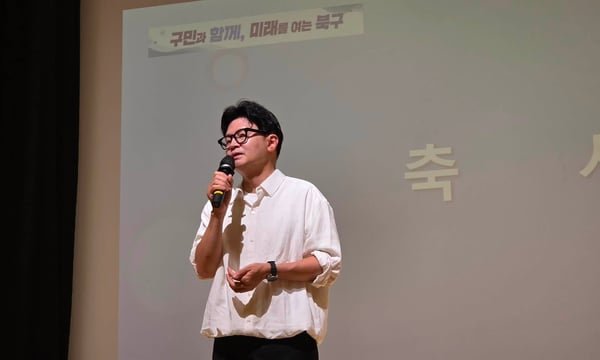
On June 3, 2026, Han Dong-hoon secured a parliamentary by-election victory in a northern district of Busan, defeating strong candidates from both the ruling Democratic Party and his own former party. The win was notable precisely because right-wing votes were split; Han's ability to prevail under those conditions signaled residual popular appeal that many within the PPP could not ignore. In the days that followed, he appeared before the National Assembly steps amid supporters and cameras, projecting a mixture of relief and steely resolve. That image captured the dual reality of his position: a political survivor returning from expulsion, yet facing an arduous path back into the institutional fold.
\n\nThe roots of the fracture run deeper than personal animosity. Han had led the PPP from December 2023 to April 2024 and again from July to December 2024. During those periods he openly clashed with then-President Yoon Suk-yeol, most consequentially by defying Yoon's martial law declaration and the failed self-coup attempt of December 2024. Party hardliners subsequently blamed Han for the conservative rout in the April 2024 general elections, which delivered the liberal bloc a near two-thirds parliamentary majority, and for the passage of Yoon's impeachment motion later that year, which some attributed to pro-Han legislators joining the opposition. In January 2026 the PPP formally expelled Han over allegations that he had mobilized family members to slander Yoon and his wife online. Yet the deeper motive, as contemporary accounts make clear, was Jang Dong-hyuk's determination to neutralize a rival capable of mobilizing intra-party dissent against his leadership.
\n\nThis pattern of expulsion, electoral resurrection, and contested reintegration is not unprecedented in South Korean conservative politics, but its timing is especially damaging. The PPP already operates from a weakened parliamentary base of roughly 110 legislators. Prolonged factional warfare risks further alienating moderate voters and ceding the center ground to the Democratic Party at a moment when public trust in institutions remains fragile.
\n\nHan Dong-hoon's Political Biography and Calculated Comeback
\n\nHan Dong-hoon's trajectory reflects the volatile career paths that have long characterized South Korean elite politics. A former prosecutor elevated to party leadership, he twice headed the PPP during the turbulent final phase of the Yoon administration. His willingness to criticize Yoon publicly, including open defiance of the December 2024 martial law episode, distinguished him from more deferential conservatives. Supporters argue that this independence actually limited the scale of the April 2024 electoral disaster; without Han's "sensible critique," they contend, the PPP would have lost still more seats. Critics inside the party counter that his confrontational style accelerated the administration's collapse and facilitated impeachment.
Expelled in January 2026, Han spent the ensuing months outside formal party structures yet never fully exited the political arena. His June 3 by-election triumph in Busan reconstituted his standing overnight. One PPP legislator likened him to "a star" possessing "power of absorption," a recognition that his personal brand retains magnetic force among conservative and swing voters alike. Rather than launching an immediate frontal assault on Jang, Han has pursued a patient courtship strategy. He has joined forums and sub-groups convened by PPP grandees; some senior figures not previously aligned with him have even co-signed his amendment bills. These gestures, while possibly motivated by a desire to capture pro-Han votes in future contests, create institutional footholds that complicate any effort to keep him permanently outside the party.
\n\nHan's public messaging has remained disciplined. He has spoken of "rebuilding conservatism and taking back the administration in 2030, not the past," deliberately framing his ambitions in forward-looking rather than revanchist terms. This rhetorical choice positions him as a potential bridge to moderate and younger voters who recoiled from the excesses of the late Yoon years. In a political culture where personal networks and factional loyalty often outweigh programmatic coherence, Han's combination of prosecutorial gravitas, rhetorical fluency, and demonstrated electoral resilience makes him a uniquely disruptive returnee.
\n\nJang Dong-hyuk's Leadership Style and Far-Right Orientation
\n\nJang Dong-hyuk assumed leadership of the PPP as a staunch Yoon loyalist and has governed the party in a manner that prioritizes consolidation of the existing membership base over broader electoral outreach. His response to Han's re-emergence has been unequivocal. On July 21, 2026, Jang declared that admitting Han "will be of no help in terms of the party expansion, solidarity and consolidation." The statement left little room for negotiation and underscored Jang's preference for ideological purity over pragmatic enlargement.
\n\nJang's leadership has drawn internal criticism on multiple fronts. Following the PPP's poor performance in the June 2026 local elections, some voices called for his resignation. Instead of engaging critics, he has been accused of staging solo activities outside parliament and remaining unresponsive to collegial counsel. One PPP legislator summarized the prevailing frustration: Jang "always says 'I am right,' 'I am isolated' and 'I am aggrieved.'" Another observed that "acting alone doesn't mean leadership. A leader should be moving all 110 PPP legislators together."
\n\nParticularly revealing is Jang's recent pattern of appearing alone at Seoul Olympic Park, where demonstrators have gathered to demand accountability for Election Commission failures during the June local elections. While the party's official position favors targeted election petitions and partial re-elections in affected districts, Jang has insisted on a complete re-run of the entire local election cycle. This maximalist demand aligns him with far-right election-fraud narratives that treat virtually every unfavorable result as evidence of systemic rigging. Veteran conservative commentator Cho Gab-je, former head of the monthly magazine of the Chosun Ilbo, has characterized Jang's posture as "acting cute with his far-right supporters" in order to prolong his political life by picking fights with Han. Cho's contrasting assessment of Han—"better than all the 110 PPP legislators combined" and armed with "diction and prose... with the constitution, facts and common sense"—illustrates the depth of elite conservative disillusionment with Jang's direction.
\n\nJang's emphasis on further consolidating registered party members rather than expanding the electorate places him at odds with figures such as floor leader Jeong Jeom-sig, who on July 20 argued that the PPP "can't just operate with just our members and their wishes" and must function as a genuine "people's party." This intra-party divergence between a membership-first, far-right-leaning leadership and a more centrist, electorally oriented faction constitutes the core strategic cleavage now defining the PPP.
\n\nThe June Local Elections Controversy and Institutional Trust
\n\nThe June 2026 local elections have become both a practical and symbolic battleground. Reports that the Election Commission fielded fewer ballots than the number of registered voters in certain locations resulted in dozens of constituents being turned away from polling stations. Such failures represent a serious institutional lapse that undermines the foundational democratic principle of equal access to the ballot. The PPP's formal stance—filing election petitions for investigation and seeking partial re-elections where voters were disenfranchised—reflects a measured institutional response.
\n\nJang's insistence on a full re-run, by contrast, transforms a legitimate administrative grievance into a vehicle for broader conspiracy narratives. In the Korean context, where memories of authoritarian-era electoral manipulation remain vivid and where democratic consolidation since 1987 has rested heavily on the perceived neutrality of electoral management bodies, the elevation of fraud claims carries particular risk. It erodes public confidence not only in the Election Commission but in the conservative party's commitment to procedural regularity. When a major opposition leader appears to validate maximalist fraud claims, he simultaneously energizes a hard-right base and alienates the moderate conservatives and independents whose support is indispensable for national power.
\n\nThe controversy also intersects with longer-standing debates about the integrity of Korea's electoral infrastructure. Previous cycles have occasionally produced localized administrative errors, yet the scale of voter turn-aways reported in June 2026 has given fresh oxygen to fringe theories. Jang's solo appearances at protest sites amplify those theories while distancing him from the parliamentary caucus that must ultimately legislate any remedial measures. The result is a leadership style that privileges symbolic solidarity with street demonstrators over the painstaking work of coalition-building inside the National Assembly.
\n\nImplications for South Korean Conservative Politics Ahead of 2030
\n\nThe Han-Jang contest carries direct consequences for the conservative camp's prospects in the 2030 presidential election. South Korean conservatives have historically oscillated between periods of disciplined unity and self-destructive factionalism. The PPP's current trajectory risks repeating the latter pattern at the worst possible moment. If Jang succeeds in permanently excluding Han, he may retain control of the party machinery and its registered membership, yet at the cost of forfeiting Han's demonstrated capacity to attract voters beyond the hard core. Conversely, if Han forces his way back in or constructs a parallel power base, the party could face a debilitating split that hands the Democratic Party a structural advantage.
\n\nFloor leader Jeong Jeom-sig's call for a "people's party" orientation points toward one possible resolution: a deliberate pivot to the center that prioritizes electability over doctrinal purity. Such a shift would require Jang either to moderate his far-right signaling or to yield leadership. Han's own rhetoric about rebuilding conservatism for 2030 suggests he is prepared to occupy that centrist-conservative space. The historical record of Korean parties shows that factions capable of speaking the language of constitutionalism, competence, and measured reform have often outlasted those that double down on grievance and conspiracy.
\n\nBeyond personnel, the struggle will influence candidate selection, policy platforms, and coalition strategies. A PPP dominated by Jang's approach is likely to emphasize cultural grievance, election-integrity maximalism, and loyalty tests linked to the Yoon legacy. A party that reintegrates Han or adopts his framing is more likely to stress institutional restoration, economic pragmatism, and a cleaner break from the martial-law trauma of December 2024. Given that Korean presidential elections are frequently decided by moderate and younger voters in the greater Seoul region, the latter path appears more promising for an actual return to power.
\n\nThe Busan by-election itself offers a microcosm. Han's victory in a competitive three-way race demonstrated that a conservative candidate willing to stand somewhat apart from the official party line can still consolidate enough support to win. Ignoring that lesson would be strategically self-defeating.
\n\nBroader Implications for Korean Democracy and Political Culture
\n\nThe PPP's internal drama is not merely a partisan story; it illuminates structural features of contemporary Korean democracy. First, it underscores the persistent personalization of party politics. Despite formal institutionalization since democratization, Korean parties remain highly leader-centric, with membership rolls, nomination processes, and ideological branding often subordinated to the fortunes of individual politicians. The ease with which Han was expelled and the difficulty of his re-entry illustrate how thin the protective tissue of party rules can be when leadership interests are threatened.
\n\nSecond, the episode highlights the unresolved legacy of the Yoon Suk-yeol presidency and the December 2024 martial law crisis. That episode inflicted profound damage on conservative credibility. Han's defiance at the time now serves as both a political liability inside the party and a potential asset with the broader public. How the PPP ultimately processes that history—whether through scapegoating, selective amnesia, or genuine reckoning—will affect the quality of democratic accountability.
\n\nThird, the flirtation with election-fraud narratives poses risks to institutional trust that extend beyond any single party. South Korea's democratic success has rested in significant measure on the professionalism of its electoral administration and the willingness of losers to accept results. When a major party leader elevates calls for wholesale re-runs on the basis of localized ballot shortages, he weakens the shared epistemic foundation upon which peaceful power alternation depends. In a society still confronting North Korean threats, demographic decline, and economic pressures from global supply-chain realignments, the luxury of manufactured electoral doubt is one Korea can ill afford.
\n\nFinally, the contest between Han and Jang reflects a wider struggle over the soul of Korean conservatism: whether it will define itself primarily through loyalty to a fallen administration and its far-right defenders, or through a renewed commitment to constitutional governance, factual argumentation, and electoral majoritarianism. Cho Gab-je's pointed contrast between Han's constitutionally grounded rhetoric and Jang's cultivation of far-right grievance captures this choice with unusual clarity.
\n\nAs Han continues his methodical courtship of party elders and Jang digs in against both internal critics and the prospect of Han's return, the PPP stands at a crossroads. The decisions taken in the coming months will determine whether South Korea's main conservative party enters the late 2020s as a competitive, broad-based alternative or as a narrowed vehicle of resentment. For Korean democracy, the healthier outcome is clear: a conservatism capable of self-correction, open to talent, and oriented toward the electorate rather than the echo chamber. Whether the People Power Party can still achieve that reorientation remains the central open question of this unfolding political drama.
\n\nBy Prof. David Park, Staff WriterThis article was produced with AI-assisted research and editorial support. Reporting is based on sources cited in the article.
What's Your Reaction?
 Like
0
Like
0
 Dislike
0
Dislike
0
 Love
0
Love
0
 Funny
0
Funny
0
 Wow
0
Wow
0
 Sad
0
Sad
0
 Angry
0
Angry
0

East Asia/Technology Correspondent at Global1.News. Seoul-based voice covering Korean politics, technology, business, and culture. Analyzes how technology and geopolitics intersect across East Asia.













Comments (0)