
Xi Jinping and Kim Jong Un Vow Stronger Ties as North Korea Visit Wraps Up
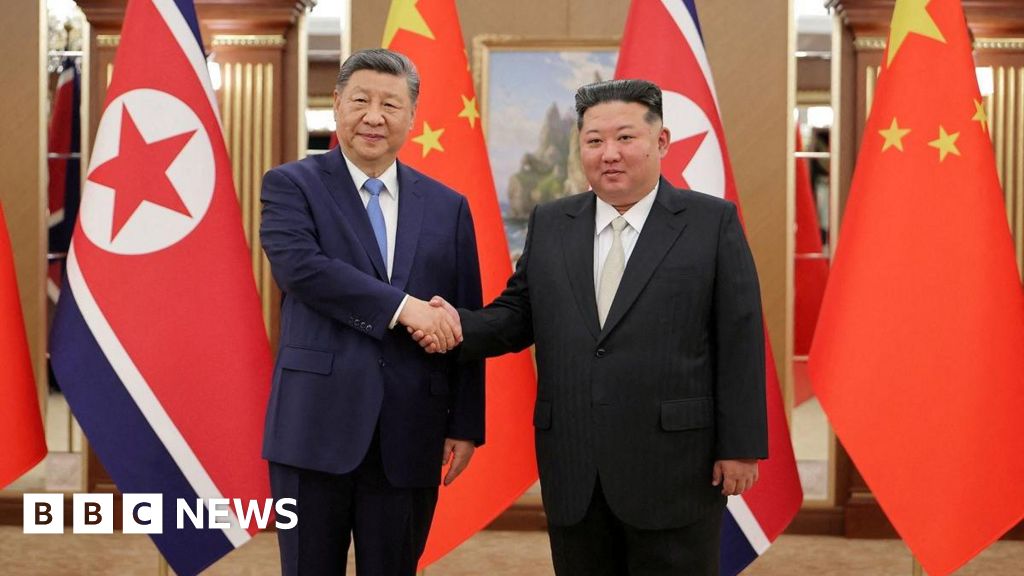
Xi Jinping and Kim Jong Un vow stronger ties as North Korea visit wraps up Geopolitical Framing of the Xi Visit to Pyongyang Chinese President Xi Jinping has concluded a two-day visit to Pyongyang, marking his first official trip to North Korea since 2019. This engagement occurs as Beijing seeks to reassert influence over a strategically vital yet unpredictable partner that has
Geopolitical Framing of the Xi Visit to Pyongyang
Chinese President Xi Jinping has concluded a two-day visit to Pyongyang, marking his first official trip to North Korea since 2019. This engagement occurs as Beijing seeks to reassert influence over a strategically vital yet unpredictable partner that has recently drawn closer to Russia. The timing follows Xi's recent meetings with US leader Donald Trump and Russian President Vladimir Putin, positioning the Pyongyang stop as a deliberate signal within China's broader foreign policy doctrine of maintaining leverage on its northern border.
North Korean leader Kim Jong Un extended elaborate welcomes, including red-carpet ceremonies and acrobatic performances, underscoring the visit's ceremonial weight. State media reports from KCNA highlighted that Xi's selection of Pyongyang for his first state visit of the year demonstrated the "utmost importance" placed on bilateral ties. This framing connects directly to China's objectives of technological self-sufficiency and regional influence expansion, even as international sanctions constrain North Korea's options.
Ceremonial Displays and Symbolic Gestures
During the visit, both leaders paid respects at the Friendship Tower, which commemorates Chinese soldiers who fought in the Korean War. They also visited Pyongyang's top cadre school, where they planted a fir tree to symbolize their evergreen friendship, as reported by Xinhua. Xi was hosted at the Kumsusan State Guest House, an exclusive residence constructed in 2019 specifically to receive him during his prior state visit, and which has since accommodated leaders including Vladimir Putin and Alexander Lukashenko.
These public displays reinforced the personal dimension of the relationship. Kim's reception emphasized the alliance's endurance amid upheaval in international affairs, while the choice of venue and activities highlighted continuity in high-level engagement between the two capitals.
Statements on Bilateral Ties and Shared Priorities
At an evening banquet on Monday, Xi praised the relations, noting that China and North Korea are "linked by mountains and rivers and share a common destiny," according to Xinhua. Kim responded by affirming that North Korea would continue to uphold its friendship with China as a top priority and reaffirmed support for Beijing's "One China" principle. The leaders reached an "important consensus" to grasp the trend of the times, deepen high-level exchanges, and strengthen people-to-people bonds.
This year marks the 65th anniversary of the China-North Korea defence pact, the only such agreement China maintains with any country. Both sides described the friendship as resilient despite external pressures, with Kim noting the visit's reminder of its strength amid shifting global conditions.
Absence of Denuclearization Topics and Economic Realities
Discussions on North Korea's denuclearisation were absent from state media readouts of the talks. This omission aligns with China's recent pattern of toning down public calls for denuclearisation of the Korean peninsula. China remains North Korea's most important political and economic partner, serving as a lifeline amid heavy international sanctions tied to the nuclear weapons programme.
Despite North Korea's reliance on China and its junior-partner status in the alliance, the visit allowed Kim to secure at least one key outcome by keeping denuclearisation off the public agenda. No concrete deals emerged from the trip, yet the optics of hosting such a high-profile visitor weeks after Xi's engagements with Trump and Putin reinforced Kim's narrative of possessing important friends despite ongoing sanctions.
Composition of the Chinese Delegation
Xi was accompanied by several senior officials, including his de facto chief of staff Cai Qi, defence minister Dong Jun, foreign minister Wang Yi, and commerce minister Wang Wentao. Their presence underscored the multi-dimensional nature of the engagement, spanning political, military, diplomatic, and economic portfolios.
These choices reflect Beijing's coordinated approach to managing relations with Pyongyang, ensuring that messages on defence cooperation, trade, and high-level coordination are delivered through authoritative channels.
Underlying Differences and Strategic Implications
Xi expressed hope that the visit would "jointly open up a brighter future for the socialist cause of both countries," a reference that touches on longstanding Chinese encouragement for North Korea to adopt elements of market-oriented reforms while preserving one-party rule. Elements in Chinese reports suggest possible frustration, as Kim made no mention of any developmental process and North Korea continues to resist learning from China's experience with foreign investment and international trade.
For regional stability and the Korean peninsula, the visit signals China's intent to remind Kim of its role as primary benefactor while acknowledging the limits of that influence. Kim gains domestic prestige from the VIP presence, yet the absence of new economic commitments or denuclearisation progress leaves core tensions unresolved. Second-order effects may include continued North Korean outreach to Russia and sustained caution from ASEAN and EU actors monitoring how Beijing balances its alliance obligations against broader non-proliferation goals.
By Prof. Marcus Chen, Staff WriterThis article was produced with AI-assisted research and editorial support. Reporting is based on sources cited in the article.
What's Your Reaction?
 Like
0
Like
0
 Dislike
0
Dislike
0
 Love
0
Love
0
 Funny
0
Funny
0
 Wow
0
Wow
0
 Sad
0
Sad
0
 Angry
0
Angry
0

World Politics Analyst at Global1.News. Based in Beijing, covering US-China relations, global trade, and geopolitical strategy. Brings deep analytical perspective to the power dynamics shaping international affairs.













Comments (0)