
Tnuva's Warehouse Crisis: How a Computer Glitch Left Israel Without Cottage Cheese
A computer glitch in Tnuva's automated warehouse has paralyzed Israel's dairy supply chain for months, turning a routine software failure into a national crisis that has emptied supermarket shelves from Tel Aviv to Jerusalem and exposed the country's vulnerability to foreign-controlled industrial infrastructure.
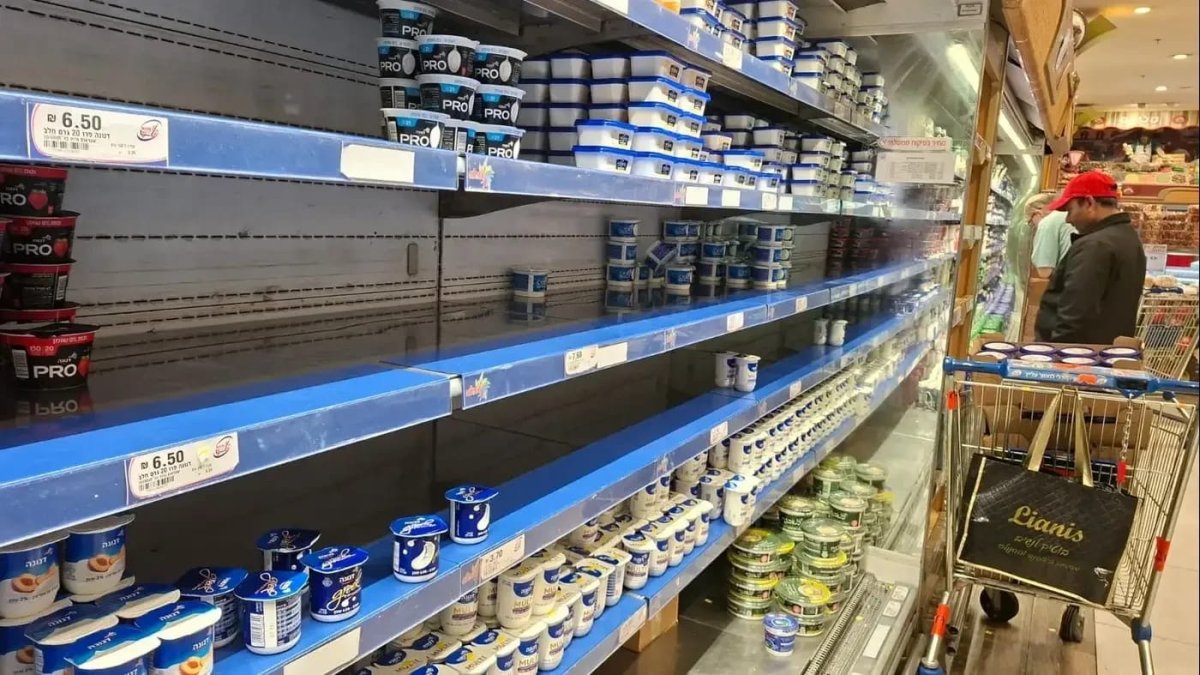
A computer glitch in Tnuva's automated warehouse has paralyzed Israel's dairy supply chain for months, turning a routine software failure into a national crisis that has emptied supermarket shelves from Tel Aviv to Jerusalem and exposed the country's vulnerability to foreign-controlled industrial infrastructure. With German technicians from KION Group refusing to travel due to the security situation, the malfunction has spread from cottage cheese to white cheese products, triggering consumer panic and raising urgent questions about food security in a wartime economy.
Tnuva's Warehouse Crisis: How a Computer Glitch Left Israel Without Cottage Cheese
Tel Aviv, Israel — The shortage that began with cottage cheese has spread to white cheese products across central Israel, as Tnuva, the country's largest dairy cooperative, struggles with a months-long distribution paralysis rooted in an automated warehouse system that no one in Israel can fix.
Tnuva Warehouse Malfunction Disrupts Dairy Supply
In recent days a computer glitch in Tnuva's automated warehouse has left shipping containers stranded inside the system, halting distribution of cottage cheese and white cheese despite fully operational production lines. The malfunction, which began months ago, has created persistent shortages across central Israel and forced retailers to ration stock.
Industry sources familiar with Tnuva's logistics hub in the Alon Tavor industrial zone near Afula say the bottleneck has idled roughly 40 percent of the company's outbound dairy pallets destined for the Gush Dan metropolitan area. Production at Tnuva's Rehovot and Tel Yosef plants continues at near-full capacity — approximately 180 tons of soft white cheeses daily — yet the goods remain physically trapped in high-bay storage aisles that the automated storage and retrieval system (AS/RS) will not release. According to figures quietly shared with the Israel Dairy Board, the cumulative shortfall since the glitch intensified in late spring has exceeded 2,100 tons of cottage cheese alone, equivalent to nearly three weeks of national household consumption under normal summer demand patterns.
The geographic impact has been uneven but politically sensitive. Supermarkets in Tel Aviv's central neighborhoods, Ramat Gan, Givatayim, and the eastern suburbs of Petah Tikva reported empty refrigerated end-caps by mid-morning throughout last week, while peripheral chains in the Negev and Galilee still received partial allocations via older manual warehouses in Beersheba and Carmiel. Tnuva spokespeople deny any export diversion, insisting that all available manual-loading capacity is being redirected to local shelves.
Economists at the Aaron Institute for Economic Policy at Reichman University estimate that prolonged disruption could shave 0.1–0.15 percentage points off the food component of the Consumer Price Index in the third quarter if substitute products from smaller dairies such as Tara and Strauss cannot scale quickly enough. Already, wholesale prices for five-percent cottage cheese on the Tnuva-to-retailer contract have quietly risen 6 percent in emergency spot deals.
Dematic and KION Group Automation at the Center
The warehouse in question relies on technology supplied by Dematic, part of the German KION Group. This automated system was designed to handle high-volume dairy logistics for Tnuva's network serving supermarkets from Tel Aviv to Petah Tikva. A software failure has prevented the cranes and conveyors from releasing filled containers, even as demand peaks during summer months.
Dematic's installation at Alon Tavor, completed in phases between 2018 and 2021 at a reported cost exceeding NIS 320 million, was marketed as a showcase of Industry 4.0 efficiency for Israel's largest food manufacturer. The system integrates Dematic's Multishuttle technology with SAP Extended Warehouse Management software and a proprietary crane-control layer developed at Dematic's Offenbach campus. When functioning, it can process 1,200 pallet movements per hour and maintain cold-chain integrity at 2–4 degrees Celsius across 38,000 storage locations. The current fault appears to sit in the "task interleaving" module that sequences crane missions; a corrupted database index has left the system convinced that certain aisles are simultaneously full and empty, triggering a safety lockout that human operators cannot override without vendor-level diagnostic keys.
KION Group's reluctance to dispatch technicians is not merely bureaucratic. German corporate travel protocols tightened after the October 7, 2023, attacks and subsequent rocket fire on the north and center; insurance underwriters in Munich and Frankfurt now classify large parts of Israel as elevated-risk, driving daily premiums for specialized engineers above 2,500 euros per person. Dematic's regional office in Dubai has offered remote desktop support, yet Tnuva's IT security team refuses to open external VPN tunnels into the operational-technology network that controls physical cranes. The standoff leaves a NIS 4 billion-a-year dairy supply chain hostage to a software handshake that neither side will complete.
Cottage Cheese: An Israeli Staple Under Pressure
Cottage cheese occupies a singular place in the Israeli pantry and psyche, far beyond its protein content or mild flavor. The June 2011 "cottage cheese protest" began with a single Facebook post by a consumer fed up with a NIS 7 tub that had doubled in price within a few years; within days it ballooned into tent encampments on Rothschild Boulevard and a national reckoning over cost of living that still shapes electoral politics. Since then, the retail price of a 250-gram container of 5 percent Tnuva cottage cheese has served as an informal barometer of household economic pain.
When that same tub vanishes from shelves in Ramat Aviv or Ashdod, the shortage registers not merely as inconvenience but as a breach of an unspoken social contract. Israeli breakfast culture — salads, soft cheeses, eggs, and bread — makes white cheese a daily ritual rather than an occasional purchase. IDF bases, hospital kitchens, and school lunch programs all hold standing orders for industrial-size containers; interruptions ripple into conscript nutrition and elderly-care menus.
Compared with earlier dairy scares — the 2014 kashrut scandal that briefly pulled certain Tnuva lines, or the 2022 bacterial contamination recall at a northern plant — the current crisis is more insidious because it is infrastructural rather than biological. No one fears illness; they fear permanence. Talk-radio hosts on 103FM and Kan Bet already draw straight lines from 2011's price revolt to today's empty refrigerators.
The Automation Paradox: High-Tech Nation, Fragile Infrastructure
Israel's global brand as a cyber and software superpower sits uneasily beside its dependence on foreign hardware for the unglamorous work of moving milk. While Check Point, CyberArk, and Unit 8200 alumni fortify banks and governments worldwide, the cranes that stack cottage cheese in Afula still phone home to Offenbach. Government R&D incentives via the Israel Innovation Authority have poured billions into SaaS, fintech, and defense-tech, yet capital expenditure support for food-grade robotics and local PLC programming talent has remained modest.
The Ministry of Economy and Industry, under successive ministers, has published resilience roadmaps since the COVID supply shocks, but implementation has lagged. Grants for "dual-use" automation that could serve both civilian and emergency needs were announced with fanfare in 2023, then slowed by budget freezes after the war began. The same ministry now finds itself reduced to monitoring meetings and gentle pressure on Tnuva, lacking both a ready roster of certified local integrators and the legal tools to compel knowledge transfer from foreign vendors.
Consumer Behavior and Market Response
Israeli shoppers have responded with a mixture of grim efficiency and online fury. In Shufersal Deal branches from Raanana to Be'er Sheva, managers imposed informal two-tub-per-customer limits by the second day of visible shortages. WhatsApp groups in parent communities across the Sharon region lit up with real-time alerts, while hardened bargain hunters drove to Rami Levy outlets in the periphery before dawn. Social media sentiment, tracked by the firm Buzzilla, showed a 340 percent spike in negative mentions of Tnuva within 72 hours.
Price-gouging fears surfaced almost immediately. The Israel Consumer Council logged more than 400 complaints in a single week about neighborhood minimarkets in south Tel Aviv and Netanya charging NIS 9–10 for the same 250-gram tub that carries a recommended price of around NIS 6.50. Economy Ministry inspectors issued a handful of fines, but enforcement remains spotty when the root problem is allocation rather than greed.
The security situation amplifies every impulse to hoard. Families already keeping extra water and canned goods in safe rooms now add dairy to the list, remembering how quickly supermarket runs emptied shelves of yeast and oil in October 2023. That muscle memory turns a technical warehouse fault into a psychological echo of existential disruption.
What This Means for Israeli Food Security
The Tnuva warehouse crisis exposes structural thinness in a food system that has been asked to perform under wartime labor shortages, fluctuating import routes, and chronic underinvestment in physical resilience. Agriculture still relies heavily on foreign workers whose numbers dropped sharply after October 7 and have only partially recovered. Logistics centers face parallel reserve-duty absences among drivers and technicians. When an automated chokepoint fails and the foreign OEM will not travel, the absence of domestic depth becomes a national vulnerability rather than a corporate inconvenience.
State Comptroller reports in 2020 and again in 2023 warned that Israel's calorie and protein self-sufficiency metrics masked dangerous concentration risks: too few firms, too few warehouses, too little redundancy in cold-chain automation. Those warnings produced inter-ministerial committees but few hardened assets. The current episode should force a sharper conversation about whether critical food infrastructure deserves the same "local manufacturing" preference long granted to defense and cyber. Possible steps include mandatory escrow of automation source code for systemically important plants, accelerated vocational tracks for industrial robotics at ORT and Ministry of Labor colleges, and strategic reserves not only of powdered milk but of spare servo motors and proprietary controllers.
In a prolonged war economy, food security is no longer just about fields and herds; it is about whether a software crash in Afula can empty refrigerators in Tel Aviv while German engineers stay home. The cottage cheese may eventually roll again, but the deeper question — how a high-tech nation protects the mundane arteries of daily life — will remain on the national table long after the shelves are restocked.
By Hannah Berg, Staff Writer
This article was produced with AI-assisted research and editorial support. Reporting is based on sources cited in the article.
What's Your Reaction?
 Like
0
Like
0
 Dislike
0
Dislike
0
 Love
0
Love
0
 Funny
0
Funny
0
 Wow
0
Wow
0
 Sad
0
Sad
0
 Angry
0
Angry
0

Israel Correspondent at Global1.News. Based in Tel Aviv, covering Israeli politics, security, technology, and society. Provides balanced, deeply-sourced reporting on one of the most closely-watched regions in the world.













Comments (0)