
How South Korea's Africa Pledges Are Faring on the Ground
How South Korea's Africa Pledges Are Faring on the Ground The 2024 Summit Framework and the June 2026 Ministerial Follow-Up In early June 2026, foreign ministers and senior representatives from 50 African countries gathered in Seoul for the first Korea-Africa Foreign Ministers' Meeting. This gathering constituted the principal follow-up mechanism promised at the inaugural Korea-Africa Summit of 2024. At that earlier summit, Seoul had pledged to expand its official developm...
The 2024 Summit Framework and the June 2026 Ministerial Follow-Up
In early June 2026, foreign ministers and senior representatives from 50 African countries gathered in Seoul for the first Korea-Africa Foreign Ministers' Meeting. This gathering constituted the principal follow-up mechanism promised at the inaugural Korea-Africa Summit of 2024. At that earlier summit, Seoul had pledged to expand its official development assistance to the African continent to 10 billion dollars by 2030, alongside 14 billion dollars in export financing. The June 2026 meeting closed with a joint statement that reaffirmed those headline commitments and advanced a proposal to convene a second Korea-Africa Summit in 2029.
The continuity of this diplomatic architecture is itself noteworthy. The initiative was conceived under the previous conservative government yet has been carried forward by the progressive administration that assumed office thereafter. In the context of South Korea's often sharply polarized domestic politics, the survival of a major foreign-policy pivot across such a transition suggests a degree of elite consensus on the strategic utility of deeper engagement with Africa. That consensus, however, remains fragile and is subject to the practical tests of implementation rather than the rhetoric of summit communiqués.
For South Korean foreign-policy planners, the Africa agenda sits at the intersection of several longer-term objectives: diversification of critical mineral supply chains, expansion of export markets for Korean firms, and the projection of middle-power diplomatic influence in a multipolar environment. The ministerial agenda in June ranged across critical minerals and supply-chain resilience, topics that transparently reflect Seoul's own industrial and security priorities. Whether this agenda can be balanced with African partners' development priorities will determine the durability of the partnership beyond 2030.
Political Continuity Across South Korea's Turbulent Transition
The fact that the Africa pivot endured the most turbulent political transition in South Korea's recent history merits careful analysis. South Korean foreign policy has frequently been vulnerable to abrupt recalibration when administrations of opposing ideological camps succeed one another. The decision by the progressive government to retain and operationalize commitments first articulated by its conservative predecessor indicates that Africa policy has acquired a measure of institutional insulation.
This continuity should not be mistaken for enthusiastic bipartisan ownership. Progressive administrations in Seoul have historically placed greater rhetorical emphasis on values-based diplomacy, human rights, and inclusive development, while conservative governments have tended to prioritize commercial diplomacy and strategic alignment with the United States. The Africa initiative, with its blend of official development assistance and export financing, offers both camps usable instruments. For the current progressive leadership, the disability-inclusion dimensions of projects such as the KOICA program in Uganda provide a natural fit with a broader narrative of equitable development. For residual conservative constituencies, the export-financing envelope and critical-minerals diplomacy remain the more salient features.
The institutional vehicle for much of this work remains the Korea International Cooperation Agency, or KOICA, which operates under the Ministry of Foreign Affairs. KOICA's country offices and project portfolios constitute the primary on-the-ground presence through which Seoul's pledges are translated into discrete interventions. The agency's capacity to maintain multi-year programming amid domestic political flux and budgetary scrutiny will be a decisive variable in whether the 10-billion-dollar ODA target retains credibility.
Structural Skepticism and the Asymmetry of Korea-Africa Relations
Skepticism has shadowed the Korea-Africa initiative from its inception. Africa continues to account for a mere 1 to 2 percent of South Korea's trade and investment flows, a structural shortfall that was acknowledged openly at the 2024 summit itself. This modest commercial footprint stands in contrast to the ambitious financial pledges and raises legitimate questions about the depth of mutual economic interdependence that can realistically be forged by 2030.
The June 2026 ministerial agenda, with its emphasis on critical minerals and supply-chain resilience, reinforced an impression among some observers that Seoul's inventory of interests remains heavily weighted toward what Korea seeks from the continent rather than what it is prepared to offer on African terms. Such asymmetries are not unique to Korea; they characterize the engagement strategies of most external partners. Yet for a country that itself graduated from aid recipient to donor within a single generation, the optics of extractive or narrowly transactional diplomacy carry particular reputational risk.
South Korea's own historical memory of rapid industrialization under conditions of resource scarcity and technological catch-up supplies a distinctive narrative asset. Korean officials frequently invoke this experience when engaging African counterparts. The translation of that narrative into concrete, demand-driven programming, however, has been uneven. Vocational training, industrial-policy advisory services, and technology transfer remain areas of comparative advantage, yet they compete for resources and political attention with more immediately commercial objectives tied to chaebol export strategies and resource security.
The KOICA Uganda Project as an Empirical Test Case
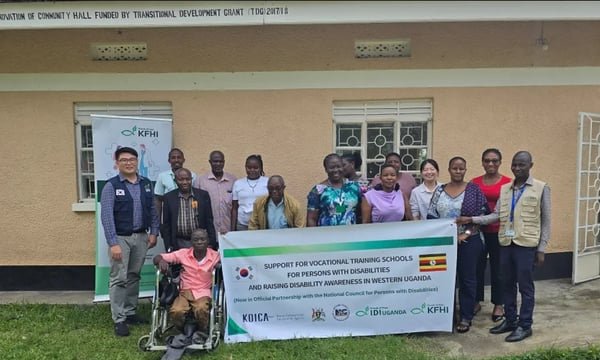
A more instructive vantage point on the quality of Korea's Africa engagement can be found in the districts of western Uganda, where a KOICA-funded project has spent the past several years supporting vocational education for persons with disabilities. The project is implemented in partnership with a Ugandan organization and the National Council for Persons with Disabilities. It supports students with disabilities at three vocational institutes across multiple districts, offering training in trades that include tailoring, carpentry, welding, and hairdressing.
The project's second-year results exceeded most of its target indicators. In the first year, 146 students with disabilities enrolled across the three technical institutes; 145 of them remained in training. The explicit goal is that graduates will convert certification into either wage employment or self-employment. These figures, while modest in absolute terms relative to the scale of continental pledges, provide one of the few granular datasets against which the operational seriousness of Seoul's commitments can be assessed.
In a conversation with the author of the original reporting, Kim Hyo-je, deputy country director of KOICA's Uganda office, characterized persons with disabilities as "the most marginalized among the marginalized," a population overlooked not only by geopolitics but, all too often, by mainstream development programs. This framing positions the project as more than a narrow sectoral intervention; it becomes a deliberate effort to reach constituencies that conventional growth-oriented or infrastructure-heavy aid portfolios frequently bypass.
Disability Inclusion, Ugandan Legal Frameworks, and Implementation Gaps
On paper, Uganda's disability legislation ranks among the more progressive on the African continent. The gap between statute and implementation, however, remains wide. The 2020 revision of the Persons with Disabilities Act quietly dropped the earlier requirement that districts set aside a portion of their budgets for disability programs. This legislative retreat illustrates a familiar pattern in which formal legal commitments outpace fiscal and administrative capacity at the subnational level.
Against this backdrop, external partners such as KOICA confront a dual challenge: delivering measurable training outcomes while simultaneously navigating and, where possible, reinforcing domestic institutional frameworks that are themselves under strain. The decision to work through the National Council for Persons with Disabilities and local vocational institutes reflects an attempt to embed the intervention within existing Ugandan structures rather than creating parallel delivery mechanisms. Whether such embedding produces sustainable capacity after project cycles conclude is an open empirical question that will require longitudinal tracking beyond the current funding horizon.
For South Korea, the emphasis on disability inclusion carries domestic resonance as well. Korean society has itself undergone a gradual, incomplete reckoning with the rights and economic participation of persons with disabilities. Legislative and policy advances in Korea over recent decades supply both technical expertise and a set of cautionary lessons about the distance between legal enactment and lived inclusion. Exporting elements of that experience through ODA channels aligns with a progressive administration's preference for values-inflected diplomacy, yet it also exposes Korean implementers to the same implementation deficits they have struggled to close at home.
South Korea's ODA Architecture Under Strain
South Korea's broader official development assistance architecture is currently in flux. Civil society partnership schemes are being restructured, and multi-year projects can see their planned scope narrowed midstream as budgetary and policy priorities shift in Seoul. These internal adjustments introduce uncertainty into country-level programming and complicate the multi-year planning horizons that vocational and inclusion-focused interventions require.
KOICA's ability to protect project integrity amid such restructuring will serve as an important indicator of whether the 10-billion-dollar continental pledge rests on durable institutional foundations or remains vulnerable to domestic fiscal and political cycles. The Uganda disability-vocational project, precisely because it targets a population often treated as residual in development planning, offers a particularly stringent test. If even relatively small-scale, high-vulnerability interventions can be sustained and scaled, confidence in the larger financial commitments may grow. If they are truncated or diluted, skepticism will intensify.
The progressive administration's stewardship of ODA policy will be watched closely by both African partners and domestic constituencies. Progressive governments in Seoul have at times sought to elevate the qualitative dimensions of aid—poverty orientation, gender and inclusion markers, civil-society participation—while facing pressure to demonstrate commercial returns and strategic alignment. Balancing these imperatives within a finite ODA budget, and against the backdrop of competing claims from Southeast Asia, Latin America, and other regions, constitutes a central policy challenge through the remainder of the decade.
Competitive Dynamics with China and Japan
South Korea's Africa engagement unfolds within a crowded field. China's Belt and Road Initiative and associated financing vehicles have established a dominant physical and financial presence across much of the continent. Japan, through the Tokyo International Conference on African Development process, has cultivated a longer-standing institutional dialogue and a reputation for quality infrastructure and human-resource development. Korea enters this competitive space with neither China's scale nor Japan's decades-long conference diplomacy, but with a distinctive brand centered on rapid development experience, digital and manufacturing know-how, and, increasingly, selective attention to social inclusion.
The 14-billion-dollar export-financing envelope attached to the 2024 pledges is clearly designed to help Korean firms compete for contracts and market share. Chaebol and mid-sized Korean enterprises in construction, energy, information technology, and consumer goods view African markets as longer-term growth frontiers, particularly as traditional markets in China and elsewhere confront structural headwinds. Yet export finance untethered from credible development outcomes risks reinforcing the perception that Seoul's interest is primarily mercantile. The KOICA Uganda project, modest though it is, functions as a counter-narrative: a demonstration that Korean cooperation can address populations and sectors that pure commercial logic would neglect.
Critical minerals diplomacy adds another layer of complexity. Korean industry requires stable access to cobalt, copper, lithium, and other inputs essential to batteries, electronics, and the energy transition. African producers hold significant reserves. Structuring mineral partnerships that deliver local value addition, environmental safeguards, and community benefits—rather than simple extraction—will test whether Korea can differentiate itself from partners whose practices have generated substantial local backlash. Here again, the quality of on-the-ground development programming will shape the political enabling environment for commercial deals.
Implications for Korea's Global Standing and the Road to 2029
When leaders reconvene for the proposed 2029 Korea-Africa Summit, the temptation will be to announce larger headline numbers. The more rigorous measure of the partnership will be whether the commitments of 2024 actually materialized in verifiable projects, disbursements, and outcomes on the ground. For South Korea, disability inclusion should not be treated as a philanthropic footnote to its Africa policy; it is one practical arena in which the credibility of the entire pivot can be evaluated.
The progressive administration inherits both an opportunity and a constraint. The opportunity lies in aligning Africa policy with a broader foreign-policy identity that emphasizes inclusive development, human security, and middle-power bridge-building. The constraint lies in the stubborn arithmetic of trade and investment shares, the competing demands on the ODA budget, and the institutional frictions within Korea's own aid system. Navigating these tensions will require sustained ministerial attention, protected multi-year funding lines for priority projects, and a willingness to let African partners shape priority-setting rather than simply responding to Korean industrial wish lists.
In the districts of western Uganda, 145 students remaining in vocational training constitute a small absolute number. Scaled against a 10-billion-dollar pledge, they are almost negligible. Yet as a signal of whether Seoul is prepared to reach the most marginalized, to work through local institutions, and to sustain focus beyond summit cycles, they carry analytical weight disproportionate to their size. South Korea's Africa policy will ultimately be judged less by the elegance of its joint statements than by the accumulation of such granular, verifiable results across multiple countries and sectors. The period between the 2026 ministerial meeting and the prospective 2029 summit offers a defined window in which that evidentiary record can either be strengthened or allowed to erode.
For Korean foreign-policy elites, the deeper strategic question is whether Africa remains a residual theater or becomes a genuine pillar of a diversified global posture. Answering that question affirmatively will demand more than financial pledges. It will require the patient construction of relationships, the protection of inclusive programming within a fluctuating ODA architecture, and the discipline to measure success by outcomes that African citizens themselves would recognize as meaningful. The KOICA project in western Uganda does not by itself answer the question, but it illuminates the standards by which any serious answer must be judged.
By Prof. David Park, Staff WriterThis article was produced with AI-assisted research and editorial support. Reporting is based on sources cited in the article.
What's Your Reaction?
 Like
0
Like
0
 Dislike
0
Dislike
0
 Love
0
Love
0
 Funny
0
Funny
0
 Wow
0
Wow
0
 Sad
0
Sad
0
 Angry
0
Angry
0

East Asia/Technology Correspondent at Global1.News. Seoul-based voice covering Korean politics, technology, business, and culture. Analyzes how technology and geopolitics intersect across East Asia.













Comments (0)