
US-China AI Talks Set for September — Implications for Japan
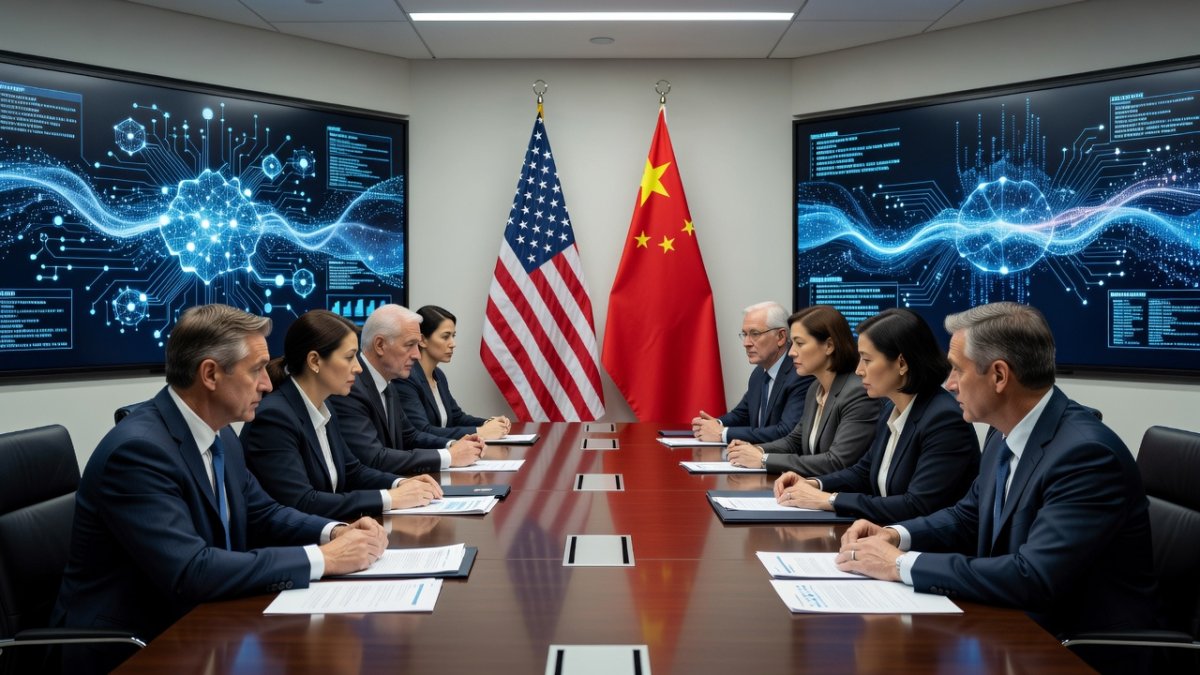
The US and China will hold AI safety negotiations in September led by Treasury Secretary Bessent, a key outcome of the Trump-Xi summit. For Japan, the talks carry significant stakes given its role in AI research, semiconductor supply chains, and the Hiroshima AI Process framework.
US-China AI Talks Set for September — Implications for Japan
The United States and China have confirmed plans to hold dedicated artificial intelligence negotiations in September 2026, with US Treasury Secretary Scott Bessent expected to lead the American delegation. The talks represent one of the most concrete outcomes of the Trump-Xi summit held in Beijing in May 2026, and come ahead of Chinese President Xi Jinping's planned visit to the United States on September 24.
Five people familiar with the matter told Reuters that the discussions will focus on AI safety protocols, risk mitigation frameworks, and mechanisms to prevent nonstate actors from obtaining advanced AI models. For Japan — a key US ally and a major player in AI research and semiconductor supply chains — the outcome of these talks carries significant strategic implications.
Tags: US-China AI talks, Scott Bessent, AI safety, Trump-Xi summit, Japan technology policy, artificial intelligence regulation, global governance, frontier AI models, semiconductor diplomacy, US-Japan alliance
The September Timeline: Bessent Leads US Delegation
Treasury Secretary Scott Bessent, who first outlined an AI safety protocol framework during bilateral talks in Beijing on May 14, will head the US negotiating team. The choice of Bessent — rather than a science or technology official — signals that Washington views AI governance through both a national security and economic competitiveness lens. Bessent has previously warned that the US could impose sanctions on China over alleged theft of American AI models, and has called for rigorous scrutiny of Chinese open-source AI releases for signs of intellectual property infringement.
The AI talks are expected to take place before Xi Jinping's scheduled state visit to the United States on September 24. US Secretary of State Marco Rubio confirmed in Manila on July 20 that preparations for Xi's visit are ongoing, telling reporters that Chinese advance teams have been arriving in the US to coordinate logistics. "We anticipate that the trip is happening in September," Rubio said on the sidelines of an ASEAN foreign ministers' meeting.
From Beijing Summit to Bilateral Negotiations
The May 2026 Trump-Xi summit in Beijing marked a turning point in US-China technology relations. During the summit, the two leaders agreed to explore AI safety guardrails — a framework for managing the risks posed by increasingly capable AI systems. At the time, Bessent told CNBC that the discussions would focus on formulating "best practices for AI to make sure nonstate actors don't get a hold of these models."
The September talks represent the operationalization of that agreement. Sources indicate the negotiations will cover several specific areas: protocols for testing and evaluating frontier AI models, mechanisms for sharing safety incident information, and potential guardrails around the deployment of AI in critical infrastructure and military applications. The scope and ambition of the talks suggest both sides recognize the urgency of managing AI risks that transcend geopolitical competition.
Japan's Stake in US-China AI Diplomacy
For Japan, the US-China AI dialogue presents both opportunities and challenges. Tokyo has been pursuing its own AI strategy, balancing economic competitiveness with safety and ethical considerations. Japan's Ministry of Economy, Trade and Industry (METI) has been active in AI governance discussions through the Hiroshima AI Process — a G7 framework launched under Japan's 2023 presidency that established international guiding principles for advanced AI systems.
The Hiroshima AI Process, which Japan has championed, emphasizes a risk-based approach to AI regulation that aligns broadly with the safety protocols the US is seeking to establish with China. However, Japan also maintains deep economic ties with China — bilateral trade exceeded ¥35 trillion in 2025 — and must navigate the risk that US-China technology decoupling could disrupt supply chains for semiconductors and AI-related components.
Japanese semiconductor equipment makers such as Tokyo Electron and Lasertec supply critical tools to both US and Chinese chip manufacturers. Any new export controls or technology transfer restrictions emerging from the AI talks could directly affect these companies' operations.
China's AI Governance Vision vs. US Security Concerns
China has been advancing its own narrative on AI governance. At the World Artificial Intelligence Conference (WAIC) in Shanghai on July 16, President Xi Jinping pitched China as a leader of a new global AI order, urging countries to seize the "historic opportunity" of open-source AI. Xi's speech at the conference outlined a vision of AI as a public good — accessible to developing nations and governed through inclusive multilateral frameworks rather than Western-dominated standard-setting bodies.
This vision stands in tension with Washington's approach. Bessent has signaled skepticism about Chinese open-source AI models, suggesting they may be vehicles for IP theft or contain hidden surveillance capabilities. The US has also raised concerns about China's use of AI in military applications and social credit systems — issues that are unlikely to be resolved in a single round of talks.
Despite these differences, the decision to engage in dialogue reflects a pragmatic recognition that neither side can unilaterally manage the risks of advanced AI. Experts note that frontier AI models, once released, can be modified and redistributed by anyone — making cross-border cooperation on safety testing and incident response essential regardless of geopolitical tensions.
What This Means for Asia Pacific Technology Policy
The September talks are being closely watched by capitals across the Asia Pacific region. South Korea, Singapore, and Taiwan — all significant players in semiconductor manufacturing and AI research — are likely to be affected by any standards or protocols that emerge from the US-China discussions. The talks could also influence the trajectory of AI governance at the United Nations, where debates over a proposed global AI treaty have been stalled by disagreements between Western and developing nations over the scope of regulation.
Australia, a member of the AUKUS security pact, has been coordinating with Washington on technology security issues. The Five Eyes intelligence alliance — which includes the US, UK, Canada, Australia, and New Zealand — has been sharing information on AI-related national security risks. Japan, as a close US ally with its own advanced AI sector, may find itself in a position to influence the dialogue's direction through bilateral channels with Washington.
Economic Implications: Yen, Energy, and AI Investment
The AI talks coincide with a period of economic strain for Japan. The yen has moved beyond ¥163 against the dollar — its weakest level in four decades — putting pressure on Japanese AI startups that rely on imported computing hardware. Japan's electricity prices have also surged to their highest in over three years, driven by blistering heat, yen weakness, and escalating fuel costs, raising the cost of training and running large AI models domestically.
These economic headwinds make the outcome of US-China AI diplomacy particularly consequential for Japanese technology firms. If the talks lead to a relaxation of technology tensions, Japanese companies could benefit from resumed collaboration with Chinese research institutions and expanded access to China's AI market. If they escalate into further restrictions, Japanese firms may face difficult choices about which technology ecosystem to align with.
What to Watch For
Several key indicators will emerge in the weeks leading up to the September talks. First, the composition of the Chinese delegation will signal Beijing's approach — whether it sends technical experts from the Ministry of Science and Technology or political appointees from the State Council. Second, any public statements on AI by Xi Jinping during his US visit will provide clues about China's willingness to make binding commitments versus maintaining flexibility.
For Japan, the most immediate concern is whether the US-China talks will produce agreements that affect semiconductor export controls or AI model distribution — areas where Japanese policy and commercial interests are deeply intertwined. The Ministry of Economy, Trade and Industry is expected to issue a statement in the coming days outlining Japan's position on the bilateral dialogue.
The September talks represent a pivotal moment for global AI governance. Whether they produce concrete protocols or remain a diplomatic forum for exchanging positions will shape the trajectory of AI development — and the rules that govern it — for years to come.
By Kenji Tanaka, Staff Writer
This article was produced with AI-assisted research and editorial support. Reporting is based on sources cited in the article.
What's Your Reaction?
 Like
0
Like
0
 Dislike
0
Dislike
0
 Love
0
Love
0
 Funny
0
Funny
0
 Wow
0
Wow
0
 Sad
0
Sad
0
 Angry
0
Angry
0

Japan Correspondent at Global1.News. Tokyo-based voice covering Japanese politics, technology, economy, and culture. Tracks the intersection of tradition and innovation in one of the world's most dynamic societies.











Comments (0)