
Vietnam Electric Motorcycle Shift Tests Japanese Manufacturers
Vietnam's transition from petrol-powered motorcycles to electric models is unfolding through a series of measured regulatory steps that began with announcements in 2025 and are being phased in across major urban centers. The process centers on Hanoi and Ho Chi Minh City, where local authorities have set concrete replacement targets tied to ring-road boundaries and specific user
Vietnam's transition from petrol-powered motorcycles to electric models is unfolding through a series of measured regulatory steps that began with announcements in 2025 and are being phased in across major urban centers. The process centers on Hanoi and Ho Chi Minh City, where local authorities have set concrete replacement targets tied to ring-road boundaries and specific user categories. Japanese manufacturers, which have long dominated the market, now face a compressed timeline that tests their ability to scale electric offerings while maintaining the reliability standards long associated with corporate Japan.
Regulatory Timeline and Urban Bans
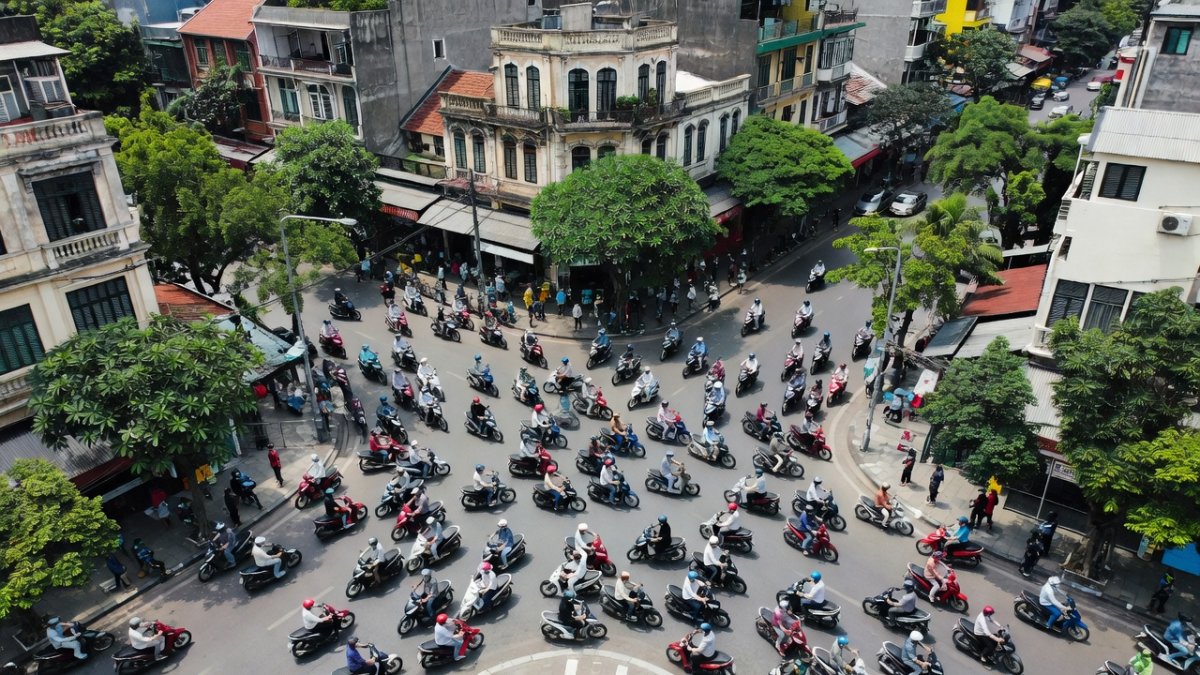
Hanoi authorities have scheduled the first restrictions for July 2026, when fossil-fuel motorcycles will be prohibited inside the Ring Road 1 area. The measure expands to the Ring Road 2 boundary by 2028 and reaches Ring Road 3 by 2030. These phased boundaries directly affect 450,000 petrol-powered motorbikes currently operating in the inner districts. Parallel developments are occurring in Ho Chi Minh City, where 400,000 gasoline motorbikes are slated for replacement by 2028 and where ride-hailing and delivery services face a 2026 prohibition on internal-combustion models.
The national framework supports these local actions through a target of one-third electric cars and one-fifth electric motorbikes by 2030. Implementation remains gradual, with enforcement mechanisms still under development by the relevant ministries. This approach mirrors elements of Japan's own Society 5.0 strategy, which emphasizes data-driven urban planning and incremental infrastructure upgrades rather than abrupt replacement.
Scale of the Two-Wheeler Fleet
Vietnam operates the second-largest motorcycle market in Southeast Asia after Indonesia, with a total stock of 77 million two-wheelers. Of these, approximately 7 million are registered in Hanoi and 8.5 million in Ho Chi Minh City. The sheer volume means that even modest percentage shifts toward electric models translate into hundreds of thousands of units annually. Sales data from the first eight months of 2025 already show strong growth differentials: smaller electric bikes increased 89 percent while full-sized models rose 197 percent compared with the prior year.
These figures underscore the market's responsiveness to policy signals. Yet the transition must accommodate the daily mobility needs of millions of commuters who rely on two-wheelers for short urban trips and longer inter-provincial journeys. For many Vietnamese families, the motorcycle serves not merely as transportation but as a primary income-generating asset used for deliveries, ride-hailing, and small-scale commerce.
Japanese Manufacturers Position and Timeline Concerns
Honda holds more than 80 percent of the Vietnamese motorcycle market and sold roughly 2.3 million units in the twelve months ending March 2025. The company only began offering electric models in 2026 and has described the government's replacement schedule as too ambitious. Yamaha, with approximately 17 percent market share, has issued similar assessments, noting that supply-chain readiness and charging infrastructure require additional years to reach scale.
Both firms maintain extensive production facilities in Vietnam and have historically aligned product development with METI guidance on quality and export standards. The current disruption arrives as Japanese industry more broadly evaluates how Society 5.0 principles — integrating sensors, connectivity, and energy management — can be applied to two-wheeler platforms. Honda and Yamaha are therefore weighing whether to accelerate local electric production or import certain components from Japan while monitoring regulatory enforcement dates.
Domestic and Regional Competitors
VinFast, part of Vingroup, has emerged as the leading domestic electric-vehicle manufacturer. Its Green SM ride-hailing service has already surpassed Grab in several Hanoi corridors, demonstrating that integrated battery-swap and app-based models can achieve rapid fleet conversion. Dat Bike, a Vietnamese startup, secured $22 million in its most recent funding round, bringing total capital to $47 million. CEO Son Nguyen has emphasized that long-term success depends on delivering high-performance electric motorcycles capable of handling both urban commuting and longer routes.
Chinese manufacturer Yadea has also entered the market with competitively priced models. Its presence adds price pressure but raises questions about after-sales service networks and parts availability in provincial areas. These dynamics create a multi-tiered competitive landscape in which Japanese brands retain advantages in durability perception while local and Chinese entrants focus on cost and speed of deployment.
VinFast is additionally partnering with Vietnamese banks to offer low-interest loans covering up to 90 percent of electric motorcycle costs, including registration fee waivers. Such aggressive financing terms aim to accelerate adoption among price-sensitive consumers who would otherwise struggle with the higher upfront cost of electric models compared to conventional petrol bikes.
Economic and Social Considerations for Riders
Ride-hailing driver Ta Manh Cuong reports daily earnings of approximately $20 and has expressed concern over the upfront cost of electric models and the uncertainty of daily charging access. Rental business owner Bao Ngoc Cao, who rents motorbikes to expats and tourists, similarly highlights questions around residual values once electric motorcycles reach secondary markets. These individual perspectives illustrate the micro-level frictions that accompany fleet-level targets.
Financing schemes tied to ride-hailing platforms and battery-leasing arrangements are under discussion, yet concrete programs remain limited. The Ministry of Industry and Trade (MOIT) has signaled interest in supporting such mechanisms, drawing on precedents from Japanese METI-backed leasing models for commercial fleets. Without accessible financing, the 450,000 units targeted in inner Hanoi and the 400,000 units in Ho Chi Minh City risk slower replacement rates than policy documents project.
Air-Quality and Environmental Dimensions
Hanoi ranks among the world's most polluted cities, with motorcycle emissions contributing significantly to particulate matter and nitrogen oxides. Zifei Yang of the International Council on Clean Transportation (ICCT) has noted that electrification offers measurable air-quality improvements, particularly when concentrated in dense urban cores. The phased ring-road approach allows authorities to quantify reductions in emissions as each successive boundary comes into force.
Japan's own experience with stringent urban emission standards since the 1990s provides a reference point. METI-supported research on low-emission zones and real-time air-quality monitoring could inform Vietnamese implementation, especially as both countries explore cooperative technology transfer under existing MOFA frameworks. Unlike the car market, Yang added, motorbikes sold in Vietnam are manufactured domestically, meaning the shift to electric could boost local producers, foster startups, and attract new investment.
Infrastructure and Charging Requirements
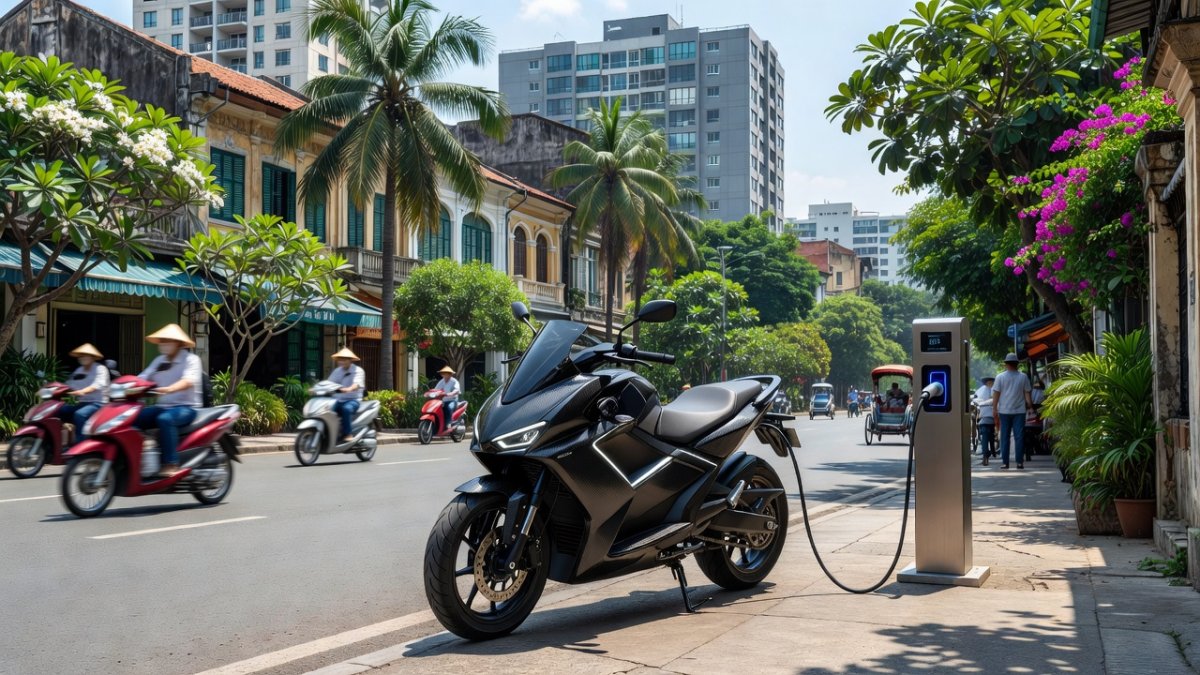
Widespread adoption hinges on charging and battery-swap networks that currently cover only a fraction of daily travel corridors. VinFast's swap stations demonstrate one operational model, yet scaling to serve 77 million two-wheelers requires coordination among utilities, local governments, and private operators. Japanese firms have begun pilot projects that integrate solar-assisted charging with existing dealership footprints, aligning with Society 5.0 goals of distributed energy systems.
The Bank of Japan's low-interest financing facilities for green infrastructure have indirectly supported similar projects elsewhere in ASEAN; analogous mechanisms could accelerate Vietnamese network build-out if bilateral channels are activated. Battery costs are falling globally, and Yang noted that smaller batteries make home charging more practical for two-wheelers than for cars.
Outlook for Japanese Industry in ASEAN
Vietnam's transition serves as an early indicator of how Japanese manufacturers will navigate EV disruption across ASEAN markets. With Indonesia still favoring internal-combustion platforms and Thailand pursuing its own 2030 electric targets, the Vietnamese experience supplies data on consumer acceptance, infrastructure sequencing, and competitive responses. Honda and Yamaha's ability to adapt their dominant market positions will influence corporate strategy for the remainder of the decade.
The measured pace of policy rollout — July 2026 for Hanoi's Ring Road 1, 2028 for Ring Road 2, and 2030 for Ring Road 3 — provides a window for iterative product development. Whether this window proves sufficient depends on continued alignment between Vietnamese targets and the manufacturing realities faced by corporate Japan. For Japanese policymakers and corporate planners, Vietnam's experiment with electric mobility offers the clearest signal yet that Southeast Asia's two-wheeler market is entering a period of fundamental transformation.
By Kenji Tanaka, Staff Writer
This article was produced with AI-assisted research and editorial support. Reporting is based on sources cited in the article.
What's Your Reaction?
 Like
0
Like
0
 Dislike
0
Dislike
0
 Love
0
Love
0
 Funny
0
Funny
0
 Wow
0
Wow
0
 Sad
0
Sad
0
 Angry
0
Angry
0

Japan Correspondent at Global1.News. Tokyo-based voice covering Japanese politics, technology, economy, and culture. Tracks the intersection of tradition and innovation in one of the world's most dynamic societies.














Comments (0)