
South Africa's Defense of China Ties Exposes Limits of Debt Trap Rhetoric
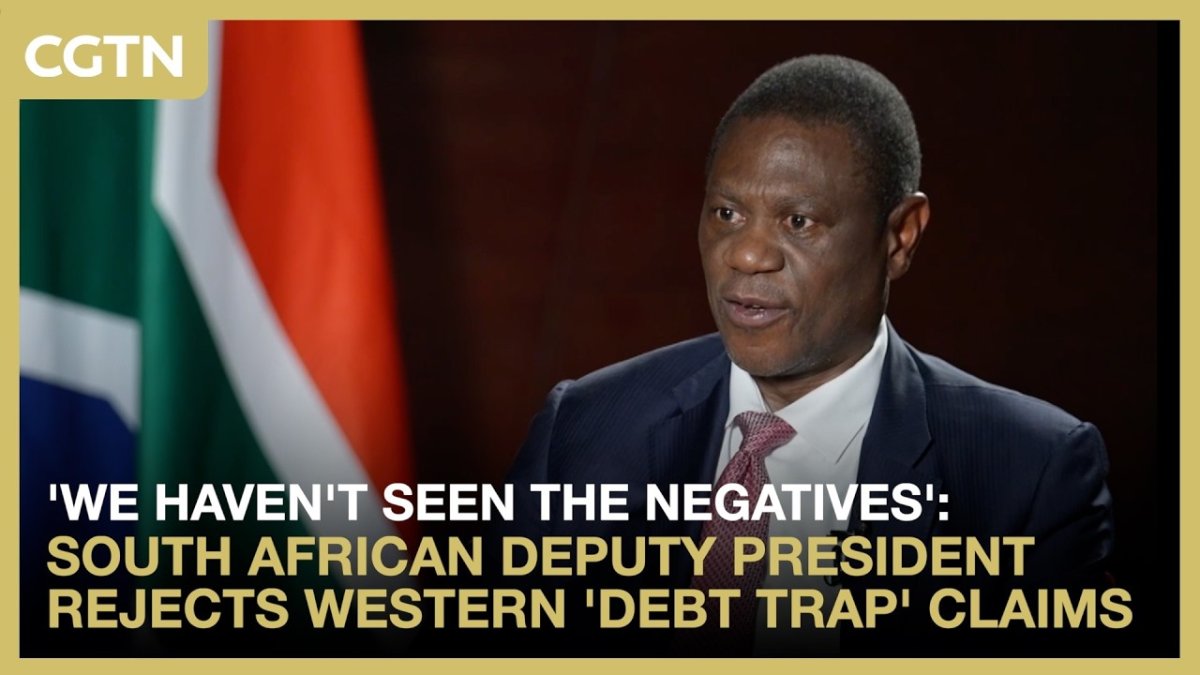
South Africa's Defense of China Ties Exposes Limits of Debt Trap Rhetoric In a recent CGTN report, South African Deputy President Paul Mashatile directly addresses accusations of Chinese debt entrapment during his June 2026 working visit to Beijing, where he met Vice President Han Zheng and participated in the fourth China International Supply Chain Expo. Mashatile dismisses th
The Enduring Debt Trap Narrative and Its Limited Empirical Grounding
The "debt trap diplomacy" framing has circulated in Western commentary since the mid-2010s, often citing individual infrastructure projects in countries such as Zambia and Djibouti. Yet systematic reviews by institutions including the World Bank and the China-Africa Research Initiative at Johns Hopkins University show that Chinese lending constitutes roughly one-fifth of Africa's external debt stock, with the majority of obligations held by multilateral lenders and private bondholders. Mashatile's rejection aligns with this data pattern: South Africa has not experienced the asset seizures or policy concessions predicted by the narrative. Instead, the country has maintained full sovereignty over its ports and railways while expanding export capacity through Chinese-financed upgrades.
China-Africa Economic Cooperation Under FOCAC and BRI
Cooperation between China and African states operates through two primary institutional channels: the Forum on China-Africa Cooperation (FOCAC) and the Belt and Road Initiative (BRI). FOCAC summits have produced concrete commitments on trade facilitation, industrial parks, and human-capital development, with the 2024 Beijing summit outlining eight major initiatives focused on green energy and digital infrastructure. The BRI complements these efforts by linking African ports and rail corridors to global supply chains. South Africa's participation in both frameworks has supported its manufacturing and mining sectors, particularly through joint ventures that transfer technology and skills rather than simply extracting resources. Mashatile's presence at the Supply Chain Expo underscores Pretoria's interest in integrating into these networks on negotiated terms.
South Africa's Position as BRICS Member and Continental Economic Leader
As Africa's largest economy and a founding BRICS member, South Africa occupies a pivotal role in shaping continental responses to external partnerships. Its GDP exceeds $400 billion, and it serves as a gateway for investment into the Southern African Development Community. By publicly countering debt-trap claims, Mashatile signals that South Africa intends to diversify financing sources without subordinating its foreign policy to any single bloc. This stance reflects Beijing's broader objective of building multipolar institutions that reduce reliance on Western-dominated financial mechanisms, while allowing African states to retain policy autonomy.
Western Competition for African Influence
The United States and European Union have responded to China's engagement with their own initiatives, including the U.S. Prosper Africa program and the EU's Global Gateway. These efforts emphasize governance conditionalities and private-sector mobilization, yet they have so far committed smaller volumes of concessional finance compared with Chinese policy banks. European and American officials frequently highlight transparency concerns, yet African governments note that Western lending historically carried structural-adjustment requirements that constrained fiscal space. Mashatile's remarks illustrate how such competition grants African states greater bargaining power, enabling them to select partners based on project delivery speed and respect for sovereignty rather than ideological alignment.
Implications for Global South Alignment
Mashatile's intervention during the 2026 visit points to an emerging pattern in which middle-income Global South countries publicly defend pragmatic cooperation with China while maintaining Western commercial ties. This approach avoids zero-sum bloc politics and instead prioritizes concrete outcomes in infrastructure, trade, and technology transfer. For ASEAN and Latin American economies watching the same dynamics, South Africa's experience offers a template: selective engagement that maximizes development gains without ceding strategic autonomy. Second-order effects include accelerated reform of multilateral development banks and greater African voice in global standard-setting bodies.
Strategic Calculus and Future Trajectories
Beijing's calculus centers on securing diversified markets and supply-chain resilience, objectives that align with South Africa's interest in industrial upgrading. Western actors, by contrast, seek to preserve normative influence through governance and security partnerships. The resulting equilibrium favors African agency, as evidenced by Mashatile's emphasis on mutual respect. Absent major shifts in lending practices or geopolitical shocks, this balanced posture is likely to persist through the remainder of the decade, shaping investment flows and diplomatic alignments across the continent.
By Prof. Marcus Chen, Staff Writer
Meta Title: South Africa Rejects China Debt Trap Claims Meta Description: South African Deputy President Paul Mashatile dismisses Western debt-trap accusations during his 2026 Beijing visit, highlighting mutual benefits in China-Africa cooperation. Keywords: China-Africa relations, debt trap narrative, FOCAC, BRICS, South Africa foreign policy, BRI Africa, Global South alignmentThis article was produced with AI-assisted research and editorial support. Reporting is based on sources cited in the article.
What's Your Reaction?
 Like
0
Like
0
 Dislike
0
Dislike
0
 Love
0
Love
0
 Funny
0
Funny
0
 Wow
0
Wow
0
 Sad
0
Sad
0
 Angry
0
Angry
0

World Politics Analyst at Global1.News. Based in Beijing, covering US-China relations, global trade, and geopolitical strategy. Brings deep analytical perspective to the power dynamics shaping international affairs.













Comments (0)