
Minab Massacre: BBC Reveals Iran School Strike Horror
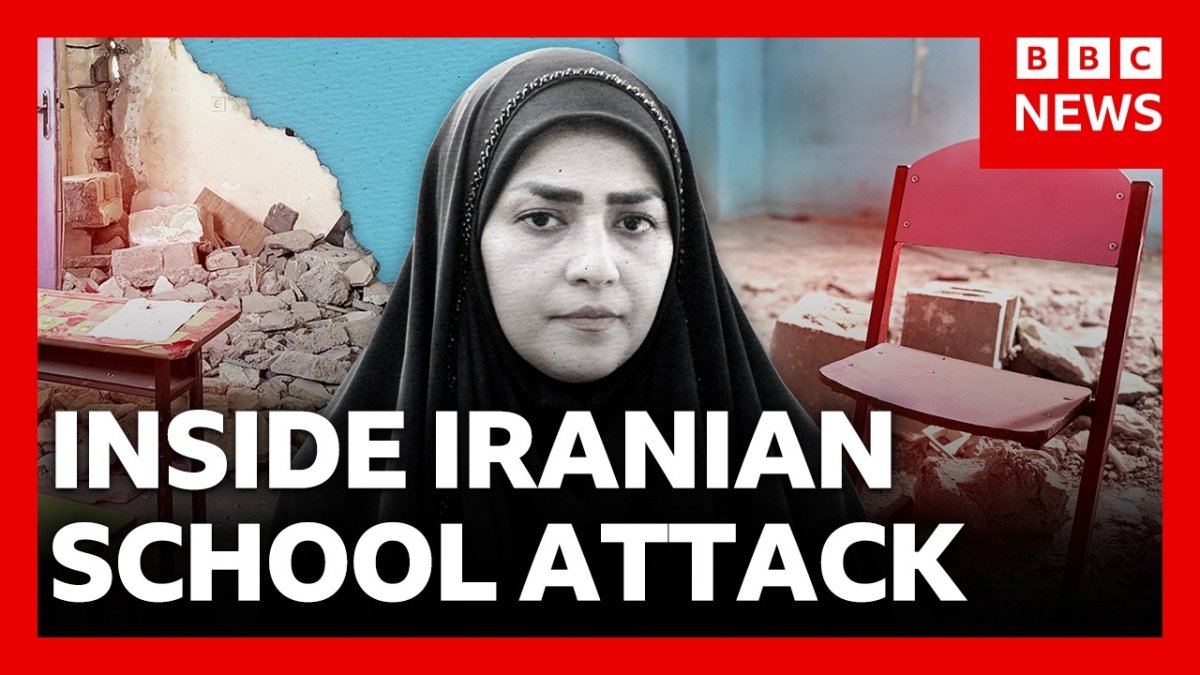
The BBC News YouTube video investigation by Nawal Al-Maghafi opens with stark footage of the rubble at Shajareh Tayyebeh Primary School in Minab. The bombing of a primary school in Minab represents the deadliest single civilian incident of the US-Israeli war with Iran, killing 156 people including 120 children.
The BBC News YouTube video investigation by Nawal Al-Maghafi opens with stark footage of the rubble at Shajareh Tayyebeh Primary School in Minab. The bombing of a primary school in Minab represents the deadliest single civilian incident of the US-Israeli war with Iran, killing 156 people including 120 children.
The Minab Massacre: BBC Investigation Reveals Full Horror of Iran School Strike
Minab, southern Iran — This week, the BBC's senior international investigations correspondent Nawal Al-Maghafi visited the ruins of Shajareh Tayyebeh Primary School in Minab, a small city in southern Iran. What she found is a testament to one of the deadliest civilian tragedies of the US-Israeli war with Iran — a strike that killed 156 people, 120 of them children, on the first day of the conflict.
The Attack: A Saturday Morning in Ramadan
February 28, 2026 began as an ordinary Saturday during the Islamic holy month of Ramadan at Shajareh Tayyebeh Primary School. The children gathered in the prayer hall to recite the Quran. Teacher Amaineh Nademi, 33, who taught first-grade girls for six years at the school, was beginning a lesson on a new letter of the Persian alphabet when the first explosions were heard across the city.
The headteacher announced the school would be closing, and teachers began contacting parents to collect their children. Only five of Amaineh's 15 first-grade pupils remained in her upper-floor classroom when she heard a nearby explosion. She rushed back for the children.
"Just as I went to leave, a missile struck the school," Amaineh told the BBC. "Something hit my head and my students' heads — we were all sent flying." Thick black smoke filled the classroom. She could not see the children she was holding in her arms. Another explosion followed, and the school collapsed around them.
The Rescue: 'Nobody Had a Complete Body'
Reza Besharati, a rescue worker with the Iranian Red Crescent Society, was among the first to arrive at the scene. The roads near the school were clogged with traffic as desperate families rushed to find their children. Besharati says he recognized people he knew among the wreckage, including relatives.
"We started to find the people, thinking maybe someone would be alive," he told the BBC. "But unfortunately, nobody was." The dead were found grimly disfigured. "Maybe just a hand, maybe just a leg… Nobody had a complete body," Besharati recalled. Many families identified their children only by their shoes or clothing.
Amaineh, bleeding from her injuries, passed the wounded children down to people below and climbed past fire and rubble toward the school gate. There she saw a crowd of parents, many of whom had rushed to the site without putting on shoes. "I didn't know that all of them were under the rubble," she said.
What the Evidence Shows
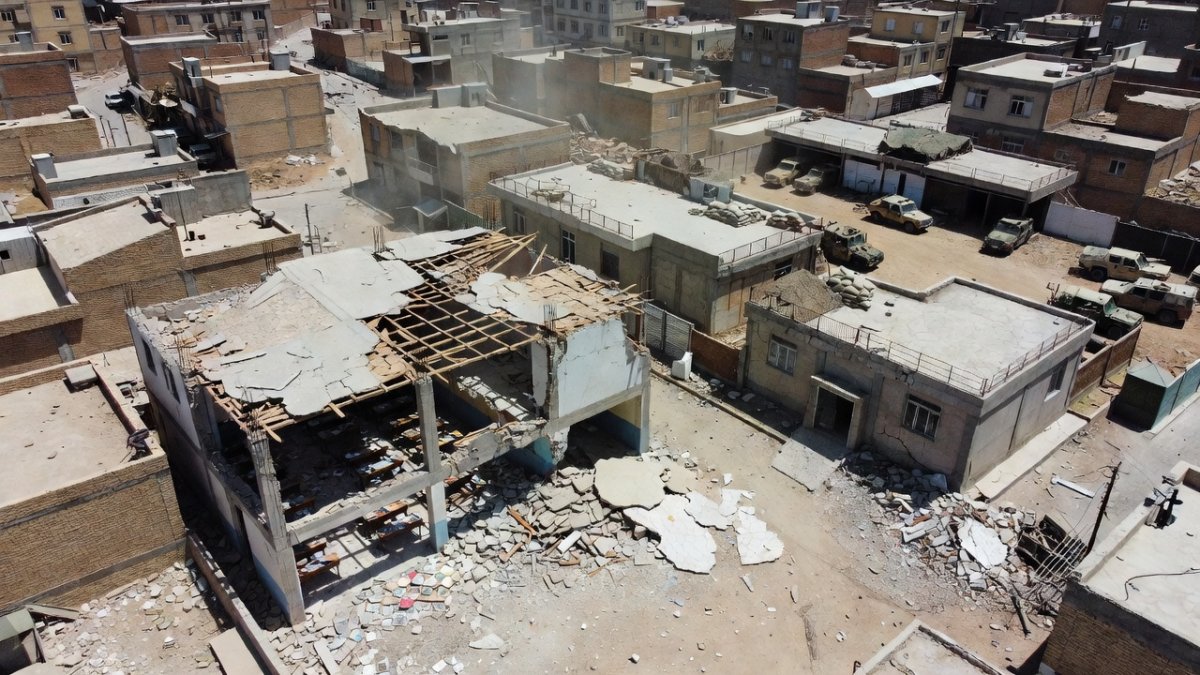
Expert video analysis has established that the IRGC compound adjacent to the school was struck by a precision-guided Tomahawk cruise missile — a weapon system that neither Israel nor Iran is known to possess, and which is exclusively operated by the United States military. Satellite imagery confirms that the school and multiple buildings in the adjacent compound were hit.
Historical satellite images show that the school grounds were once part of the IRGC complex, but have been walled off since 2016 with their own separate entrances and yards. Information identifying the site as a school was publicly available online, including archived snapshots of the school's website taken months before the attack.
Several US media outlets have reported, citing sources familiar with the military investigation, that preliminary findings concluded it was likely that outdated data supplied by the US Defense Intelligence Agency led to the school being treated as part of the military site. The Trump administration has still not released the investigation's findings.
Washington's Response: 'Never Target Civilians'
In the immediate aftermath, President Donald Trump blamed Iran for the strike without providing any evidence. Defense Secretary Pete Hegseth stated that US forces never target civilian targets and announced a higher-level investigation led by an officer from outside US Central Command. Months later, the findings have not been made public.
In May, the head of Centcom told a congressional committee that the investigation was complex because the school sat on an active IRGC cruise missile base. Iran's foreign ministry rejected this characterization as a baseless fabrication, noting that the IRGC also operates community and medical facilities. Local residents told BBC Persian that while the site had previously housed an IRGC naval brigade, they believed its military use had ceased years ago.
The Human Cost: 'Identified by Her Socks'
Nine-year-old Setayesh wanted to be a teacher. Every evening, her mother Masoumeh Mehran Shekhabadi visits her grave in the cemetery a short drive from the ruined school. "There was no school," Masoumeh said, her voice breaking. There was only smoke, children's hair, a hand on one side, a foot on the other. "They had been torn to pieces." Setayesh's body was identified by her cream-colored socks, the only recognizable detail left.
Amaineh Nademi now walks the cemetery among the graves of her former pupils. She recites the names of the dead: Adrina, who was killed on the stairs with her mother. Fatemeh, second grade. The headteacher, the deputy head, the PE teacher, the Quran teacher — all killed. "You can't call it a school," she says of the ruins. Just walls that smell of death, grief and the blood that was shed here.
International Condemnation and Diplomatic Fallout
The UN Secretary-General and UNESCO condemned the bombing as a grave violation of humanitarian law. The Guardian reported fears the Trump administration wanted to bury the findings. Iran named a plane carrying negotiators Minab-168 referencing the death toll. The war has divided Iranian public opinion according to local observers.
The UN Secretary-General described the school bombing as a grave violation of humanitarian law, emphasizing that attacks on educational facilities housing children during conflict contravene core protections under international conventions. The Guardian's reporting highlighted internal concerns that the Trump administration sought to bury the investigation findings to shield military decision-making from scrutiny. Iran has leveraged the Minab incident as a diplomatic counter-narrative, naming its negotiator plane Minab-168 to reference the death toll and invoking the strike in international forums to challenge US assertions of precision targeting. This approach frames the event as evidence of broader accountability failures, amplifying calls for independent examination while exposing fractures in Iranian public opinion that test regime cohesion amid ongoing hostilities.
The Russia-China-Iran Axis and Shifting Power Dynamics
Analysts suggest the Minab incident has placed new pressure on the Russia-China-Iran axis. Moscow and Beijing have issued statements urging restraint while monitoring how civilian casualties affect Tehran's position in ongoing regional talks. This could indicate a recalibration of support as global attention focuses on accountability questions.
The Minab school strike has prompted Moscow to issue measured statements urging restraint, while closely monitoring how civilian casualties influence Tehran's leverage in regional negotiations. Beijing has echoed similar cautions, reflecting unease over how the incident complicates joint diplomatic positioning. This development signals potential recalibration within the trilateral relationship, as both powers weigh the costs of association with operations drawing heightened international scrutiny. The strike simultaneously undermines the credibility of US claims regarding precision targeting, illustrating how civilian harm can erode narratives of controlled engagement and force partners to reassess the sustainability of their alignment amid evolving accountability pressures.
Implications for Accountability in the Ongoing Conflict
The absence of released findings months after the strike leaves open questions about responsibility. According to Tehran, the incident underscores the need for independent probes. International observers note that such events test the limits of claims about precision targeting. The divided Iranian public opinion reflects broader uncertainty over how the war will shape future alliances. The Minab case stands as a reminder that civilian protection remains central to any assessment of the campaign's conduct. Without transparent outcomes from the announced investigation, trust in official narratives continues to erode across multiple capitals.
The Pentagon investigation has yet to release findings months after the strike, leaving unresolved questions of responsibility despite Centcom's characterization of the probe as complex due to the site's proximity to military infrastructure. Divided Iranian public opinion reveals strains on the regime's domestic standing, with segments questioning official narratives while others rally around external condemnation. The Minab case could establish a precedent for post-war accountability mechanisms, raising whether independent international probes will prove necessary to restore credibility where national inquiries stall. This episode highlights how unresolved civilian incidents shape the broader conduct of the war, influencing perceptions of legitimacy and constraining diplomatic options for all parties involved.
By Irina Volkov, Staff Writer
This article was produced with AI-assisted research and editorial support. Reporting is based on sources cited in the article.
What's Your Reaction?
 Like
0
Like
0
 Dislike
0
Dislike
0
 Love
0
Love
0
 Funny
0
Funny
0
 Wow
0
Wow
0
 Sad
0
Sad
0
 Angry
0
Angry
0
Russia/Eastern Europe Correspondent at Global1.News. Covering Russian politics, energy, security, and the shifting dynamics of the post-Soviet space. Provides clear-eyed analysis on one of the world's most opaque regions.











Comments (0)