
Micron Stock: Anthropic Deal, Korean Crash, and Q3 Earnings Due Today
Folks, this is Jessica Ali, and I need you to sit down for this one. In the span of 72 hours, Micron Technology — the backbone of the AI memory boom — went from signing one of the biggest partnerships in semiconductor history to getting body-slammed by a leveraged-ETF meltdown in Seoul, all while heading into earnings that could reshape the entire tech narrative for the second
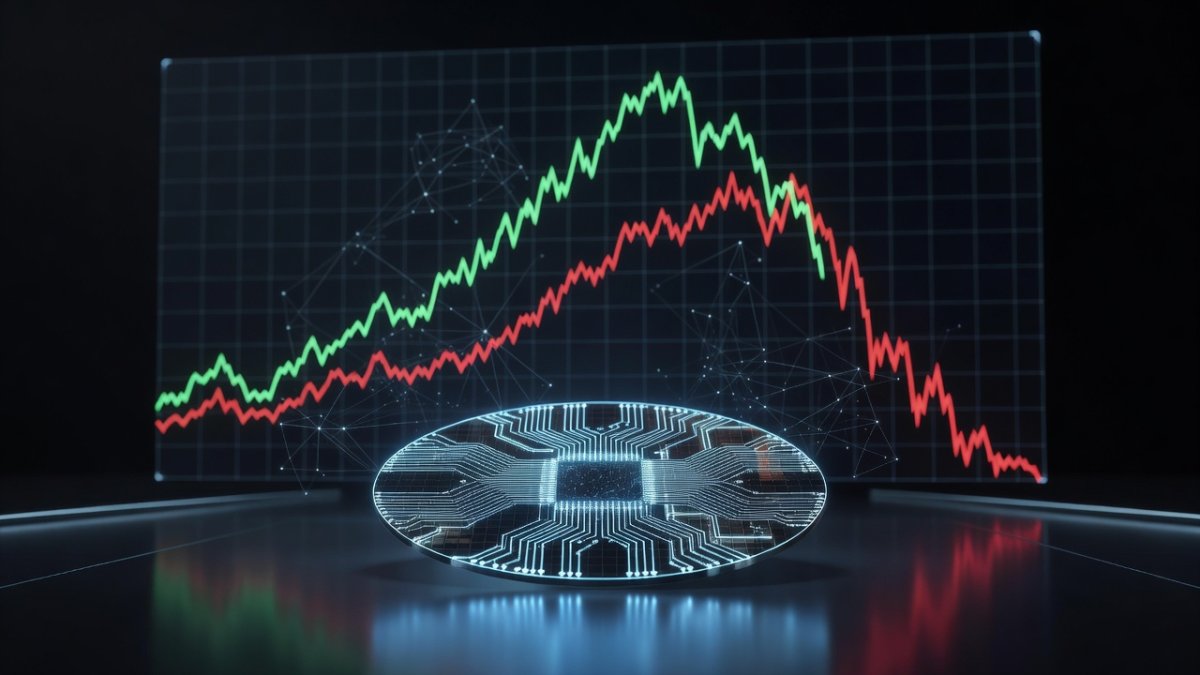
Folks, this is Jessica Ali, and I need you to sit down for this one. In the span of 72 hours, Micron Technology — the backbone of the AI memory boom — went from signing one of the biggest partnerships in semiconductor history to getting body-slammed by a leveraged-ETF meltdown in Seoul, all while heading into earnings that could reshape the entire tech narrative for the second half of 2026. If you blinked, you missed it. But I didn't blink. And neither should you.
Here's the three-act story that just unfolded: On June 22, Micron announced a blockbuster strategic agreement with Anthropic, the AI company behind Claude. The stock ripped to a fresh 52-week high above $1,097. Then on June 23, South Korea's financial regulator blinked, a 10 percent crash hit the KOSPI, and Micron got dragged down 13.3 percent in the chaos. And now — right now, today, June 24 — Micron drops fiscal Q3 2026 earnings after the bell. This is not a normal week. This is a stress test for the entire AI trade, and I am going to break it down piece by piece so you know exactly what is signal and what is noise.
The Anthropic Deal: Why June 22 Was a Landmark Day for AI Memory
Let's start with what actually moved the needle. On Monday, June 22, 2026, Micron Technology and Anthropic announced a strategic agreement that goes far beyond a simple supplier relationship. This thing has four pillars, and every single one of them matters.
First, a multi-year supply agreement covering High Bandwidth Memory — that's HBM, the super-fast memory that AI training clusters cannot function without — plus DRAM and SSDs. We are talking about the kind of volume commitments that let Micron lock in fab capacity years in advance. Second, the two companies are co-designing memory and storage architecture specifically for next-generation AI workloads. That is not off-the-shelf. That is custom engineering. Third, Micron participated in Anthropic's Series H funding round — $65 billion raised at a $965 billion valuation — making this a financial partnership as much as a supply deal. And fourth, Micron is deploying Claude enterprise-wide across its own operations. They are eating their own cooking.
Reuters confirmed the details straight from the announcement. The official Micron investor site laid out all four pillars without any corporate fluff. The market reaction was immediate and unambiguous: MU stock blasted to an intraday high of $1,097.47, a new 52-week peak. This was not retail traders piling on. This was institutional money recognizing that the most important memory company in America just locked in another anchor AI customer with real, multi-year volume commitments. The AI infrastructure buildout is happening right now, and Micron just proved it is at the center of it.
The Korean Leveraged-ETF Crash: How a Regulator in Seoul Sank a US Tech Giant
Now we get to the part that makes me angry. Because what happened on June 23 had absolutely nothing to do with Micron's business, nothing to do with AI demand, and nothing to do with the fundamentals of semiconductor memory. It was a mechanical liquidation triggered by South Korea's Financial Supervisory Service warning about single-stock leveraged ETFs tied to Samsung and SK Hynix. And yet Micron shareholders lost 13.3 percent of their value in a single day.
Here is how it happened. The KOSPI — South Korea's main stock index — dropped 10 percent, triggering an automatic trading halt. The sell-off bled straight into US-listed semiconductor names because global markets are interconnected and algorithms do not distinguish between a Korean memory stock and an American one when they are both in the same sector ETF. The Nasdaq Composite fell 2.2 percent. The S&P 500 got dragged down too. Forbes confirmed the trigger was the FSS warning. The Motley Fool correctly nailed it as a leveraged-product unwind, not a fundamental shift. Dan Ives called it noise, and he was right.
Let me be crystal clear about what happened here. Single-stock leveraged ETFs amplify daily moves by 2x or 3x. When a regulator in any country signals concern about those products, the forced selling cascade is mathematical — not fundamental. Nothing changed about Micron's HBM orders. Nothing changed about the Anthropic partnership. Nothing changed about AI demand. What changed was that some leveraged products in Seoul got margin-called, and because the market is wired the way it is, a Boise-based memory company lost $30 billion in market cap in a day. That is the BS I am calling out right now.
The Numbers That Matter: Q2 Record, Q3 Guidance, and Tonight's Earnings
Let's get away from the noise and into the data that actually tells us where this company is headed. Micron's fiscal Q2 2026 was a record across every meaningful metric: $23.9 billion in revenue, a 74.4 percent gross margin, and earnings that crushed analyst estimates. The business is not just growing — it is printing money at semiconductor margins that would have been unthinkable five years ago.
The guidance for Q3 — the quarter we are about to get results for tonight — was even more aggressive: $33.5 billion in revenue. That is a 40 percent sequential increase. Wall Street is modeling earnings per share of $18.97. TD Cowen analyst Krish Sankar just more than doubled his price target to $1,500, emphasizing robust margin expectations and the complete sell-out of Micron's 2026 HBM capacity. The stock closed June 23 at $1,051.77 after the crash, and it is trading in the $1,051 to $1,065 range today. That is a 30 percent discount to TD Cowen's target.
Tonight after the bell, we get the actual Q3 print. The whisper number is that Micron may have already shipped more HBM in the first half of 2026 than in all of 2025. If the gross margin holds above 70 percent, the Korean crash will look like a gift for anyone who bought the dip. If margins compress, the sell-off starts to look prescient. That is what we are watching.
Why the Sell-Off Was Garbage and What Smart Money Knows
I want to be absolutely direct with you because this is where the mainstream coverage is failing. The 13.3 percent drop on June 23 was not a signal about Micron. It was a signal about the fragility of leveraged ETF products in an interconnected global market. The underlying business — AI memory demand, HBM supply constraints, enterprise AI adoption — got stronger, not weaker, in that same 48-hour window.
The Anthropic deal is multi-year. The HBM ramp is already underway with shipments to Nvidia and other AI accelerator makers. Enterprise deployment of Claude inside Micron itself shows the company is using the very AI infrastructure it helps build. None of that got reversed on June 23. What got reversed was a speculative position in Korean leveraged products. If you cannot tell the difference between those two things, you are going to make bad decisions.
This is exactly the kind of dislocation that institutional investors love. When mechanical selling forces a 13 percent drop in a stock that just locked in a marquee AI customer two days earlier, the smart money steps in. The question is whether retail investors — the folks reading this — are going to let a Korean ETF warning dictate their portfolio decisions on a US tech company executing at record levels.
What to Watch in Tonight's Q3 Print
Here is my scorecard for tonight's earnings. First and most important: HBM revenue trajectory. Is the sequential growth accelerating or decelerating? Second: any updates on the Anthropic supply ramp — how fast are those volume commitments coming online? Third: gross margins. The 74.4 percent Q2 number is stunning. Can Micron hold that level as they scale HBM production, or does mix shift compress margins? Fourth: the forward guidance. The $33.5 billion Q3 guide set a high bar. If management raises the full-year outlook, the Korean crash becomes a footnote. If they guide cautiously, the sell-off extends.
The stock at $1,051 is pricing in a lot of uncertainty. TD Cowen's $1,500 target implies 42 percent upside from here. But the Korean crash also reminded everyone that volatility cuts both ways. If you are holding into earnings, you are betting that the AI memory cycle has more room to run. If you are waiting on the sidelines, you are betting that the leveraged-ETF unwind is a leading indicator, not a lagging one. I know which side the data supports.
Here Is What You Should Do Right Now
Do not sit there pretending this is too complicated to understand. Micron is the purest publicly traded bet on the AI memory buildout. The Anthropic relationship just got locked in with a multi-year commitment and a direct equity stake. Earnings are hours away. The Korean ETF drama was a speed bump created by leveraged product mechanics in another country — it was not a change in the AI investment thesis.
Decide what you believe about AI infrastructure spending for the next 24 months. If you believe it is accelerating — and every data point from Microsoft, Amazon, Google, and now Anthropic says it is — then the Micron story is intact. The Korean crash gave you a better entry point than you had on June 21. Do not waste it by letting somebody else's margin call dictate your conviction. Get informed. Watch the print tonight. And stop letting leveraged products in Seoul tell you what American technology is worth.
By Jessica Ali, Lead Anchor — Global 1 News
This article was produced with AI-assisted research and editorial support. Reporting is based on sources cited in the article.
What's Your Reaction?
 Like
0
Like
0
 Dislike
0
Dislike
0
 Love
0
Love
0
 Funny
0
Funny
0
 Wow
0
Wow
0
 Sad
0
Sad
0
 Angry
0
Angry
0

Editor-in-Chief at Global1.News. Atlanta-based journalist who cuts through the BS and tells it like it is. Lead anchor, host, and the voice you hear when the spin stops and the truth starts.











Comments (0)