
CoreWeave Is Betting $6 Billion on Lancaster -- But the Revolt Is Already National
CoreWeave Is Betting $6 Billion on Lancaster — But the Revolt Is Already National Let me tell you something that's been sitting wrong with me all week.
CoreWeave Is Betting $6 Billion on Lancaster — But the Revolt Is Already National
Let me tell you something that's been sitting wrong with me all week.
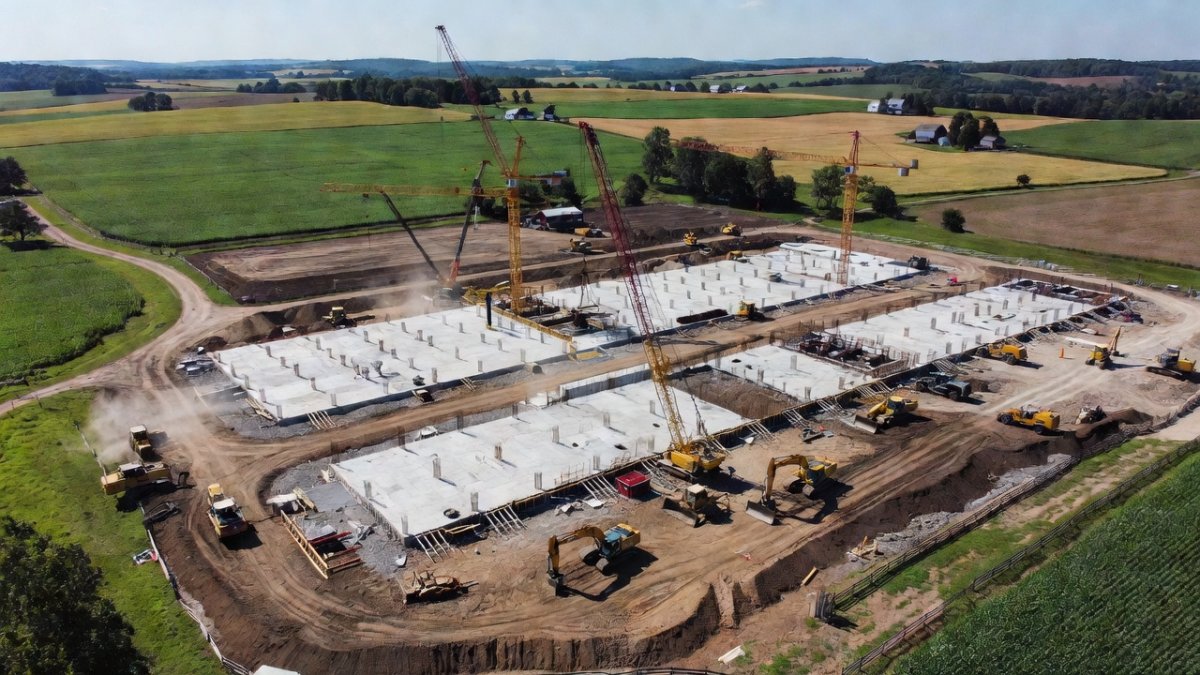
On Monday, Turner Construction announced it won the contract to build CoreWeave's $6 billion AI data center in Lancaster, Pennsylvania — a 100-megawatt facility scalable to 300 megawatts, financed by $4 billion from Blue Owl Capital, Chirisa Technology Parks, and Machine Investment Group. Big news. Handshakes. Press release. Construction starting soon.
But here's the thing nobody in that press release is talking about. The same week this deal got its contractor, 142 protests against data centers happened across 42 states. The first coordinated national day of action. Tea Party veterans and left-leaning organizers standing side by side, holding signs that say "Not in My Backyard" in two dozen different languages.
This is the convergence that's going to define the next five years of AI infrastructure: billions of dollars flowing into construction, and a political backlash spreading faster than the concrete can dry. Both forces are real. Both are accelerating. And they're on a collision course.
CoreWeave Is Betting $6 Billion on Lancaster — But the Revolt Is Already National
Lancaster, Pennsylvania — July 21, 2026 — Today's announcement that Turner-Wohlsen Construction won the $6 billion CoreWeave AI data center contract in Lancaster is the kind of news that would have been pure celebration two years ago. But in July 2026, it lands inside a very different reality.
The $6 Billion Bet — CoreWeave's Lancaster AI Campus
Let me give CoreWeave credit where it's due. The company has built itself into one of the most significant AI infrastructure players in the world — $45 billion market cap, $77 billion enterprise value as of July 3, 250,000 GPUs across 32 data centers, $1.92 billion in revenue in 2024. Microsoft alone accounts for 62% of their revenue. When CoreWeave announces a project, Wall Street listens.
The Lancaster campus will start at 100 megawatts of IT load, scalable to 300 megawatts. For context, 300 megawatts is enough to power roughly 240,000 homes. The project is backed by a joint venture structure that includes Blue Owl Capital, Chirisa Technology Parks, and Machine Investment Group — financial heavyweights who know this is a multi-decade asset play, not a quick flip.
Turner Construction, one of the largest builders in the country, brought in Wohlsen as the joint venture partner. These are not small operators. They build hospitals, stadiums, skyscrapers. That they're now building data centers at this scale tells you everything you need to know about where the construction industry's center of gravity has shifted.
But here's the part the press release doesn't mention: Lancaster residents have already raised concerns about noise, zoning, and whether the city has the regulatory framework to handle a $6 billion project that will consume as much power as a small city. A Lancaster Online report from earlier this year had residents asking whether the city even has the expertise to verify the developer's noise-neutrality claims. The zoning commission is scrambling to catch up.
The 142 Protests That Changed Everything
While CoreWeave was finalizing its construction contract, something else was happening across America. On Saturday, July 18, the first coordinated national day of action against data centers took place. Humans First — a grassroots movement founded by former Tea Party leader Amy Kremer — organized 142 rallies across 42 states. From Wasilla, Alaska to Naples, Florida, people showed up.
And I mean people. Not just NIMBYs. Not just environmentalists. Not just one political party. The rallies drew a cross-section of America that surprised everyone. In California's Imperial Valley, a MAGA stalwart and a left-leaning organizer stood side by side at the same protest, united against a proposed data center that would pull 260 million gallons of water a year from the Colorado River.
The New York Times called data center opposition "the most bipartisan issue since beer." And that was two months before the national protests. Now? It's not bipartisan — it's nonpartisan. Everybody hates these things.
Bernie Sanders wants to ban data centers. Donald Trump slammed New York's data center moratorium as a "terrible decision" — not because he wants data centers, but because he frames it as a China-AI race issue. The opposition spans from the Sierra Club to the Tea Party. When was the last time you saw that kind of coalition on anything?
The Numbers That Should Terrify Every Data Center Developer
Let me put the numbers on the table, because the industry press isn't leading with these.
According to Tom's Hardware, more than 75 data center build-outs worth a combined $130 billion were successfully blocked in the first three months of 2026 alone. Not delayed. Not negotiated. Blocked. Communities across the country told hyperscalers, "You cannot build here."
There are now 69 jurisdictions across the United States that have enacted moratoriums or outright bans on new data center construction. That number was 28 at the start of the year. It has more than doubled in six months.
Tom's Hardware also ran a survey showing that 47% of Americans don't want new data centers built near their homes. Fortune cited a Gallup poll in a July 19 report showing 70% of Americans oppose data center construction in their communities. Seven out of ten.
These are not fringe numbers. These are mainstream, middle-America, we-showed-up-at-the-town-hall numbers. And they're getting worse for the industry, not better.
The Squeeze Nobody's Talking About — Capital vs. Consent
Here's what keeps me up at night as someone who runs actual hosting infrastructure.
On one side, you have the most concentrated capital deployment in the history of the technology industry. The hyperscalers — Microsoft, Amazon, Google, Meta, Oracle — are on track to spend over $725 billion on AI infrastructure in 2026. CoreWeave's $6 billion Lancaster campus is one project among hundreds. The money is not slowing down.
On the other side, you have a political backlash that has already blocked $130 billion worth of projects, prompted 69 jurisdictions to enact moratoriums, and organized 142 simultaneous protests across 42 states. The backlash is not slowing down either.
These two forces are on a collision course. And when they meet, the outcome isn't going to be pretty for the companies stuck in the middle.
What happens when a hyperscaler has spent $500 million on site preparation, power interconnection studies, and permitting — only to have the local zoning board deny the project because 300 people showed up to a county meeting with signs? That's already happening. It happened to QTS in Prince William County, Virginia. It's happening now to Google in Ohio. It's happening to every major player in Georgia.
The capital is committed. The land is purchased. But community consent is a bottleneck that no amount of money can buy. You can't write a big enough check to make 70% of your neighbors change their minds about a 300-megawatt power draw in their backyard.
What This Actually Means for Independent Hosting Providers
Now let me bring this home for the people who actually run hosting businesses, because this matters to you in ways that aren't obvious.
First — Your power costs are going up, and nothing is stopping that. Every data center that does get built puts upward pressure on regional power prices. Every data center that gets blocked means more demand concentrated into fewer available locations, which also pushes prices up. Either way, your electricity bill is going to be higher next year than this year. Lock in fixed-rate power contracts now if you can.
Second — The colocation market is about to bifurcate. We're going to see two tiers of colocation emerge: "approved" facilities in jurisdictions that welcome data centers (rural counties with tax incentives and spare transmission capacity) and "contested" facilities in areas where every new project requires a political fight. The former will have stable pricing. The latter will carry a risk premium. If you're choosing colocation space right now, pick jurisdictions that have not seen significant community backlash. Look at the map of the 69 moratorium jurisdictions and steer clear.
Third — The secondary markets are your best hedge. While the big players fight over Virginia, Northern Virginia, and the primary data center corridors, secondary markets are quietly welcoming infrastructure. Places like Ohio, Indiana, and Pennsylvania — before the backlash caught up — were prime examples. The game now is to identify markets that are about to welcome data centers but haven't yet triggered the political opposition. Watch for places where the local economic development authority is actively recruiting but the community hasn't yet organized. That window is shrinking fast.
Fourth — Your customers are going to start asking questions. As the data center backlash becomes mainstream news — and it will, after 142 protests across 42 states made national headlines — your business customers will start asking where their data lives, whether their hosting provider uses "responsible" data centers, and whether the power source is controversial. Have answers ready. Being able to say "our facilities are in communities that actively welcomed us" is going to become a competitive differentiator.
The Structural Reality — This Squeeze Isn't Ending Soon
Here's the hard truth that nobody in the CoreWeave press release wants to acknowledge.
The $130 billion in blocked projects isn't going to unblock itself. The 69 moratorium jurisdictions aren't going to reverse course. The 142 protests aren't going to be the last ones — they're going to be the first ones. Humans First is already planning more actions. The movement has organizational infrastructure now, and it's not going away.
Meanwhile, the AI infrastructure buildout continues. Meta is committing 6 gigawatts. OpenAI is committing 6 gigawatts. Microsoft is spending $190 billion on capex in 2026. CoreWeave is dropping $6 billion on one campus. The money is real. The demand is real. The need for power and space is real.
But community consent is also real. And right now, the industry is discovering that you can't build your way past a political problem. You can build around it — choose a different county, a different state, a different country. But you can't build through it. The people have to want you there, and in 2026, they don't.
The Bottom Line
CoreWeave's Lancaster data center is going to get built. Turner-Wohlsen has the contract, the financing is secured, and the demand for AI compute is insatiable. That project will happen.
But the next Lancaster — the next $6 billion campus that gets announced six months from now — is going to face a very different political environment. The protests have given local opposition a playbook. The moratoriums have given communities a template. The $130 billion in blocked projects has given activists a proof point that resistance works.
This isn't a warning about something that might happen. It's already happening. The capital is flowing. The backlash is organizing. And the collision between them is going to reshape where, how, and at what cost AI infrastructure gets built for the rest of this decade.
If you're running a hosting business, pay attention. The map of where you can build is shrinking. The timeline for getting permits is lengthening. And the political risk of every new project is now a line item on the budget.
This is not a short-term problem. This is the new normal.
— Allan Ali, Founder
This article was produced with AI-assisted research and editorial support. Reporting is based on sources cited in the article.
What's Your Reaction?
 Like
0
Like
0
 Dislike
0
Dislike
0
 Love
0
Love
0
 Funny
0
Funny
0
 Wow
0
Wow
0
 Sad
0
Sad
0
 Angry
0
Angry
0

Publisher of Global1.News. Automation architect, systems builder, and the guy making sure the truth gets published.











Comments (0)