
GTB Hospital Fan Death Highlights Delhi Infra Crisis
In a chilling reminder of crumbling public infrastructure, a 42-year-old man died within hours of admission when a ceiling fan detached and struck him in the emergency ward of Delhi's Guru Teg Bahadur Hospital. The July 18 incident at the 35-year-old facility has ignited outrage over patient safety in government hospitals already stretched beyond capacity.
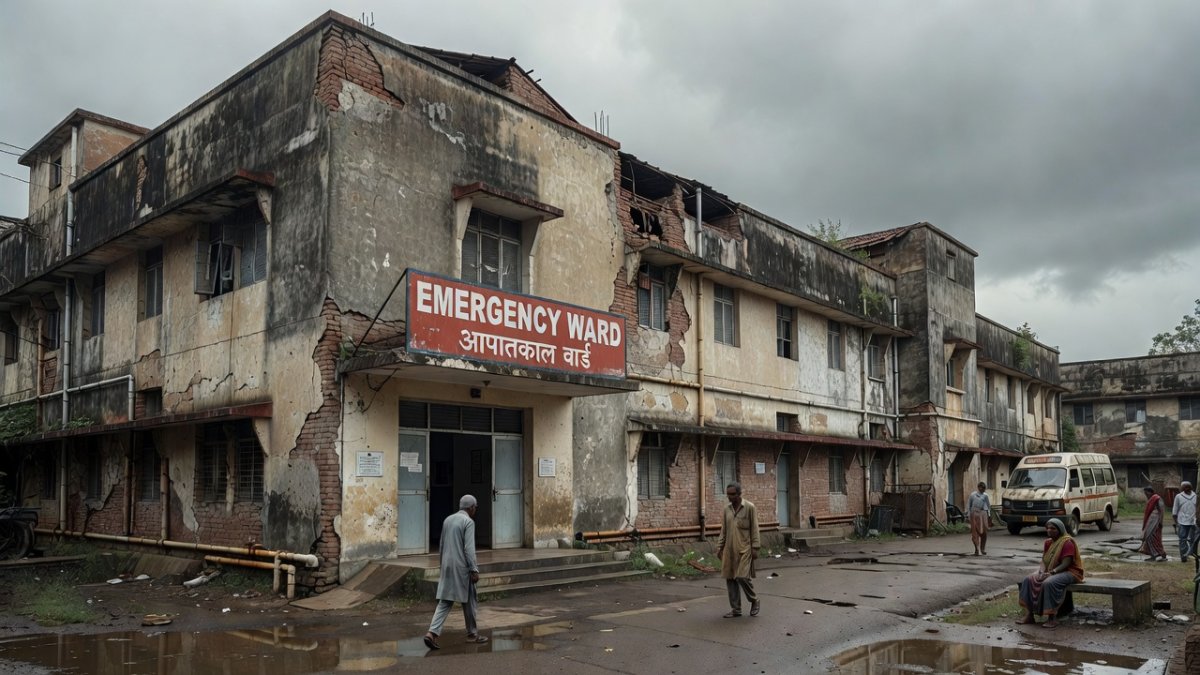
In a chilling reminder of crumbling public infrastructure, a 42-year-old man died within hours of admission when a ceiling fan detached and struck him in the emergency ward of Delhi's Guru Teg Bahadur Hospital. The July 18 incident at the 35-year-old facility has ignited outrage over patient safety in government hospitals already stretched beyond capacity. It also raises urgent questions about how deferred maintenance turns treatable conditions into fatal outcomes.
GTB Hospital Fan Death Highlights Delhi Infra Crisis
New Delhi, July 19 — A 42-year-old patient named Md Akbar died at 12:16 AM on July 19 after a ceiling fan fell on him in Emergency Ward 27 of Guru Teg Bahadur Hospital, exposing long-standing structural neglect at one of Delhi's busiest government facilities.
The incident occurred around 9:30 PM on July 18 while a nursing officer was administering treatment in the emergency ward. The ceiling fan detached from its mountings and struck the patient directly on the head and torso. The nursing officer attending to him also sustained injuries during the incident. GTB Hospital, the primary referral centre for East Delhi's trans-Yamuna region, was built in 1991 and now operates well beyond its intended service life under crushing patient loads.
The Patient and the Incident
Md Akbar was admitted to GTB Hospital on July 18, 2026, by his brother with complaints of hypertension, meningoencephalitis, and aspiration pneumonia — three serious conditions requiring intensive monitoring and a safe treatment environment. While a nursing officer administered care in Emergency Ward 27, the ceiling fan detached and fell directly onto the patient's bed. Hospital staff confirmed to Hindustan Times that "the fan fell directly onto the patient's bed while treatment was being administered."
Akbar's death followed within three hours, at 12:16 AM on July 19. According to his death certificate reviewed by Hindustan Times reporter Ridhima Gupta, the cause was recorded as hypertension, meningoencephalitis, and aspiration pneumonia — with no mention of the physical trauma from the falling fan. GTB Hospital records 4,800 to 5,200 daily OPD visits and maintains 1,050 beds, with occupancy reaching 138 percent in the last quarter alone, making it one of the most overcrowded government hospitals in the national capital.
Hospital's Response and Death Certificate
GTB Hospital officials maintained that the recorded cause of death remained unchanged by the fan incident. The hospital's position is that Akbar's death was due to his pre-existing medical conditions rather than the structural failure. No public inquiry into the ceiling fan detachment or the circumstances surrounding the patient's death has been announced.
This stance places the burden of proof squarely on grieving families to demonstrate that external trauma contributed to the outcome. Meningoencephalitis — inflammation of the brain and its surrounding membranes — carries a 25 to 40 percent mortality rate even with prompt administration of acyclovir and supportive intensive care, according to published clinical data. Medical experts note that additional cranial trauma from any source would further complicate recovery in already critical neurological patients, though the hospital's death certificate attributes the outcome exclusively to pre-existing conditions.
Family's Demands and Patient Safety Concerns
Family members gathered at GTB Hospital on the morning of July 19 and demanded a formal inquiry into the fan detachment. They questioned whether basic safety standards were met in an emergency ward where critically ill patients receive round-the-clock care. "There is no value of patients' lives here," eyewitnesses told local media, pointing to the stark contrast between air-conditioned doctor facilities and malfunctioning equipment in patient areas.
The incident has heightened uncertainty for families across Delhi government hospitals about the physical safety of their relatives during treatment. When basic building components fail during active medical procedures, the trust between citizen and public healthcare system erodes further.
Previous Infrastructure Failures at GTB Hospital

Only one month before the fan death, a portion of the ceiling inside the emergency operation theatre complex at GTB Hospital collapsed. No injuries occurred in that earlier event, yet the pattern of structural failure remained unaddressed. Medical staff have repeatedly flagged corroded fan clamps and deteriorating ceiling fixtures, but these warnings were logged only as "minor maintenance" once the Directorate of Health Services capital expenditure envelope was exhausted by March 2024.
These successive incidents in the same hospital — a ceiling collapse in the OT complex followed by a fatal fan detachment in the emergency ward — indicate systemic neglect rather than isolated accidents. East Delhi residents who depend on GTB Hospital for emergency and critical care continue to encounter environments where basic infrastructure components fail during active treatment. The hospital's annual infrastructure spend stands at roughly ₹18 crore, a fraction of the ₹120 to ₹150 crore routinely invested by 500-bed NABH-accredited private hospitals serving the same catchment area.
The Infrastructure Crisis in Delhi Government Hospitals
Delhi's FY2025-26 health budget totals ₹9,872 crore, with only 14.8 percent allocated to capital works and maintenance — a figure the Delhi Medical Association has repeatedly criticised as insufficient. Of 38 Delhi government hospitals, 19 currently operate above 100 percent bed occupancy; GTB recorded a staggering 138 percent occupancy in the last quarter. Most facilities were constructed between 1965 and 1995, and the average age of their main blocks now exceeds 42 years against a 30-year design life assumed by Central Public Works Department norms.
The Directorate of Health Services annual maintenance budget has remained frozen at ₹210 crore since 2021 despite a 31 percent rise in patient footfall across the system. GTB's sanctioned annual repair grant is only ₹22 crore. The Delhi government's 2023 "Hospital Modernisation Mission" promised ₹3,500 crore over five years for structural retrofitting and fire-safety upgrades, but only ₹487 crore has been released to date. Health Minister Saurabh Bhardwaj has cited land-acquisition delays and tendering bottlenecks for the slow disbursal, while the Delhi Medical Association points to the absence of any dedicated engineering cell within the health department as a structural oversight.
The Indian Medical Association's Delhi chapter has demanded mandatory structural audits every five years for all government hospitals, pointing to the absence of such protocols after the 2022 Safdarjung Hospital roof incident. NABH accreditation standards explicitly require load-bearing assessments, ceiling-anchor inspections, and emergency evacuation modelling — none of which featured in GTB Hospital's last internal infrastructure report. The crisis extends beyond GTB: in October 2024 a false-ceiling panel collapsed at Lok Nayak Hospital's emergency block, injuring two nurses, and in December 2024 an electrical short-circuit forced evacuation of an entire ward at Deen Dayal Upadhyay Hospital.
What This Means for India's Healthcare System
National Health Mission guidelines prescribe that every 500-bed district hospital must undergo a comprehensive structural audit every three years and maintain a five-year rolling maintenance plan funded at two percent of asset value annually. Recent NHM reports indicate that 62 percent of India's 810 district hospitals were built before 1990 and have never received such audits. This cohort spans Uttar Pradesh, Bihar, and Madhya Pradesh — states sharing GTB's profile: seismic and wind-load zones, deferred plaster and reinforcement work, and ceiling-mounted equipment installed without fresh structural certification.
India's National Patient Safety Implementation Framework (2018) lists structural collapse and equipment detachment as "never events" that should trigger immediate root-cause analysis and public reporting. Yet the framework remains largely aspirational; only seven of 28 states have notified rules to enforce it. WHO patient-safety benchmarks require immediate investigation and compensation mechanisms — standards Indian tertiary centres rarely meet.
The GTB case highlights a deeper question: when a patient with meningoencephalitis — already facing 25 to 40 percent mortality odds — suffers additional trauma during treatment, the line between treatable illness and preventable complication blurs. Hospital officials maintain the outcome was driven by pre-existing disease, while the family questions whether infrastructure failures compromised the standard of care. Without ring-fenced funding for structural audits, independent engineering oversight within health departments, and enforcement of NABH infrastructure standards, the conditions that led to Md Akbar's death may persist not just in Delhi but across India's aging public hospital network.
The Bottom Line
Md Akbar's death at GTB Hospital on July 19, 2026, followed a documented ceiling fan detachment in an emergency ward. The hospital attributes the outcome solely to his pre-existing medical conditions, while his family demands a formal inquiry. Prior ceiling collapse in the emergency operation theatre, flat maintenance budgets since 2021, and repeated staff warnings about corroded fixtures confirm systemic deterioration at this critical trans-Yamuna facility. Delhi government hospitals must address structural integrity with the same urgency applied to clinical services if they are to protect the patients and staff who depend on them daily.
— By Dr. Raj Patel, Staff Writer
This article was produced with AI-assisted research and editorial support. Reporting is based on sources cited in the article.
What's Your Reaction?
 Like
0
Like
0
 Dislike
0
Dislike
0
 Love
0
Love
0
 Funny
0
Funny
0
 Wow
0
Wow
0
 Sad
0
Sad
0
 Angry
0
Angry
0

India/South Asia Correspondent at Global1.News. Analytical voice with a background in science and health journalism. Based in New Delhi, covering Indian politics, education, healthcare, technology, and policy. Breaks down complex data into clear, actionable reporting.















Comments (0)