
US-Iran War Explodes: Tankers Burn in Hormuz as America Hits Night 10 of Strikes
US-Iran war escalates: IRGC sets tankers ablaze in Hormuz (Al Jazeera/AP), traffic crashes to 8 ships/day (CENTCOM/Reuters). Trump orders 10th night of strikes (AP/NYT); 3 US troops dead, 1 missing in Jordan (CENTCOM). Oil $85-90; drones hit Gulf bases. Jessica Ali reports the stakes for America.
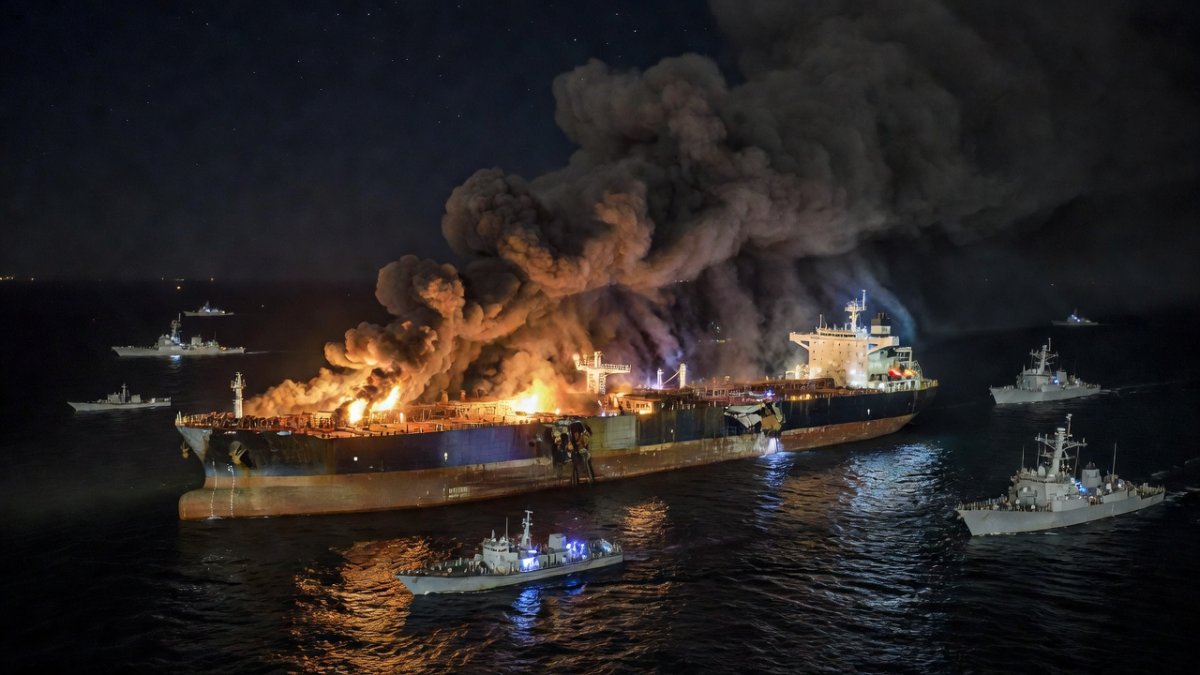
Folks, buckle up because the powder keg just blew sky-high. What started with those US-Israeli airstrikes on February 28, 2026, that took out Supreme Leader Ali Khamenei and a chunk of Iran's top brass, as first detailed in reporting by The New York Times and Reuters, has now turned the Strait of Hormuz into a floating inferno. On July 21, Iran's IRGC bragged about "massive fires" ripping through two oil tankers trying to squeeze through that chokepoint, according to official IRGC statements carried by Al Jazeera and confirmed in AP dispatches. Crews evacuated, per Reuters. Another tanker hit earlier in the week, sailors jumping ship, USA Today reported. A fifth of the world's crude and natural gas used to flow there in peacetime, a figure long cited by energy analysts and restated by CENTCOM. Now? Barely eight ships a day, according to maritime tracking data referenced by Reuters and CENTCOM briefings. This isn't shadow boxing anymore. This is full-scale war, and America is right in the thick of it.
I'm Jessica Ali, and I'm not here to soft-pedal. President Trump just wrapped the 10th straight night of US airstrikes, telling the world we hit them "very, very hard" and we'll keep hitting until he says enough, per his own remarks quoted by AP and The New York Times. Two of our service members dead in Jordan on July 18, a third killed the next day defusing a downed Iranian drone, and one still missing, according to official CENTCOM statements and USA Today reporting. Iran's lobbing drones at our bases in Kuwait, Qatar, Bahrain, and Jordan, as documented by Reuters and Al Jazeera. Power plants smashed. Water cut off. Oil bouncing between $85 and $90 a barrel while Trump warns it could've hit $250 without our secret runs through the strait, comments carried by AP and NYT. Atlanta drivers already feel it at the pump. This is the story that matters right now.
Tankers Torched and the Strait Choked Off
Picture this: massive fires lighting up the night on two oil tankers as they tried to transit the Strait of Hormuz on July 21. Iran's Islamic Revolutionary Guard Corps claimed responsibility with that cold, calculated language they love, according to IRGC statements reported by Al Jazeera and AP. Crews got out alive, thank God, but the message was crystal, Reuters confirmed. Another tanker took a hit earlier in the week, forcing its people to abandon ship entirely, per USA Today and maritime officials cited by Reuters. Folks, that waterway once carried about 20 percent of global crude oil and natural gas, a baseline figure repeatedly cited by CENTCOM and energy reports in The New York Times. Today it's a near-standstill, down to roughly eight vessels scraping through daily, according to CENTCOM operational updates and Reuters shipping data.
This isn't random piracy. This is Iran weaponizing the world's energy jugular. CENTCOM has been crystal clear in official statements: these attacks threaten commercial shipping and the free flow of energy that keeps lights on from Savannah to Seattle. When tankers burn, insurance rates skyrocket, freighters reroute around Africa, and every gallon of gas in Georgia feels the pinch, as market analysts told AP and USA Today. We've seen this movie before in smaller doses. This time the theater is on fire.
The IRGC isn't hiding. They're daring the world to blink, per their own public claims amplified by Al Jazeera. And while diplomats wring their hands, American sailors and airmen are the ones keeping any traffic moving at all. That's not opinion. That's the operational reality reported straight from the theater by CENTCOM. If the strait stays this clogged, the economic shockwaves won't stop at the Middle East. They'll hit your grocery bill and your commute by next week, a warning echoed in NYT economic coverage.
Let's be straight: Iran chose this escalation. They could have stood down after the February strikes that removed Khamenei, strikes first reported by Reuters and The New York Times. Instead they doubled down on the one piece of geography that can hold the global economy hostage. Eight ships a day is not commerce. It's a trickle. And trickles dry up fast.
Night After Night: America's Relentless Air Campaign
Ten nights. Let that sink in. The United States military has now conducted its 10th consecutive night of airstrikes against Iranian targets, according to CENTCOM official statements quoted by AP and Reuters. CENTCOM says the focus is laser-sharp: military infrastructure and the exact capabilities Iran uses to menace vessels in the strait. No fluff. No mission creep into pure civilian sites, according to our side's briefings carried by USA Today and NYT.
President Trump, speaking from the NATO summit in Ankara where he sat down with Ukrainian President Volodymyr Zelensky, didn't mince words. "We hit them very hard last night, very, very hard, and we'll probably hit them hard again tonight," he said, per AP and Reuters transcripts. Later he added the strikes continue until "I say it's enough," remarks widely reported by The New York Times. That's the commander-in-chief setting the tempo in plain English. No endless timelines. No vague off-ramps. Hard power until the threat to shipping ends.
Iran claims the bombs have smashed bridges, railway stations, airports, and other infrastructure, putting the civilian death toll from July strikes alone at 50, according to Iranian official statements reported by Al Jazeera. CENTCOM rejects the framing and insists every aimpoint is military, per its public releases cited by AP and Reuters. We've heard both versions before. What we know for certain is the campaign is sustained, precise by modern standards, and showing no sign of pause, as CENTCOM has repeatedly stated. Ten nights is a statement. It tells Tehran the cost of closing Hormuz keeps climbing every sunset.
For folks back home watching the news between shifts, this is the new normal until the strait reopens safely. Our pilots and ship crews are carrying the load so the rest of us don't wake up to $10 gas. That's the trade-off, and it's being executed with American resolve, according to the operational picture painted by CENTCOM.
American Blood Spilled: The Human Cost Hits Home
War has a body count, and this one just claimed more of our own. Two US service members were killed in Jordan on July 18, a third died on July 19 during a controlled detonation of a downed Iranian drone, and one American remains missing in action, according to official CENTCOM statements confirmed by AP, Reuters, and USA Today. These aren't statistics. These are sons, daughters, husbands, wives from bases and hometowns across this country, including right here in the South.
Jordan has long hosted US forces helping secure the region, a fact long reported by The New York Times. Iran's drone campaign turned that quiet partnership into a kill zone, per CENTCOM and Reuters accounts. The controlled detonation that took the third life shows how even "safe" cleanup carries lethal risk when the enemy is flinging cheap, deadly drones by the dozen, as detailed in USA Today reporting. One missing in action means a family somewhere is living the worst kind of limbo, and every American ought to feel that weight.
We honor them by telling the truth: Iran brought this fight to our troops. The February 28 opening salvos that killed Khamenei and other officials were a response to years of proxy attacks and nuclear brinkmanship, according to the sequence of events laid out by Reuters, AP, and NYT. Now the bill is coming due in American blood. Three dead, one missing in a matter of days, per CENTCOM. That tempo is unacceptable, which is exactly why the strikes keep coming.
Atlanta knows military families. We see the flags, the reunions, the empty chairs. These losses demand more than thoughts. They demand victory conditions that bring our people home and keep the strait open.
Iran Strikes Back: Drones, Desalination, and Full-Scale War Talk
Tehran isn't rolling over. Iran's IRGC launched drone swarms at US facilities across Kuwait, Qatar, Bahrain, and Jordan, according to CENTCOM assessments and reporting by Reuters and AP. Kuwait reported "severe damage" to two power and water desalination plants, telling civilians to ration electricity, as stated by Kuwaiti officials and carried by Al Jazeera and USA Today. That's not a pinprick. That's an attempt to make daily life miserable for our partners and anyone nearby.
Iran flipped the script and claimed the United States struck one of their own desalination plants, leaving 10,000 Iranians without water, per Iranian government statements reported by Al Jazeera. Their president went on record calling it a "full-scale war," remarks quoted by Reuters and AP. When both sides are hitting water infrastructure, the humanitarian edge gets razor sharp fast. Iran also floated the idea of suspending the Islamabad MoU peace agreement, tossing another diplomatic grenade onto the table, according to official Iranian comments cited by The New York Times.
This is classic IRGC playbook: punch soft targets, cry victim, and hope the international chorus pressures Washington to ease up. But facts first. They started the tanker fires, per IRGC's own claims via Al Jazeera. They flew the drones that killed Americans, according to CENTCOM. They chose escalation after Khamenei's death, as the timeline from Reuters and NYT makes clear. Calling it full-scale war doesn't make them the aggrieved party. It makes them the architects of their own isolation.
Kuwait's power plants and those 10,000 thirsty Iranians are tragic symptoms of a regime that would rather burn the region than accept it no longer calls the shots in the Gulf. America didn't seek this round. We are finishing it.
Oil Shockwaves and the $250 Nightmare Trump Dodged
Look at your next fill-up. Oil is trading between $85 and $90 a barrel right now, according to market data reported by Reuters, AP, and USA Today. That's elevated, and every Atlanta commuter feels it. President Trump went further, saying prices would be sitting at $250 a barrel if the United States hadn't run a secret mission to keep some oil moving through the Strait of Hormuz, comments quoted directly by The New York Times and AP. Whether that exact figure is rhetorical heat or cold calculation, the direction is obvious: closed strait equals economic freefall.
A fifth of global seaborne oil once passed those waters, a long-standing figure cited by CENTCOM and energy reporters at Reuters. Drop to eight ships daily and the math gets ugly quick, per the same CENTCOM and Reuters tracking. Refineries scramble. Tanker rates explode. Gasoline futures jump. We've already got elevated pump prices; a full closure would rewrite household budgets overnight. Trump's point lands because history backs it. Every previous Hormuz scare sent crude soaring, as NYT and AP retrospectives have noted. This time the scare is real fires and real evacuations.
Energy security isn't some think-tank slogan. It's whether working families in Georgia can afford to drive to work and cool their homes in July heat. US strikes targeting the boats and missiles threatening the strait are, bluntly, defending your wallet as much as the sea lanes, according to the rationale outlined in CENTCOM briefings. Iran wants leverage. We're denying it.
Watch the next few trading sessions. If the eight-ship trickle continues, $90 becomes the floor, not the ceiling, market watchers told Reuters. That's the stake for every American who doesn't live inside the Beltway.
NATO Summit Side Show and the Zelensky Handshake
While bombs fell, diplomacy still flickered at the NATO summit in Ankara. Trump met Ukrainian President Volodymyr Zelensky there and used the moment to underscore the Iran strikes: hit hard, hit again, decide when it's enough, according to pool reports from AP, Reuters, and The New York Times. Two wars, one American president setting terms in public. That dual-track reality is the world of July 2026.
Iran's threat to suspend the Islamabad MoU peace agreement adds another layer of chaos, per Iranian statements carried by Al Jazeera and NYT. Peace papers mean little when tankers burn and drones fly. The Ankara meeting signals that Washington is managing multiple theaters without apology. Support for Ukraine continues; the Iran campaign accelerates. No false choice.
Allies are watching. Some will cheer the decisive language. Others will clutch pearls over escalation. Facts remain: American forces are bleeding, energy arteries are clogged, and half-measures already failed, as CENTCOM casualty and shipping reports make plain. Trump's "until I say it's enough" line, quoted by AP and Reuters, is the clearest end-state articulation we've heard. Military pressure plus diplomatic side conversations. That's the play.
For an Atlanta audience that remembers every overseas entanglement, the message is simple. We can walk and chew gum. We can back partners in Europe and still crush threats in the Gulf. The summit photos will fade. The open strait will not.
What the Numbers Really Say About This Fight
Let's run the tape with hard markers. War open since February 28, 2026, per the opening strike timeline from Reuters, AP, and NYT. Tanker attacks climaxing July 21, according to IRGC claims via Al Jazeera and confirmation from Reuters. Ten straight nights of US airstrikes, CENTCOM stated. Three American service members killed in 48 hours, one missing, per official CENTCOM releases reported by USA Today and AP. Iranian claim of 50 dead from July strikes, Al Jazeera relayed. Ten thousand Iranians without water after the desalination hit, according to Iranian officials quoted by Al Jazeera. Oil at $85-90, with a presidential warning of $250, market data and Trump remarks via Reuters and NYT. Strait traffic collapsed from 20 percent of global supply to eight ships daily, CENTCOM and Reuters figures. Those are the load-bearing facts.
CENTCOM says military targets only. Iran says bridges and airports. Both can publish their bomb damage assessments; the American people will judge. What cannot be spun is the IRGC's decision to light up commercial tankers, by their own admission reported through Al Jazeera, and the subsequent US decision to answer with sustained airpower, per CENTCOM. Causality matters. Iran closed the door on de-escalation when the first tanker burned.
Casualty figures will keep climbing if the strait stays contested. Every night of strikes raises the price for Tehran. Every drone that reaches a US base raises the price for us. The only off-ramp that protects American lives and global energy is Iranian capitulation on shipping interference. Everything else is noise.
This is not forever war. This is conditional war with a measurable goal: free navigation restored and the people who killed our troops held to account. Ten nights is the beginning of that enforcement, not the end, according to the campaign tempo described by CENTCOM.
Where We Go From Here — And What You Can Do
Folks, this fight is about whether a radical regime can hold the world's oil hostage and kill Americans without decisive consequence. The answer coming out of Washington and CENTCOM is a thunderous no, reflected in official statements and the ongoing strike package reported by AP and Reuters. Strikes continue. Pressure mounts. The strait will reopen under conditions we set, not theirs.
Stay sharp. Watch the tanker counts daily, as tracked by Reuters and CENTCOM. Track the oil price via the same market wires. Demand that every representative treats energy security and troop protection as non-negotiable. Support the families of the fallen and the missing, whose losses CENTCOM has confirmed. Fill up when it makes sense, carpool if you can, and refuse to let panic merchants talk America into retreat.
We have the best military on earth, the economic depth to outlast any petro-tyrant, and a commander who has drawn a bright line, in his own words reported by NYT and AP. Iran wanted full-scale war, their president's phrase per Al Jazeera. They've got the American version of it. The outcome is not in doubt if we keep our nerve.
Hold the line with us. Share the facts, not the fear. And remember: free seas and safe troops are worth every hard night of strikes it takes to secure them. We'll be right here with the unvarnished truth every step of the way.
By Jessica Ali, Staff WriterThis article was produced with AI-assisted research and editorial support. Reporting is based on sources cited in the article.
What's Your Reaction?
 Like
0
Like
0
 Dislike
0
Dislike
0
 Love
0
Love
0
 Funny
0
Funny
0
 Wow
0
Wow
0
 Sad
0
Sad
0
 Angry
0
Angry
0

Editor-in-Chief at Global1.News. Atlanta-based journalist who cuts through the BS and tells it like it is. Lead anchor, host, and the voice you hear when the spin stops and the truth starts.











Comments (0)