
Tnuva Dairy Crisis — Cottage Cheese to White Cheese
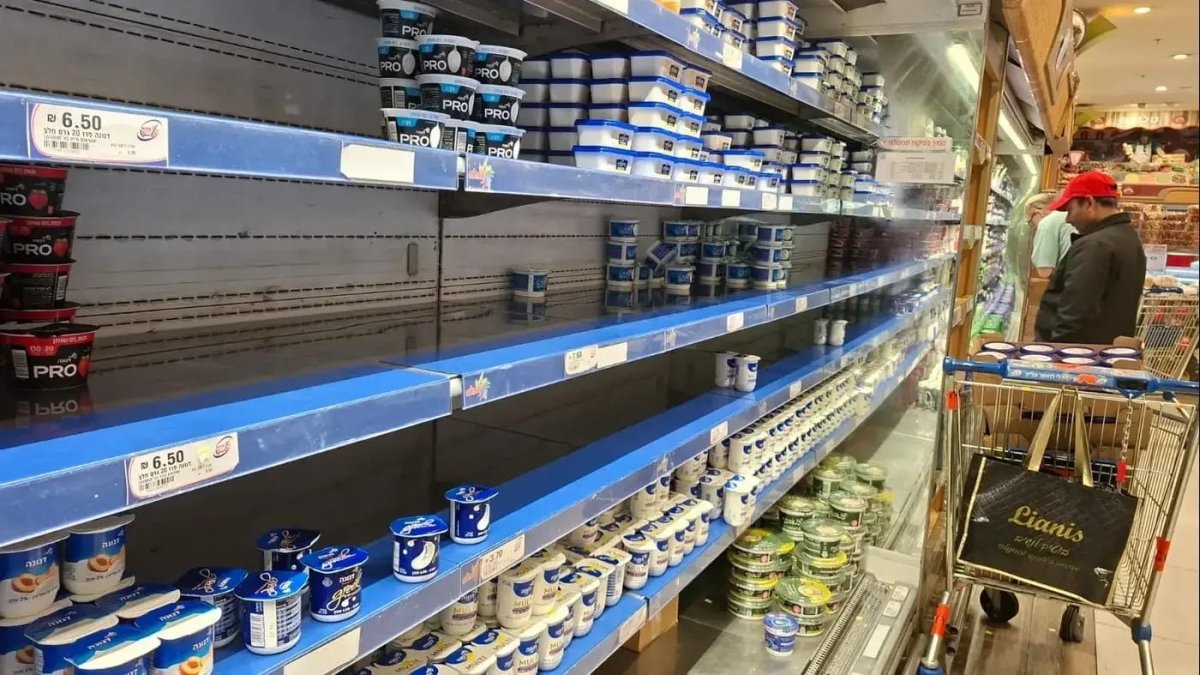
Cottage Cheese Shortage Spreads to White Cheese as Tnuva Warehouse Crisis Deepens Israel’s dairy aisles are looking emptier by the day. What began weeks ago as a frustrating shortage of cottage cheese — a staple on nearly every Israeli breakfast table — has now expanded to white cheese products, leaving shoppers at major chains scrambling and supermarket managers struggling to keep shelves stocked.
Cottage Cheese Shortage Spreads to White Cheese as Tnuva Warehouse Crisis Deepens
Israel’s dairy aisles are looking emptier by the day. What began weeks ago as a frustrating shortage of cottage cheese — a staple on nearly every Israeli breakfast table — has now expanded to white cheese products, leaving shoppers at major chains scrambling and supermarket managers struggling to keep shelves stocked. At the center of the disruption sits Tnuva, the country’s largest dairy company, whose automated warehouse systems at the Alon Tavor facility have been hobbled for months by a technical malfunction that local teams have been unable to fully resolve.
The timing could hardly be worse. Peak summer demand for fresh dairy has collided with a supply chain bottleneck rooted not in milk production itself, but in the sophisticated German-made automation that moves finished products from factory floor to distribution. German technicians from Dematic, a subsidiary of the KION Group, who maintain those systems have declined to travel to Israel, citing the security situation tied to the ongoing regional conflict involving Iran. The result is a slow-motion crisis that is now visible in refrigerators from Tel Aviv to the periphery.
From Cottage Cheese to White Cheese: An Expanding Gap on the Shelves
Cottage cheese was the first and most visible casualty. For weeks, consumers reported sparse selections or completely bare sections where the familiar tubs once sat in abundance. In recent days, the shortage has widened. White cheese products — another high-volume category in the Israeli diet — are increasingly difficult to find in consistent supply. Retail workers at Shufersal branches and other supermarket chains describe a pattern of partial deliveries and rapid sell-outs, with customers buying multiple units when stock appears.
This is not a failure of milking herds or processing capacity in the classic sense. Production lines at Tnuva facilities continue to operate. The choke point is downstream: the automated warehouse at Alon Tavor that is supposed to sort, store, and dispatch dairy goods efficiently across the national distribution network. When that system falters, even robust output cannot reach stores in the volumes and rhythms the market expects. Panic-buying has compounded the problem, as households respond to images of empty shelves by stocking up whenever product appears.
The Alon Tavor Warehouse: Where Automation Meets Reality
Alon Tavor, in the north, houses critical logistics infrastructure for Tnuva’s dairy operations. The facility relies on automated storage and retrieval systems supplied and supported by Dematic, part of Germany’s KION Group. These systems are designed for high-throughput environments, using software, sensors, and mechanical components that require specialized expertise when major faults occur. According to industry descriptions of the situation, a malfunction has been impairing warehouse operations for months, limiting the company’s ability to move product at normal speed and scale.
Israeli technical staff have kept partial functionality going, but the complexity of the integrated system means that certain repairs and recalibrations fall outside routine local maintenance. That is where the German specialists normally come in. Their continued absence has turned a repairable industrial problem into a prolonged supply disruption with national visibility. For a company of Tnuva’s size and market share, warehouse paralysis quickly translates into gaps at Shufersal, other retail chains, and smaller grocers that depend on steady dairy inflows.
German Technicians and the Security Calculation
Dematic and KION Group technicians have refused to travel to Israel to address the warehouse systems, pointing to the security situation arising from the broader Iran-related conflict and associated regional tensions. This is not an abstract corporate caution. Foreign technical personnel and their employers routinely reassess travel to Israel when missile threats, regional escalation, or insurance and duty-of-care considerations intensify. In the current climate, that reassessment has produced a hard no for the teams needed at Alon Tavor.
The refusal underscores a quiet vulnerability in Israel’s advanced food infrastructure. Highly automated plants and logistics hubs often depend on original-equipment manufacturers and their certified engineers for deep interventions. When those engineers will not board a flight, even a world-class local industrial base can find itself waiting. Tnuva’s predicament is therefore both a company-level operational failure and a case study in how security perceptions among foreign specialists can ripple into everyday consumer goods.
Israeli Consumers Feel the Pinch at Breakfast and Beyond
For ordinary households, the crisis registers in small but cumulative frustrations. Cottage cheese is not a luxury item; it is a protein staple for children, soldiers, students, and older adults. White cheese appears in salads, pastries, and quick meals across the cultural spectrum. When these products become scarce or require store-hopping to locate, the inconvenience lands hardest on families already navigating higher living costs and the background stress of the security environment.
Shoppers in Tel Aviv, Petah Tikva, and northern communities near the production zone have described uneven availability and a sense that the shortage is no longer temporary. Social media feeds fill with photos of empty dairy cases, amplifying the urge to buy extra when stock arrives. Retail staff report that deliveries, when they come, are cleared quickly. The Ministry of Economy and the Israel Innovation Authority do not manage supermarket inventories, but the public expectation is that a core food category should not remain disrupted for months without clearer resolution pathways.
Tnuva’s Position and Contingency Efforts
Tnuva has faced intense scrutiny as the shortage has lengthened and spread. The company continues to emphasize that production itself is active and that the constraint is logistical rather than a collapse in milk supply. Contingency measures reportedly include manual workarounds, rerouting through less automated channels where possible, and prioritization of certain product lines. Yet manual processes cannot fully replace a high-capacity automated warehouse designed for national scale. The gap between factory output and retail availability remains the core problem.
There has been no public indication that a full remote-repair solution has restored normal operations, nor that alternative foreign teams have been successfully substituted for the Dematic specialists. In the absence of those technicians on site at Alon Tavor, Tnuva is left managing a degraded logistics system while demand stays elevated. How long such a holding pattern can continue without deeper intervention is an open question for both the company and its retail partners.
Supermarket Chains and the Daily Reality of Empty Cases
Shufersal and other major chains sit at the customer-facing end of the disruption. Store-level managers cannot manufacture cheese; they can only allocate what arrives and communicate with frustrated shoppers. In recent days, the pattern of partial dairy sections has become familiar enough that some branches adjust displays or substitute private-label and competing brands where available. Smaller dairies and alternative suppliers have limited capacity to fill a Tnuva-sized hole in the market, especially in the short run.
The retail sector’s experience also highlights how concentrated Israel’s dairy market remains. When the leading player’s distribution stumbles, the entire shelf set feels it. Chains have incentives to diversify suppliers over time, but building parallel volume in fresh dairy is neither quick nor simple. For now, the visible outcome is the same: consumers walking past gaps where cottage cheese and white cheese should be.
Foreign Technical Expertise as a Quiet Dependency
Israel’s food and manufacturing sectors pride themselves on technological sophistication. Automated warehouses, precision processing, and data-driven logistics are part of that story. Yet sophistication often arrives with strings attached — proprietary systems, specialized software, and service contracts that assume foreign experts can enter the country when needed. The Dematic/KION Group standoff at Alon Tavor shows what happens when that assumption breaks.
Similar dependencies exist across other critical infrastructures, from medical equipment to semiconductor tools to energy components. The dairy case is simply more intimate because it affects breakfast tables rather than factory dashboards. Policymakers and industry bodies, including those linked to the Ministry of Economy, have long discussed resilience and local capability-building. Episodes like this one give those discussions concrete urgency: if German technicians will not fly in, can Israeli engineers be trained and certified to a deeper level on the same platforms, or can systems be designed with greater local maintainability from the start?
Food Security and Economic Resilience Under Strain
Food security in Israel has traditionally focused on production capacity, water, land, and emergency stockpiles. The Tnuva warehouse crisis adds another dimension: the fragility of just-in-time, highly automated distribution when external technical support is withdrawn for security reasons. A country that can innovate in agritech and dairy science still needs its finished goods to move from Alon Tavor to Shufersal refrigerators without multi-month paralysis.
Economic resilience is similarly tested. Prolonged shortages invite public anger, political attention, and potential shifts in consumer loyalty. They also raise costs — for the manufacturer managing workarounds, for retailers handling complaints and lost sales, and for households substituting more expensive or less preferred products. In a period already marked by regional tension and economic caution, a basic dairy shortfall becomes a symbol of broader vulnerability.
Echoes of Past Supply Chain Crises
Israelis of a certain age remember earlier shocks to everyday goods — temporary egg shortages, disruptions in imported components, or logistical snarls during previous rounds of conflict. The cottage cheese protests of an earlier decade, though rooted in pricing rather than warehouse automation, showed how quickly dairy can become a national conversation. What distinguishes the current episode is the combination of advanced automation failure and the explicit refusal of foreign technicians to enter the country because of the Iran-related security environment.
Past crises were often resolved by alternative sourcing, government coordination, or the simple passage of time as ports and roads reopened. Here, the bottleneck is knowledge and physical presence on a proprietary system. That makes the comparison instructive: resilience planning must now account not only for rockets and closed airspace, but for whether the people who understand the machines are willing to come.
Summer Demand Makes Every Missing Tub Count
Summer magnifies dairy consumption. Hot weather, school holidays, and outdoor eating increase demand for fresh cheeses and cold proteins. Tnuva’s distribution troubles have therefore hit at the season when buffers are thinnest and consumer impatience is highest. Industry observers note that even modest percentage shortfalls feel dramatic when households are buying more and shelves turn over faster.
The expansion from cottage cheese into white cheese suggests that whatever allocation and prioritization Tnuva has attempted inside the constrained warehouse system is no longer containing the damage to a single category. As more product families compete for limited outbound capacity, the visible shortages multiply. Without a restoration of full automated throughput at Alon Tavor, the summer peak will continue to expose every inefficiency.
What Resolution Could Look Like — and What Stands in the Way
A durable fix requires either the arrival of Dematic-certified technicians willing to work at Alon Tavor, a successful remote or hybrid repair protocol that restores full automation, or a longer-term reconfiguration of Tnuva’s logistics that reduces single points of failure. None of these paths is trivial. Security assessments by foreign firms can remain conservative for extended periods. Remote diagnostics have limits when mechanical and integrated software issues are involved. And rebuilding warehouse processes takes investment and time the market does not feel it has.
In the interim, Israeli consumers will keep checking dairy cases, Shufersal and rival chains will keep managing scarcity, and Tnuva will keep trying to push volume through a damaged artery in its supply chain. The episode is already more than a corporate headache; it is a live demonstration of how security perceptions, foreign technical monopolies, and everyday nutrition intersect in Israel’s political economy.
A Test for Israel’s Food-Tech and Industrial Base
Israel markets itself as a nation that turns constraints into innovation. The Alon Tavor malfunction tests whether that ethos extends to the unglamorous work of keeping automated dairy warehouses running when the original German experts stay home. Strengthening local deep-maintenance capabilities, diversifying automation vendors, and stress-testing food logistics against technician unavailability are no longer theoretical exercises. They are practical responses to empty shelves.
For now, the public measure of success remains simple: whether cottage cheese and white cheese return to reliable abundance at ordinary prices. Until the systems at Alon Tavor are properly restored, that measure will stay unmet, and the conversation about resilience will continue in kitchens and supermarket aisles across the country.
By Hannah Berg, Staff Writer
This article was produced with AI-assisted research and editorial support. Reporting is based on sources cited in the article.
What's Your Reaction?
 Like
0
Like
0
 Dislike
0
Dislike
0
 Love
0
Love
0
 Funny
0
Funny
0
 Wow
0
Wow
0
 Sad
0
Sad
0
 Angry
0
Angry
0

Israel Correspondent at Global1.News. Based in Tel Aviv, covering Israeli politics, security, technology, and society. Provides balanced, deeply-sourced reporting on one of the most closely-watched regions in the world.














Comments (0)