
Mexico Deploys 17,000 Police for England World Cup Clash
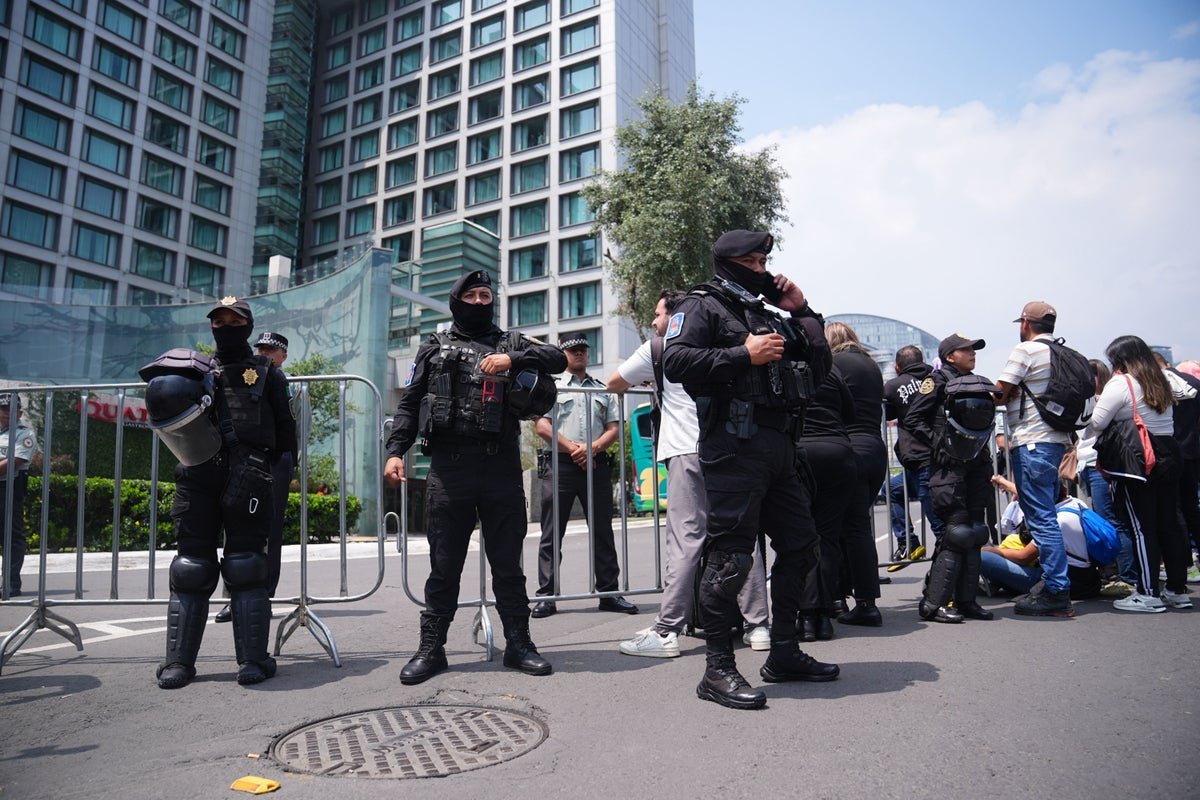
Security Operation Mexican authorities have announced that 17,000 police officers will be deployed on the streets of Mexico City on Sunday for Mexico's blockbuster World Cup 2026 clash against England. This substantial security presence reflects the scale of the occasion and the lessons drawn from recent events. Around 6,000 officers are expected on Paseo de la Reforma, Mexico
Security Operation
Mexican authorities have announced that 17,000 police officers will be deployed on the streets of Mexico City on Sunday for Mexico's blockbuster World Cup 2026 clash against England. This substantial security presence reflects the scale of the occasion and the lessons drawn from recent events. Around 6,000 officers are expected on Paseo de la Reforma, Mexico City's iconic 12km avenue through the centre of the city, ensuring that the main thoroughfare remains under close supervision throughout the day and evening. In addition, after Ecuador players were disturbed by noise at their team hotel last week, a total of 100 riot police are guarding England's team hotel over the next 24 hours to avoid similar disturbances.
The contrast with the Ecuador match is stark. That fixture was manned by around 15,000 officers, yet the number will increase by 2,000 on Sunday. Organisers are clearly determined to prevent any repetition of the disorder that followed the round-of-32 victory. The deployment covers not only the stadium perimeter but also key transport hubs and residential areas where supporters are likely to gather. Riot police units stationed at the England hotel represent a targeted measure designed to maintain calm around the visiting squad, allowing players to focus without external interruption.
Authorities have coordinated closely with Fifa to balance public order with the smooth running of the match itself. The increased numbers on Paseo de la Reforma are intended to manage both pre-match processions and any post-match celebrations that may spill onto the streets. With such a large force in place, officials hope to create a secure environment that reassures both local residents and international visitors. The operation underscores the seriousness with which Mexican security services are treating this fixture, recognising its significance for the co-host nation and the potential for large-scale public gatherings.
Mexican authorities have deployed 17,000 officers across Mexico City for the World Cup clash. (The Independent)
Tragic Deaths
Four people tragically died in a crush during post-game celebrations on Tuesday after Mexico's round of 32 win against Ecuador. The incident has cast a long shadow over preparations for the England match and forced organisers to reconsider every aspect of crowd management. Around 1.5 million people lined the streets on Tuesday, and that figure could top 2 million on Sunday if Mexico are victorious. Such numbers bring both excitement and risk, and the memory of Tuesday's fatalities remains fresh in the minds of those responsible for public safety.
Organisers have responded by significantly expanding the police presence and refining their plans for containing large crowds along major routes. The focus is on preventing any repetition of the crush that claimed lives after the Ecuador fixture. Additional barriers, designated viewing areas and clearer evacuation routes are all under discussion, though the precise measures remain fluid. The increase from 15,000 to 17,000 officers reflects a direct response to the scale of expected celebrations and the need to avoid dangerous overcrowding in confined spaces.
While the sporting achievement of reaching the last 16 has lifted national spirits, the human cost of Tuesday's events cannot be overlooked. Families and communities continue to mourn, and authorities have expressed their determination that sporting joy should never again come at such a price. The planning for Sunday therefore carries an added moral weight, with every deployment decision weighed against the imperative to protect life. Organisers are acutely aware that the eyes of the world will be watching how Mexico manages both its footballing ambitions and its duty of care to supporters.
Fifa's Decision
While extreme weather and thunderstorms were a consideration in moving the kick-off time forward by six hours, it is understood that concerns from local authorities surrounding celebrations after an evening kick-off, compared to a midday kick-off, was also a factor in talks. However, as it stands, Fifa have confirmed the match at the Azteca Stadium will take place at 6pm as originally planned, despite an estimated 80% chance of thunderstorms on Sunday afternoon. Under tournament safety rules, any lightning strikes detected within eight miles of the stadium result in an automatic 30-minute delay to play, something that affected France's group-stage clash with Iraq.
Fifa regulations for the tournament state it has the right to "cancel, reschedule or relocate" matches "at its sole discretion". This clause gives the governing body considerable latitude, yet it has chosen to maintain the original schedule. The decision has left some observers questioning whether sufficient weight was given to meteorological forecasts or to the practical challenges of managing vast crowds after dark. The precedent of the France-Iraq match demonstrates that lightning protocols are already in force, but their application on Sunday remains to be seen.
The retention of the 6pm kick-off also reflects Fifa's broader responsibility to balance commercial interests, broadcasting schedules and the wishes of participating nations. Local organisers had advocated an earlier start partly to reduce the risks associated with night-time celebrations, yet Fifa has ultimately prioritised continuity. This stance places additional pressure on stadium safety teams and municipal authorities, who must now prepare for the possibility of weather-related interruptions alongside the already formidable task of crowd control. The governing body's final word on the matter has been accepted, but the underlying tensions remain evident.
Aguirre's Anger
Mexico boss Javier Aguirre was furious at the proposed change and lashed out at Fifa for their lack of consultation in an interview. Aguirre spoke to Spanish-Mexican journalist Joaquin Lopez Doriga on Radio Formula, saying: "It's like a kick in the gut, it changes everything, the plan. It's not that it's completely ruined, but almost, because you have to swallow six hours of scheduled training. Obviously, we will abide by what Fifa says. I don't like it at all, nor do my players. Of course, the food, the nap, the sleep, the physiotherapy, everything, everything, it seems trivial, but it isn't. I can understand reasons and arguments but they didn't consult me and yes, I'm quite angry."
He continued: "This is all designed so, since that day in Ecuador we talked, we knew the schedule, we knew the venue, we didn't know the opponent, that's true, but in the end, yes, they screw me over a little. We have no choice but to abide by what Fifa says." The coach's remarks reveal deep frustration at the disruption to carefully calibrated preparations. Training times, meal schedules and recovery routines form the backbone of any elite team's routine, and an abrupt alteration threatens to unsettle players at a critical moment.
Aguirre's public expression of anger also highlights the wider issue of communication between Fifa and national associations. While the governing body retains ultimate authority, the perception that coaches and players are merely informed rather than consulted can breed resentment. The Mexico manager has made clear that he will comply, yet his words underscore the human element behind tournament logistics. Players must now adjust their physical and mental preparation at short notice, adding another layer of complexity to an already high-stakes encounter. The episode serves as a reminder that even the most meticulously planned events can be unsettled by last-minute interventions from above.
England supporters face a 1am kick-off, with pubs allowed to stay open until 5am. (The Independent)
UK Angle
An earlier start would have suited fans at home in England, with 7pm being much more palatable than a 1am kick-off. Outgoing prime minister Sir Keir Starmer has relaxed licensing laws to allow pubs in the UK to stay open until 5am. There is also an ongoing debate over whether children should be allowed to start school later on Monday morning in order to watch the match. The timing therefore carries domestic implications that extend far beyond the pitch, touching on public health, education policy and the management of large-scale social gatherings across British cities and towns.
The decision to maintain the 6pm local time kick-off means English supporters will face a late night, yet the licensing extension offers a partial remedy. Pubs and bars can now accommodate fans without the pressure of an abrupt closing time, potentially reducing street congestion and disorder. At the same time, the measure raises questions about alcohol consumption and its effects on Monday's workforce and school population. Policymakers must weigh the cultural significance of the occasion against longer-term social consequences.
Westminster has so far avoided prescribing a uniform approach to school start times, leaving individual headteachers and local authorities to decide. This decentralised response reflects the varied circumstances of different regions, yet it also creates inconsistency that some parents find frustrating. The match has therefore become a talking point in households and staff rooms alike, illustrating how international sporting events can intersect with everyday British life in unexpected ways. The government's licensing move demonstrates a willingness to accommodate public enthusiasm, but the broader debate over Monday morning routines continues to evolve.
Co-Host Pressure
Arguably the biggest game in the history of Mexican football, the co-hosts are aiming to reach the quarter-finals of the World Cup for just the third time. The game is set to kick-off at 6pm local time as originally planned. Mexico's quarter-final history at the Azteca Stadium adds further weight to the occasion, with the venue carrying deep emotional resonance for supporters. Reaching this stage on home soil represents a rare opportunity to advance deeper into the tournament than has been achieved in recent decades.
The pressure on the Mexican team is therefore immense. Players and staff are acutely aware that a victory would write a new chapter in national sporting lore, yet the burden of expectation can weigh heavily. The presence of 17,000 officers on the streets further emphasises the national significance attached to the result. Every aspect of the build-up, from training schedules to security arrangements, has been shaped by the desire to create optimal conditions for success.
At the same time, the tragic events following the Ecuador match have tempered celebrations and reminded everyone involved that sporting triumph must be pursued responsibly. The co-hosts face the dual challenge of delivering a memorable performance while ensuring that public safety remains paramount. The Azteca Stadium will host what many regard as the most consequential fixture in modern Mexican football history, and the outcome will resonate far beyond the final whistle. The nation waits with a mixture of hope and caution.
Analysis & Outlook
Balancing public safety with sporting spectacle remains the central dilemma facing organisers as Sunday approaches. The deployment of 17,000 officers, the protection afforded to the England team hotel and the retention of the 6pm kick-off all reflect competing priorities that must be reconciled in real time. The memory of four deaths after the Ecuador match serves as a sombre reminder that large-scale celebrations carry inherent risks, particularly when emotions run high and crowds swell beyond two million people.
Fifa's decision to maintain the original schedule, despite an 80% thunderstorm probability and the availability of lightning-delay protocols, places additional responsibility on local authorities. The governing body's sole discretion clause has been exercised, yet the practical consequences will be felt most acutely in Mexico City. Meanwhile, the UK government's licensing extension and the debate over school timings illustrate how the match's timing ripples across continents, affecting everyday routines far from the Azteca Stadium.
Looking ahead, the implications for remaining tournament matches are significant. Organisers will study Sunday's operation closely, seeking lessons that can be applied to future fixtures. The tension between maximising attendance and minimising risk will persist, requiring constant adaptation. For Mexico, the stakes could scarcely be higher; for England, the challenge is to navigate an unfamiliar environment with professionalism. Ultimately, the evening will test not only the players but also the institutions charged with safeguarding the spectacle itself. The outcome, whatever it may be, will shape perceptions of how major sporting events can be staged responsibly in an era of heightened scrutiny.
By Erica Thornton, Staff WriterThis article was produced with AI-assisted research and editorial support. Reporting is based on sources cited in the article.
What's Your Reaction?
 Like
0
Like
0
 Dislike
0
Dislike
0
 Love
0
Love
0
 Funny
0
Funny
0
 Wow
0
Wow
0
 Sad
0
Sad
0
 Angry
0
Angry
0

US Politics and Policy Correspondent at Global1.News. Based in Washington DC, covering American politics, policy, elections, and the courts. Knows how the system works and tells you what it actually means.











Comments (0)