
Khamenei Funeral: Mojtaba Succession and Regional Fallout
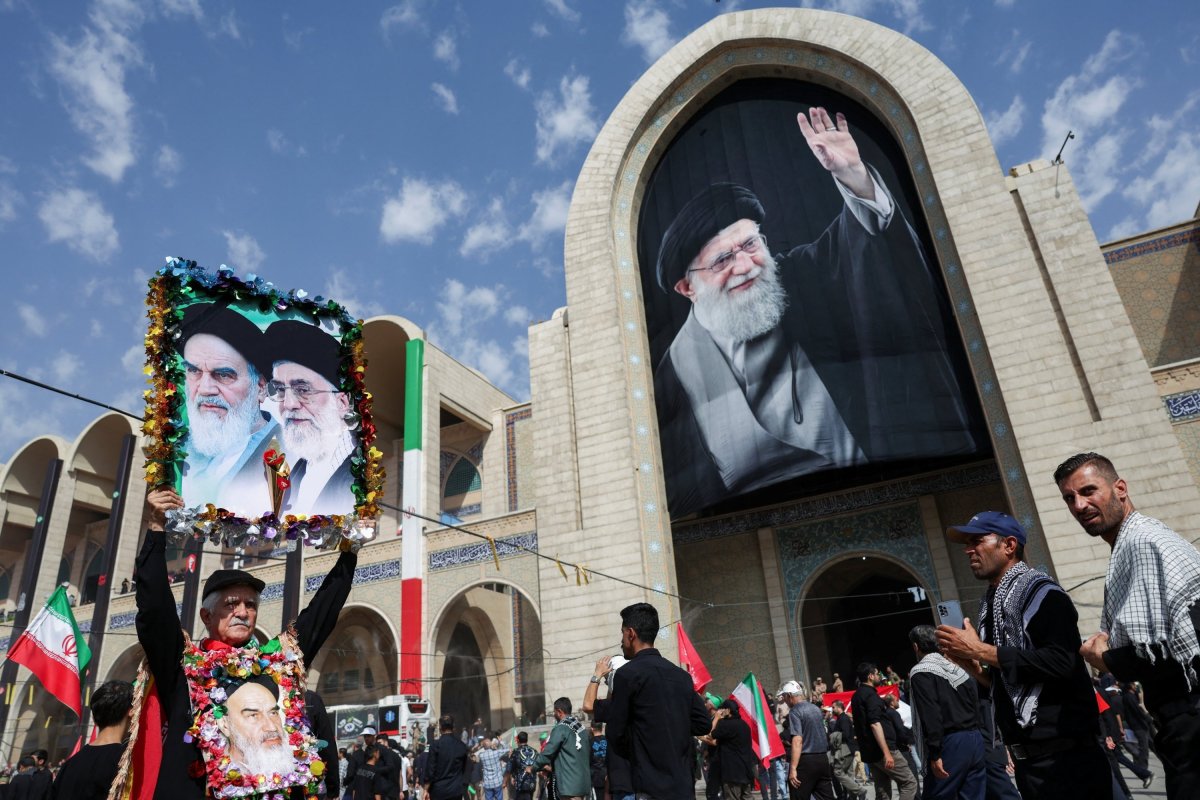
The Scale of Mourning in Tehran The July 4, 2026, gathering at Tehran's Grand Mosalla drew hundreds of thousands of mourners who filled the vast prayer grounds under tight security arrangements. The flag-draped coffin rested inside a glass case, topped by the black turban that signaled descent from the Prophet Muhammad. Chants of "Death to America!" and "Death to Israel!" echoe
The Scale of Mourning in Tehran
The July 4, 2026, gathering at Tehran's Grand Mosalla drew hundreds of thousands of mourners who filled the vast prayer grounds under tight security arrangements. The flag-draped coffin rested inside a glass case, topped by the black turban that signaled descent from the Prophet Muhammad. Chants of "Death to America!" and "Death to Israel!" echoed across the site, accompanied by a prominent banner reading "#KillTrump." Volunteers operated cooling sprays while security personnel maintained order along designated routes.
Compared with the chaotic 1989 funeral of Ayatollah Khomeini, when millions overwhelmed central Tehran, the current arrangements reflected greater institutional control. Barriers, medical stations, and staggered entry points prevented the trampling incidents that marked the earlier event. State media broadcast the proceedings live, emphasizing continuity of the revolutionary message even as the leadership transition unfolded.
The scale of attendance underscored the regime's remaining mobilizational capacity despite years of sanctions and internal protests. Regional observers noted that the organized nature of the event projected resilience to both domestic and international audiences. Shia communities in Iraq and Lebanon followed the proceedings closely, viewing the funeral as a moment that could either stabilize or fracture Iran's regional networks. The emotional intensity on display also served as a reminder that ideological slogans retain potency within core constituencies even after the February 28 airstrike that initiated the current conflict.
Khamenei's 36-Year Legacy
Ayatollah Ali Khamenei served 36 years as supreme leader from 1989 until his death in the February 28 airstrike. He had previously held the presidency during the Iran-Iraq War, gaining firsthand experience of the conflict's costs. Upon succeeding Ayatollah Khomeini, he consolidated the doctrine of velayat-e faqih, ensuring clerical oversight over elected institutions and the Islamic Revolutionary Guard Corps.
Under his tenure, Iran expanded its network of regional partners, including Hezbollah in Lebanon, Hamas in Gaza, Iraqi Shia militias, and the Houthis in Yemen. These relationships allowed Tehran to project influence without direct conventional confrontation. Successive rounds of sanctions tested the economy, yet the leadership maintained nuclear activities at varying levels of enrichment, navigating the 2015 nuclear deal and its subsequent collapse.
Khamenei never traveled abroad after assuming the supreme leadership, relying instead on trusted emissaries and institutional channels. This isolation reinforced a worldview centered on self-reliance and resistance to external pressure. His death marks the end of the only transition the Islamic Republic had known since 1979, leaving institutions to manage both the immediate security consequences of the airstrike and longer-term questions of authority. Sunni-Shia competition across the region intensified during his rule, shaping alignments that continue to influence Gulf diversification strategies and energy market calculations today.
The Succession Question: Mojtaba Khamenei Takes Power
Mojtaba Khamenei has assumed the role of supreme leader in the first hereditary-style transfer since the 1979 Revolution. Previously head of scholars affiliated with the Islamic Revolutionary Guard Corps, he had been positioned within establishment circles for years. Wounded in the same February 28 airstrike that killed his father and other family members, including his wife, he now leads an establishment facing simultaneous external pressure and internal factional competition.
Hardliners emphasize continuity in support for regional partners and resistance to Western demands, while pragmatists argue for limited economic openings to ease sanctions. Public discontent over living standards adds another layer of constraint. Mojtaba must balance these currents while overseeing negotiations with the United States aimed at a permanent end to the current conflict.
The transition occurs at a moment when Iran's economy remains constrained and its proxy networks face degradation from recent exchanges. Whether the new leader can maintain cohesion within the security apparatus and clerical establishment will determine the durability of policy choices in the coming months. Regional actors watch for signs of either ideological rigidity or tactical flexibility that could alter the balance of Sunni-Shia competition and the trajectory of Gulf energy strategies.
Gulf States: Watching and Waiting
Saudi Arabia, the United Arab Emirates, and Qatar have maintained public silence while conducting internal assessments of Iran's leadership change. Saudi Vision 2030 requires predictable oil revenues and regional stability to attract investment, making any escalation around the Strait of Hormuz a direct concern. The kingdom has expanded diplomatic and security ties with the United States and Israel in recent years, yet it also retains channels that could prove useful if tensions require de-escalation.
The UAE, having normalized relations with Israel through the Abraham Accords, continues to host significant Iranian commercial activity through Dubai ports. This dual posture allows Abu Dhabi to hedge between economic opportunity and security alignment. Qatar, which hosts a major United States military facility while maintaining dialogue with Tehran, occupies a distinct position that could facilitate indirect communication during the current negotiations.
Each state's calculus reflects different exposure to Iranian proxy activity and energy market volatility. Sunni-Shia competition remains a background factor, yet immediate priorities center on protecting diversification timelines and avoiding disruptions that would raise global oil prices. The funeral period and subsequent burial arrangements in Mashhad and other cities provide a temporary window during which Gulf capitals can refine their positioning ahead of any renewed Israeli action or shifts in the US-Iran talks.
Strait of Hormuz: The Energy Flashpoint
Iran's negotiator Kazem Gharibabadi warned France and the United Kingdom that security arrangements for the Strait of Hormuz rest with the coastal states. Approximately one-fifth of global oil supply transits the waterway daily, exposing Asian importers such as China, Japan, and South Korea to any interruption. Past Iranian threats to close the strait during the 1980s tanker wars and 2019 shipping incidents demonstrated both capability and willingness to use the chokepoint as leverage.
Current statements suggest Tehran may explore passage fees or regulatory measures rather than outright closure, seeking revenue while avoiding full escalation. OPEC+ dynamics would shift quickly if volumes were restricted, affecting Saudi and Emirati production strategies and global price benchmarks. Great power competition adds another dimension, as China maintains significant energy dependence on Gulf supplies and Russia seeks to deepen arms and oil ties with Iran.
The warning arrives amid ongoing US-Iran negotiations, where any perceived threat to Hormuz could strengthen arguments for continued sanctions or military presence. Coastal states' insistence on primary responsibility also reflects long-standing Iranian objections to external naval involvement. How these positions evolve will influence both immediate ceasefire prospects and longer-term energy market stability across Asia and Europe.
US-Iran Negotiations: A Fragile Window
President Trump stated in South Dakota that the United States had "knocked the hell out of Iran" and granted a week off for the funeral, framing the pause as evidence of Iranian desire to settle. Tehran seeks an end to active conflict and relief from sanctions that have constrained its economy. Washington, in turn, seeks verifiable limits on nuclear activities and reduced support for proxy networks.
The timing of the July 4 funeral, coinciding with the United States' 250th anniversary, adds symbolic weight but does not alter core bargaining positions. Internal Iranian politics, now under Mojtaba Khamenei's leadership, complicate rapid concessions. Hardline elements may view any agreement as capitulation, while pragmatists see sanctions relief as essential for regime stability.
The burial scheduled for July 10 at the Imam Reza shrine in Mashhad, following a tour of Iranian cities and Iraq, extends the period of national focus. This sequence creates a narrow window during which negotiators must determine whether mutual guarantees can be reached before external pressures, including potential Israeli strikes, resume. The outcome will shape not only bilateral relations but also the broader regional balance involving Gulf states and great power actors.
Israeli Security Calculus
Israel conducted the February 28 airstrike that killed Ayatollah Khamenei, viewing the action as an opportunity to degrade both the Islamic Revolutionary Guard Corps and Iran's nuclear infrastructure. Prime Minister Netanyahu has emphasized the need for permanent weakening of these capabilities. Iran's proxies, including Hezbollah and Hamas, have already conducted retaliatory operations, yet Israeli planners remain concerned about remaining long-range missile inventories and potential second-strike options.
The leadership transition to Mojtaba Khamenei introduces uncertainty regarding command continuity within the security establishment. Israel must assess whether the new supreme leader will authorize escalation or seek breathing room through negotiations. Abraham Accords partners such as the UAE and Bahrain share some of these concerns, though their public stance remains measured.
Any further Israeli action would occur against the backdrop of US-Iran talks and the Hormuz warning issued by Kazem Gharibabadi. The risk of wider regional spillover, including involvement of Iraqi and Yemeni partners, factors into calculations. Israeli strategy therefore balances immediate military advantage against the possibility that a fragile ceasefire could collapse into sustained multi-front conflict.
Regional Implications: What Comes Next
Mojtaba Khamenei faces the task of preserving ideological continuity while managing pragmatic diplomacy under external pressure. Russia and China have expanded arms, oil, and infrastructure cooperation with Iran in recent years, offering alternative partnerships that could offset Western sanctions. These ties intersect with great power competition across the Middle East and Central Asia.
Sunni-Shia competition continues to shape alignments from Lebanon to Yemen, influencing how Gulf states calibrate their responses to the leadership change. Energy markets remain sensitive to any signal that Hormuz access could be restricted, affecting both OPEC+ coordination and Asian import strategies. The Abraham Accords framework, while intact, faces renewed tests if proxy activity intensifies.
The coming months will reveal whether the new supreme leader can stabilize internal factions sufficiently to conclude negotiations with the United States or whether factional resistance and external strikes push the region toward renewed confrontation. Burial arrangements extending into Iraq and the July 10 ceremony in Mashhad keep national attention focused on continuity, yet underlying economic and security pressures persist. Observers across the region will monitor these developments for signs of durable de-escalation or further fragmentation. By Malik Hassan, Staff Writer
This article was produced with AI-assisted research and editorial support. Reporting is based on sources cited in the article.
What's Your Reaction?
 Like
0
Like
0
 Dislike
0
Dislike
0
 Love
0
Love
0
 Funny
0
Funny
0
 Wow
0
Wow
0
 Sad
0
Sad
0
 Angry
0
Angry
0
Middle East Correspondent at Global1.News. Based in Beirut, covering politics, conflict, energy, and society across the Middle East. Brings context and depth to a region often reduced to headlines.











Comments (0)