
Iran-US Peace Deal Reached, Pakistan PM Confirms Final Text
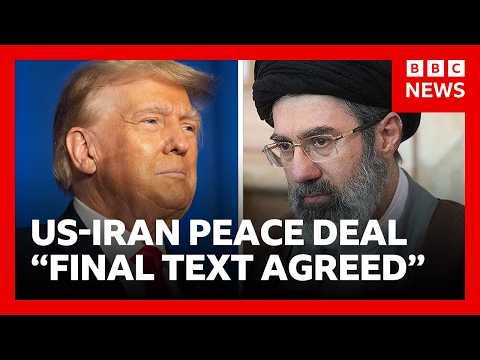
In a recent BBC News report, Pakistan's Prime Minister Shehbaz Sharif announced that a "final, agreed upon text" of a peace deal between the United States and Iran has been reached, marking a potential breakthrough in a conflict that has roiled the Middle East since late February. The development, confirmed in a social media post from Islamabad, comes after months of mediation
In a recent BBC News report, Pakistan's Prime Minister Shehbaz Sharif announced that a "final, agreed upon text" of a peace deal between the United States and Iran has been reached, marking a potential breakthrough in a conflict that has roiled the Middle East since late February. The development, confirmed in a social media post from Islamabad, comes after months of mediation efforts by Pakistan and Qatar, and follows President Donald Trump's claim that a "great settlement" was imminent.
Iran-US Peace Deal Reached, Pakistan PM Confirms Final Text
Islamabad – June 13, 2026 — The announcement by Prime Minister Shehbaz Sharif on Friday represents the most concrete signal yet that the US-Iran conflict, which began with coordinated American and Israeli strikes on Iranian territory on 28 February, may be approaching a diplomatic resolution. Pakistan, which has positioned itself as a key intermediary between Washington and Tehran, confirmed that it is now working with both sides to finalize the next steps before a formal signing.
The Collapse of Hostilities: From War to Negotiation
The conflict that erupted on 28 February reshaped the Middle East overnight. US and Israeli strikes across Iran triggered a swift and devastating Iranian response — ballistic missiles and drone swarms targeting Israel and American-allied Gulf states, while Iranian naval forces effectively sealed the Strait of Hormuz, a narrow chokepoint through which approximately one-fifth of the world's oil and liquefied natural gas transits daily. Global energy markets buckled. Oil prices surged. The United Nations convened emergency sessions.
A ceasefire was eventually brokered in early April, but it proved fragile. Both sides accused each other of violations, and intermittent exchanges of fire continued — including two distinct rounds of strikes this week alone, hours before Sharif's announcement. The pattern of escalation followed by eleventh-hour diplomacy had become familiar, with variations of the current agreement expected several times over the past two months only to collapse at advanced stages.
The difference this time, according to US administration officials speaking in a detailed briefing on Friday, is a greater level of optimism on both sides and an unprecedented openness about the substance of what has been negotiated. The framework — a Memorandum of Understanding encompassing 14 points — represents the most comprehensive attempt at a permanent cessation since the conflict began.
Key Terms: Strait of Hormuz, Nuclear Programme, and Economic Reintegration
According to detailed briefings from US officials and statements from Iranian Foreign Minister Seyed Abbas Araghchi, the MOU is structured around three interconnected pillars. The first, and most immediately consequential, is the reopening of the Strait of Hormuz. Iran has leveraged its geographical control over the waterway as its primary strategic bargaining chip throughout the conflict. Under the deal's terms, Iran would allow the resumption of normal maritime traffic through the Strait in exchange for the United States lifting its naval blockade of Iranian ports. US officials said both measures would take effect more or less immediately upon signing.
The second pillar addresses Iran's nuclear programme — the issue that Western capitals have long identified as the most dangerous dimension of the crisis. The MOU provides for a 60-day negotiation period focused exclusively on Iran's stockpile of enriched uranium. US officials stated that all enriched uranium material would be destroyed on site and subsequently removed from the country, though the precise mechanism for verification and removal is still being developed. "This is not an agreement based on trust or promises," one US official emphasised on Friday. "It is based on performance."
The economic dimension forms the third pillar, and it is here that the most careful calibration has been required. Contrary to earlier Iranian media reports suggesting that assets would be unfrozen upfront, US officials stressed that no money would be provided to Tehran before implementation begins. Instead, the agreement envisions a staged reintegration of Iran into the global economy — sanctions relief and the unfreezing of Iranian assets would occur incrementally, tied directly to verifiable compliance with each phase of the deal.
Pakistan's Diplomatic Pivot and Regional Reactions
Pakistan's emergence as a lead mediator in the US-Iran conflict has surprised few analysts who follow South Asian geopolitics. Islamabad maintains a historically complex relationship with Tehran — sharing a 900-kilometre border, managing significant trade ties, and navigating the presence of millions of Iranian pilgrims who visit Shia shrines in Pakistan each year. At the same time, Pakistan has cultivated strategic partnerships with Washington, particularly on security and counterterrorism cooperation.
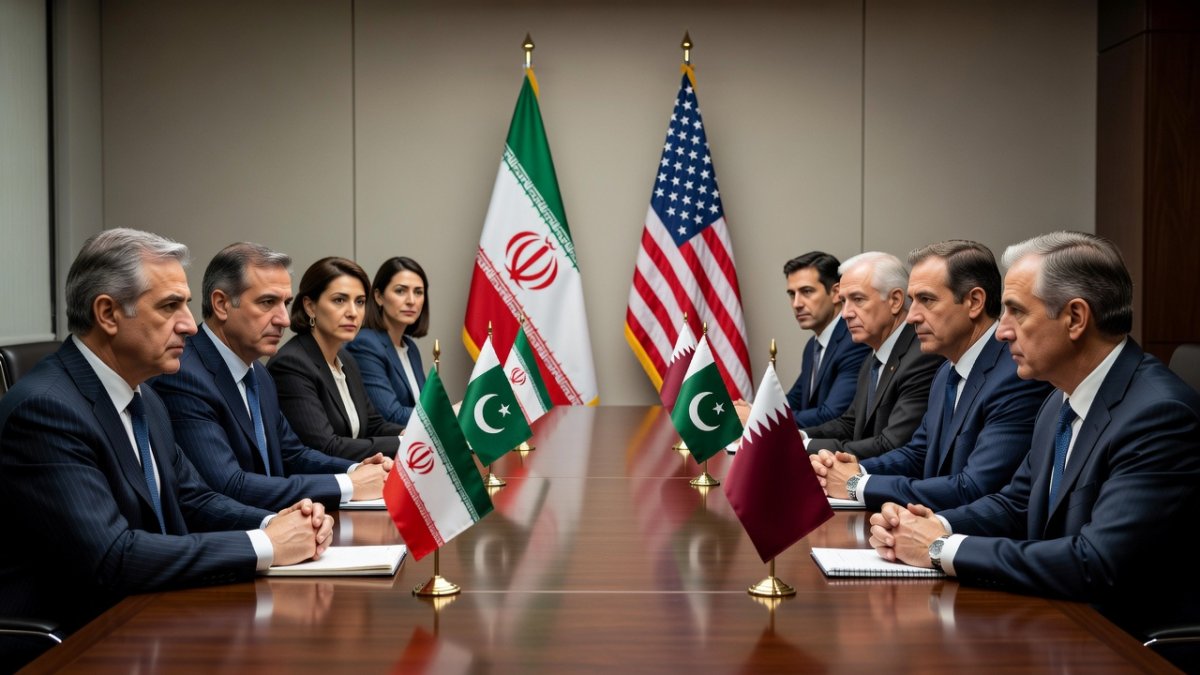
Prime Minister Sharif's announcement on Friday was unequivocal. "Setting aside the noise, we can confirm that a final, agreed upon text of the peace deal has been reached," he wrote. "Pakistan is now working closely with both sides to finalize the next steps." Qatar, which has also been deeply involved in the mediation efforts, echoed the cautious optimism emanating from both Washington and Tehran.
Significantly, Israel was not party to the negotiations. Israeli Prime Minister Benjamin Netanyahu spoke with Trump on Saturday, according to the US president's social media account, but Israeli officials have expressed deep reservations about any agreement that leaves Iran's nuclear infrastructure partially intact. The exclusion of Israel from the talks could become a source of tension as the MOU moves toward formal signing, particularly given the 60-day nuclear negotiation window that follows the initial ceasefire implementation.
Internal Iranian Politics: The Supreme National Security Council Debate
Within Iran, the path to agreement is far from smooth. Foreign Minister Araghchi acknowledged in an interview with state television that there are "supporters and opponents" of the current terms within Iran's Supreme National Security Council — the country's highest security decision-making body, which includes representatives from the military, the Islamic Revolutionary Guard Corps, the intelligence ministry, and senior clerical figures. No collective decision has yet been reached, Araghchi said, adding: "For now, we must wait. If approved, the agreement will be signed remotely."
The internal debate reflects deep divisions within Iran's political establishment. Hardliners within the IRGC have long argued that any agreement that requires Iran to dismantle or surrender elements of its nuclear infrastructure amounts to capitulation. Moderate factions, aligned with President Masoud Pezeshkian's administration, view the deal as a necessary pathway to sanctions relief and economic recovery. The Supreme Leader, Ayatollah Ali Khamenei, holds ultimate authority over any security agreement, and his position — which has oscillated between cautious engagement and outright rejection of US overtures — will determine the deal's fate.
From Moscow's perspective, the US-Iran negotiations present a complex calculus. Russia has maintained strategic partnerships with Iran, particularly in the energy and military domains, and has watched the US-Iran conflict with concern for its implications on global oil markets and regional stability. Any agreement that stabilises the Middle East and normalises Iranian oil exports could affect Russia's own energy leverage, particularly in European markets where Russian gas has been displaced since the Ukraine conflict.
Another point of tension between the parties involves Iran's network of proxy forces across the region. The MOU calls on Iran to cease funding and arming groups such as Hezbollah in Lebanon, Shia militias in Iraq, and Houthi rebels in Yemen. For Washington, this provision is non-negotiable — the proxy network has been a primary mechanism through which Iran projects power beyond its borders. For Tehran, however, these relationships represent decades of strategic investment and ideological commitment.
Analysis: The Fragile Path to a Signed Agreement
Even as optimism builds across diplomatic channels, seasoned observers of US-Iran relations are guarded. The history of American-Iranian negotiations is littered with near-misses — the 2015 Joint Comprehensive Plan of Action (JCPOA) being the rare exception that actually produced a signed agreement, only to be abandoned by the Trump administration in 2018. Since then, the mutual distrust has only deepened. Trump's characterisation of Iranian negotiators as "very dishonourable people to deal with," made on Friday in response to leaked deal details, underscores the personal animosity that permeates the process.
The 60-day nuclear negotiation window is perhaps the most precarious element of the framework. Destroying enriched uranium on site and removing it from the country — as US officials describe — would require unprecedented levels of on-the-ground verification. International Atomic Energy Agency inspectors would need unfettered access to Iranian nuclear facilities, a condition that has been a point of contention in past negotiations. The logistical challenges alone are formidable: Iran's enriched uranium stockpile is dispersed across multiple sites, including Natanz, Fordow, and Isfahan.
Economically, the staged sanctions relief model represents a compromise between Washington's insistence on verifiable compliance and Tehran's demand for immediate tangible benefits. But the mechanism for verification remains opaque. "Performance-based" relief sounds reasonable in principle, but in practice it requires both sides to agree on what constitutes compliance, who adjudicates disputes, and what happens if either party claims the other is not delivering.
If the deal is signed in the coming days — as Trump has suggested could happen "over the weekend or on Monday" — it would represent the most significant diplomatic achievement in the Middle East since the Abraham Accords. But signing is only the beginning. Implementation, verification, and the long-term sustainability of the agreement will determine whether this moment is remembered as a genuine breakthrough or another chapter in the long, troubled history of US-Iran relations.
The stakes could not be higher. For the millions of Iranians who have endured months of war, economic blockade, and uncertainty, a deal offers the prospect of a return to normality — reopening of trade routes, access to global markets, and an end to the airstrikes that have devastated parts of their country. For global energy markets, the reopening of the Strait of Hormuz would bring immediate relief to supply chains that have been stretched to breaking point. And for the broader Middle East, a US-Iran agreement could begin to unravel the proxy conflicts that have fuelled instability from Yemen to Lebanon.
But the distance between an agreed text and a lasting peace remains considerable. As Araghchi himself cautioned: "If approved, the agreement will be signed remotely." That single word — "if" — carries the weight of a region holding its breath.
By Irina Volkov, Staff Writer
This article was produced with AI-assisted research and editorial support. Reporting is based on sources cited in the article.
What's Your Reaction?
 Like
0
Like
0
 Dislike
0
Dislike
0
 Love
0
Love
0
 Funny
0
Funny
0
 Wow
0
Wow
0
 Sad
0
Sad
0
 Angry
0
Angry
0

Russia/Eastern Europe Correspondent at Global1.News. Covering Russian politics, energy, security, and the shifting dynamics of the post-Soviet space. Provides clear-eyed analysis on one of the world's most opaque regions.











Comments (0)