
China Coast Guard Jurisdiction Claims and Sino-Russian Drills in Japan’s EEZ: Strategic Implications for South Korea and Northeast Asia
Introduction: Escalating Maritime Friction in the Western Pacific Two incidents in the summer of 2026 have sharpened the contest over maritime rights in waters surrounding Japan’s southern islands and raised acute questions for South Korean security planners. On June 3, China Coast Guard vessels entered Japan’s exclusive economic zone south of Yonaguni Island and asserted that they were conducting a “routine patrol within China’s jurisdiction.” On July 20, a People’s Liberation Army Navy Luya...
Introduction: Escalating Maritime Friction in the Western Pacific
Two incidents in the summer of 2026 have sharpened the contest over maritime rights in waters surrounding Japan’s southern islands and raised acute questions for South Korean security planners. On June 3, China Coast Guard vessels entered Japan’s exclusive economic zone south of Yonaguni Island and asserted that they were conducting a “routine patrol within China’s jurisdiction.” On July 20, a People’s Liberation Army Navy Luyang III-class destroyer, operating with a Russian naval vessel, conducted a live-fire machine-gun drill inside Japan’s EEZ roughly 180 kilometers southwest of Okinotori Island. Taken together, these actions illustrate Beijing’s willingness to test the legal and operational boundaries of the United Nations Convention on the Law of the Sea while deepening military coordination with Moscow. For the Republic of Korea, which maintains overlapping EEZ claims with both China and Japan in the East China Sea and faces recurrent Chinese maritime pressure near Ieodo, the episodes are not distant curiosities. They form part of a broader pattern of Chinese maritime assertiveness that directly shapes Seoul’s alliance management, resource diplomacy, and regional risk calculus.
The June 3 China Coast Guard Jurisdiction Claim South of Yonaguni
According to Japanese government accounts, two China Coast Guard vessels entered Japan’s exclusive economic zone south of Yonaguni Island in Okinawa Prefecture on June 3, 2026, after sailing east of Taiwan. When hailed by the Japan Coast Guard via radio, the Chinese crew replied that they were on “routine patrol within China’s jurisdiction.” Japan’s Chief Cabinet Secretary Minoru Kihara stated that this was the first time Chinese Coast Guard vessels had advanced such a claim inside Japan’s EEZ. Tokyo formally rejected the assertion. The vessels had departed from Zhejiang province, passed east of Taiwan on June 1, entered the Japanese EEZ on June 3, and remained in surrounding waters through June 8.
The timing was not accidental. On May 28, 2026, Japan and the Philippines announced negotiations on maritime boundary delimitation. Beijing denounced that announcement as a violation of Chinese sovereignty. The China Coast Guard stated on June 1 that it had conducted patrols east of Taiwan in response. China also deployed the Xiushan vessel formation east of Taiwan from June 1, relieving the Daishan formation, underscoring a pattern of permanent Chinese Coast Guard rotation in those waters despite Japanese protests. The June episode therefore combined operational presence with an explicit jurisdictional claim, elevating the dispute from physical presence to a contest over legal title.
From a Korean vantage point, the language of “jurisdiction” is especially consequential. South Korea has long contended with Chinese fishing fleets and Coast Guard activity in contested East China Sea waters, including around Ieodo (Socotra Rock), where Seoul maintains an ocean research station and asserts EEZ rights that Beijing contests. A Chinese practice of treating foreign EEZs as zones of Chinese “jurisdiction” for patrol purposes would erode the distinction between resource rights and sovereign control that underpins the Korean position as well as Japan’s.
The July 20 China-Russia Live-Fire Drill Near Okinotori
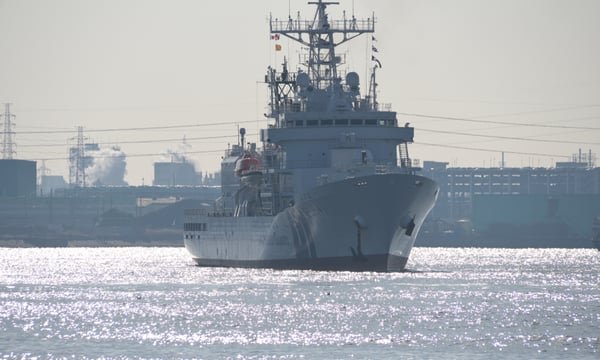
On July 20, 2026, a Chinese PLA Navy Luyang III-class missile destroyer conducted a live-fire machine-gun drill within Japan’s EEZ approximately 180 kilometers southwest of Okinotori Island, Japan’s southernmost territory. A Russian naval vessel participated alongside. Japan’s Defense Minister Shinjiro Koizumi publicly announced the incident—the first time Tokyo had disclosed Chinese live-fire drills inside its EEZ. Chief Cabinet Secretary Minoru Kihara characterized the exercise as “part of a move by the two militaries toward strengthening their cooperation.” A fleet comprising three Chinese ships and a Russian frigate had been sighted 330 kilometers southwest of the island at 2:00 a.m. on July 20. Japan informed Beijing that the drill “could have endangered the navigation of nearby ships” and lodged formal protests with both the Chinese and Russian embassies.
Okinotori’s status remains disputed under UNCLOS Article 121. China regards it as a rock incapable of generating an exclusive economic zone, whereas Japan treats it as an island entitled to a full EEZ. By conducting live-fire activity in waters Japan claims as EEZ, Beijing simultaneously challenged Japan’s maritime entitlement and demonstrated operational coordination with Russia far from the traditional Sino-Russian theater of the Sea of Japan or the Northwest Pacific. The participation of a Russian frigate signals that China-Russia military coordination, which has deepened substantially since 2022, now extends to joint signaling inside contested Japanese maritime zones.
For South Korea, the joint character of the drill carries particular weight. Seoul already monitors expanding China-Russia air and naval activity near the Korean Peninsula and in the East Sea. Joint Sino-Russian operations inside a Japanese EEZ normalize a pattern of combined presence that could, over time, appear in waters closer to Korean interests, complicating both crisis management and the trilateral security coordination among Seoul, Tokyo, and Washington.
The UNCLOS Legal Framework and Competing Interpretations
Exclusive economic zones under the United Nations Convention on the Law of the Sea grant coastal states sovereign rights over living and non-living resources—fishing, mineral extraction, and energy development—but do not confer full sovereignty. Other states retain high-seas freedoms of navigation and overflight. The legal dispute turns on whether military activities, including live-fire exercises and coast-guard “patrols” asserting jurisdiction, fall within those residual freedoms or require coastal-state consent.
Analysis distinguishing Chinese Marine Scientific Research from coast-guard patrols is instructive. Marine Scientific Research conducted in a foreign EEZ without the coastal state’s consent violates UNCLOS and constitutes a breach of international law. Coast-guard “patrols,” by contrast, occupy a more ambiguous legal space because they can be framed as exercises of navigational freedom. Japan’s position is that military exercises, especially those involving weapons discharge, require coastal-state permission because they can endanger navigation and interfere with the coastal state’s resource rights and regulatory authority. China and Russia maintain that military activities may be conducted without consent in foreign EEZs.
Live-fire drills escalate beyond simple transit or surveillance. The discharge of weapons introduces concrete safety risks to commercial shipping and fishing vessels and signals an intent to treat the area as a zone of operational control rather than mere passage. The Okinotori dispute further complicates the picture: if China successfully advances the claim that Okinotori is a mere rock under Article 121, the surrounding waters would not constitute a Japanese EEZ at all, removing even the resource-rights layer of Japanese authority. Japan rejects that interpretation and continues to treat the area as EEZ.
South Korea has a direct stake in the integrity of the EEZ regime. Korean EEZ claims in the East China Sea overlap with both Chinese and Japanese claims. Any erosion of the principle that coastal states control economic activity and can regulate hazardous military exercises inside their EEZs weakens Seoul’s legal hand in future delimitation talks and in day-to-day enforcement against illegal fishing and unwanted survey activity.
Japan’s Response Options and Diplomatic Constraints
Tokyo faces a familiar menu of responses, each carrying costs. Diplomatic protest has already been employed: formal démarches to the Chinese and Russian embassies and public statements by the Defense Minister and Chief Cabinet Secretary. Legal options include documenting the incidents for potential submission to international dispute-settlement mechanisms, though China’s rejection of compulsory third-party adjudication on many maritime matters limits the practical utility of that path. Operational responses could include increased Japan Coast Guard and Maritime Self-Defense Force presence, more frequent shadowing of Chinese and Russian vessels, and tighter real-time information-sharing with the United States and partners.
Political context constrains Japanese choices. Prime Minister Sanae Takaichi’s comments on Taiwan in November 2025 already angered Beijing; further escalation risks additional economic and military pressure. At the same time, inaction would invite further Chinese Coast Guard rotations and additional joint drills. Japan must therefore calibrate visibility and firmness without crossing thresholds that trigger disproportionate Chinese retaliation. Coordination with the Philippines, whose boundary negotiations with Japan helped precipitate the June patrols, offers one avenue for collective diplomatic pushback, yet Manila’s own exposure to Chinese pressure in the South China Sea limits how far that coordination can go in the near term.
South Korea watches these Japanese choices closely. A more forward-leaning Japanese posture could create space for tighter Korea-Japan maritime information-sharing; an overly cautious Japanese posture could leave Seoul more exposed to Chinese salami-slicing tactics in the East China Sea. Either outcome affects the density of trilateral security cooperation that Washington has sought to institutionalize.
China’s Broader Maritime Strategy and the Taiwan Linkage
The June and July incidents fit a coherent Chinese maritime strategy that links the East China Sea, the waters east of Taiwan, and the South China Sea into a single operational continuum. Permanent China Coast Guard rotation east of Taiwan, the explicit jurisdictional claim south of Yonaguni, and the live-fire drill near Okinotori collectively demonstrate an intent to normalize Chinese presence and to erode the practical meaning of foreign EEZ rights along the first island chain. The May 28 Japan-Philippines delimitation announcement was treated in Beijing as a sovereignty challenge warranting an immediate Coast Guard response, revealing how sensitively China reacts to any strengthening of maritime legal coordination among its neighbors.
Deepening China-Russia military coordination since 2022 supplies Beijing with an additional partner willing to operate inside contested Japanese zones, diluting the political cost that China alone would bear and complicating Japanese and American responses. The use of a Luyang III-class destroyer for a live-fire drill, rather than a purely coast-guard asset, further blurs the line between law-enforcement presence and naval power projection—a hallmark of Chinese gray-zone practice.
For South Korea, the strategic implication is clear. Chinese maritime assertiveness is not confined to the South China Sea or the Taiwan Strait; it is advancing along the entire Chinese periphery, including the East China Sea where Korean resource and security interests are directly engaged. A Chinese ability to conduct joint live-fire activity with Russia inside a Japanese EEZ without decisive international pushback lowers the expected cost of similar activity near Korean-claimed waters.
Implications for South Korea’s EEZ Interests and Alliance Management
South Korea’s overlapping EEZ claims with China and Japan in the East China Sea, centered in part on the Ieodo/Socotra Rock area, place Seoul in a structurally similar position to Tokyo. Korean authorities have repeatedly confronted Chinese fishing fleets and Chinese Coast Guard vessels operating in waters Seoul regards as its EEZ. The Chinese assertion of “jurisdiction” south of Yonaguni supplies a doctrinal precedent that could be invoked, mutatis mutandis, against Korean enforcement actions. Likewise, the legal argument that military exercises require no coastal-state consent would, if accepted, constrain Korea’s ability to regulate hazardous activity near its offshore infrastructure and research assets.
Seoul’s strategic calculus is further complicated by the need to balance the U.S. alliance—under which support for Japan’s maritime rights is a natural corollary of trilateral security cooperation—with deep economic interdependence with China. Excessive alignment with a hard Japanese line risks Chinese economic retaliation; excessive equidistance risks weakening the very alliance structures that deter coercion on the Korean Peninsula. The June and July incidents therefore force Korean policymakers to refine dual-track diplomacy: quiet but firm defense of EEZ rights and UNCLOS principles, paired with calibrated participation in Japan-U.S.-Korea information-sharing and maritime domain awareness initiatives.
Institutionally, the Korea Coast Guard and the Ministry of Oceans and Fisheries, together with the Ministry of Foreign Affairs and the Ministry of National Defense, will need to treat Chinese jurisdictional language and Sino-Russian joint drills as indicators for Korean contingency planning. Enhanced monitoring of Chinese Coast Guard deployments east of Taiwan and in the East China Sea, closer real-time data exchange with Japanese counterparts where politically feasible, and consistent public articulation of UNCLOS-based positions can help Seoul avoid strategic surprise.
Northeast Asian Security Dynamics and the Trilateral Dimension
The incidents of June and July 2026 occur against a backdrop of fragile Korea-Japan relations, persistent China-Russia alignment, and U.S. efforts to solidify trilateral deterrence. Every Chinese challenge to Japanese EEZ rights tests the cohesion of that trilateral framework. If Tokyo perceives insufficient solidarity from Seoul, the political basis for intelligence-sharing and coordinated responses to regional contingencies—including Taiwan-related scenarios—narrows. Conversely, visible Korean support for the principle that live-fire drills and jurisdictional claims inside foreign EEZs are unacceptable strengthens the normative foundation on which Korea itself relies.
Historically, Northeast Asian maritime order has rested on a combination of U.S. forward presence, bilateral alliances, and a shared, if imperfect, commitment to UNCLOS rules. Chinese practice in 2026 seeks to replace that order with a hierarchy in which Chinese “jurisdiction” and Sino-Russian operational freedom take precedence over coastal-state resource rights. South Korea cannot remain agnostic about that substitution. The credibility of Korean claims at Ieodo, the safety of Korean sea lines of communication, and the freedom of Korean naval and coast-guard operations all depend on the same legal architecture Japan is now defending.
Policy implications follow. First, Seoul should continue to insist, in multilateral and bilateral settings, that EEZ resource rights and navigational safety impose real limits on foreign military exercises. Second, Korea should expand technical cooperation on maritime domain awareness with Japan and the United States while managing the political optics through careful public messaging. Third, Korean diplomacy should link East China Sea stability to the broader agenda of crisis prevention, making clear that unchecked gray-zone escalation near Yonaguni and Okinotori raises risks for the entire region, including the Korean Peninsula.
Conclusion: A Test of Rules and Resolve
The China Coast Guard’s June 3 assertion of “jurisdiction” inside Japan’s EEZ south of Yonaguni and the July 20 PLA Navy-Russian live-fire drill near Okinotori constitute deliberate probes of legal and operational red lines. They exploit ambiguities in UNCLOS regarding military activities, leverage the disputed status of Okinotori under Article 121, and capitalize on deepening China-Russia military coordination. Japan’s responses—protests, public disclosure, and diplomatic démarches—have registered objection without yet altering Chinese behavior. China’s broader maritime strategy continues to integrate pressure east of Taiwan with challenges in the East China Sea, treating neighborly legal coordination, such as the Japan-Philippines delimitation talks, as provocation.
For South Korea, these developments are proximate, not peripheral. Overlapping EEZ claims, recurrent Chinese maritime incursions, and the imperative to balance alliance commitments against economic ties with China all ensure that the erosion of EEZ norms will be felt in Korean waters and Korean politics. The task for Seoul is to defend the legal principles that protect its own maritime rights, to contribute to trilateral resilience without unnecessary provocation, and to treat Chinese jurisdictional language and joint Sino-Russian drills as early indicators of a more contested Northeast Asian maritime order. How Japan, Korea, and their partners respond in the coming months will help determine whether UNCLOS remains a meaningful constraint or becomes a hollow text in the face of sustained gray-zone pressure.
By Prof. David Park, Staff WriterThis article was produced with AI-assisted research and editorial support. Reporting is based on sources cited in the article.
What's Your Reaction?
 Like
0
Like
0
 Dislike
0
Dislike
0
 Love
0
Love
0
 Funny
0
Funny
0
 Wow
0
Wow
0
 Sad
0
Sad
0
 Angry
0
Angry
0

East Asia/Technology Correspondent at Global1.News. Seoul-based voice covering Korean politics, technology, business, and culture. Analyzes how technology and geopolitics intersect across East Asia.















Comments (0)