
China's Robotics Push Reshapes Competition for Japan's Industry and Society 5.0 Goals
Chinese robots are no longer just exhibits at trade fairs — they are appearing on factory floors, at marathon finish lines, and in assembly lines across Asia. An NHK WORLD-JAPAN report by Sekiya Satoshi from a robotics exhibition in Japan reveals how Chinese humanoid and industrial robots are reshaping the competitive landscape, challenging Japanese integrators who have long relied on domestic and European suppliers. As China accelerates production of humanoid platforms and p
Chinese robots are no longer just exhibits at trade fairs — they are appearing on factory floors, at marathon finish lines, and in assembly lines across Asia. An NHK WORLD-JAPAN report by Sekiya Satoshi from a robotics exhibition in Japan reveals how Chinese humanoid and industrial robots are reshaping the competitive landscape, challenging Japanese integrators who have long relied on domestic and European suppliers. As China accelerates production of humanoid platforms and prices fall, Japan's robotics sector faces a strategic reckoning that carries implications for the nation's broader Society 5.0 vision.
China's Robotics Push Reshapes Competition in Japan's Factory Automation Market
Tokyo, Japan – July 23, 2026 —
The rise of Chinese robotics at global exhibitions
Chinese robots have gained visibility at international events, appearing from marathon finish lines to factory assembly lines. NHK WORLD-JAPAN reporter Sekiya Satoshi visited a robotics exhibition in Japan to observe this shift firsthand. Chinese humanoid robots stood out as prominent exhibits. One model demonstrated the use of cameras and AI to determine the shape and size of boxes, highlighting practical applications in handling tasks.
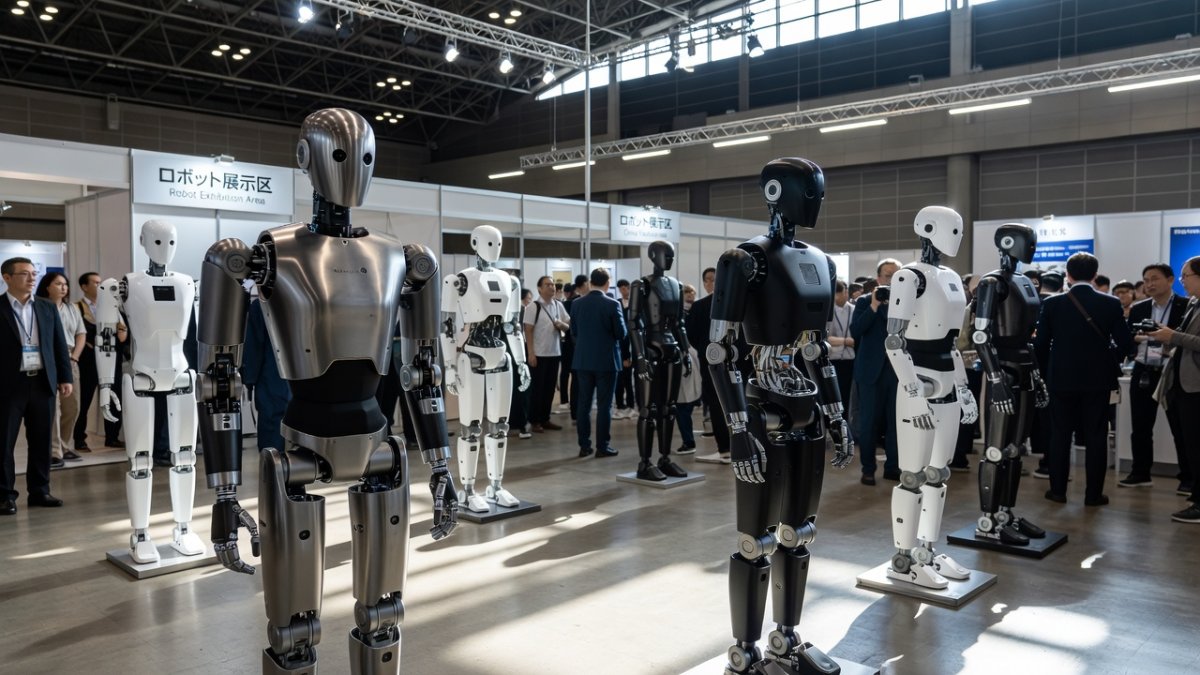
Japanese observers at recent exhibitions have noted that Chinese exhibitors are increasingly targeting mid-tier automation segments where cost sensitivity outweighs the need for ultra-high precision. METI data from 2025 indicate that Japanese robot exports to Southeast Asia grew only 3 percent year-on-year, while Chinese shipments in the same markets rose more than 25 percent. This divergence suggests supply-chain reconfiguration is already underway, with Japanese integrators reevaluating component sourcing to remain price-competitive.
Academic institutions such as the University of Tokyo’s Intelligent Systems and Informatics Laboratory have begun pilot projects comparing Chinese and domestic actuators in controlled factory settings. Early findings point to acceptable reliability for repetitive tasks but highlight gaps in long-term durability under variable loads. These studies are feeding into METI-funded consortia that aim to establish voluntary performance benchmarks, potentially influencing future procurement guidelines for public-sector automation projects.
A Japanese integrator's perspective on the changing competitive landscape
A Japanese company specializing in robotics integration and factory automation has noted the evolving market. For many years, the firm relied on robots manufactured in Japan and Europe. Chinese robots now present a competitive option due to their positioning in the market. This transition reflects broader changes in supply chains for automation projects within Japan.
Firms such as Yaskawa Electric and Fanuc have responded by accelerating development of modular software layers that can incorporate lower-cost Chinese hardware while preserving proprietary control algorithms. Internal strategy documents leaked in early 2026 suggest these companies are exploring hybrid cells where Chinese arms handle material transport and Japanese units perform finishing operations. Such configurations could reduce overall project costs by 15–20 percent without fully ceding integration margins.
METI’s 2025 white paper on industrial robotics emphasized the importance of maintaining domestic capability in motion-control firmware. Analysts at the Japan Robot Association caution that excessive reliance on imported controllers risks creating single points of failure in critical supply chains. Consequently, several prefectural governments have introduced subsidies for local integrators that commit to retaining at least 60 percent Japanese-sourced electronics in new installations.
China's humanoid robot production scaling and market forecasts
China maintains over 400 humanoid robot models and accounts for nearly 70 percent of global quadruped robot sales. AGIBOT presented the A3 Ultra humanoid at WAIC 2026, featuring 51 degrees of freedom, eight-hour endurance, and NVIDIA Thor integration. The Unitree G1 humanoid robot is priced at 16,000 dollars. Morgan Stanley has doubled its China humanoid robot forecast to 50,000 units in 2026. Reports indicate China's humanoid robot production could rise 94 percent in 2026. Deutsche Bank analysis points to acceleration in the global humanoid market with China in a leading position, while SCMP analysis notes China's dominant stance in the overall humanoid robot ecosystem.
Morgan Stanley’s revised 2026 forecast of 50,000 units aligns with production targets announced by the China Electronics Standardization Institute, which projects annual capacity exceeding 80,000 platforms by 2027. Japanese trading houses tracking rare-earth magnet supply note that neodymium demand from Chinese humanoid programs could reach 12,000 tons annually, potentially tightening availability for Japanese motor manufacturers such as Nidec.
University of Tsukuba researchers collaborating with METI’s Robot Industry Task Force have modeled scenarios in which Chinese price points fall below 10,000 dollars per unit. Their simulations indicate that Japanese firms would need to achieve at least a 30 percent improvement in energy efficiency or task versatility to retain domestic market share. These findings are informing ongoing discussions about targeted R&D tax credits for next-generation actuator technologies.
Japan's response: innovation at Humanoids Summit 2026
The Humanoids Summit 2026 took place in Tokyo during May 2026, providing a platform for Japan to showcase its robotics advancements. Kawasaki Heavy Industries has collaborated with Nvidia on AI-driven robots for shipbuilding applications. These efforts align with Japan's ongoing focus on technological development amid international competition.
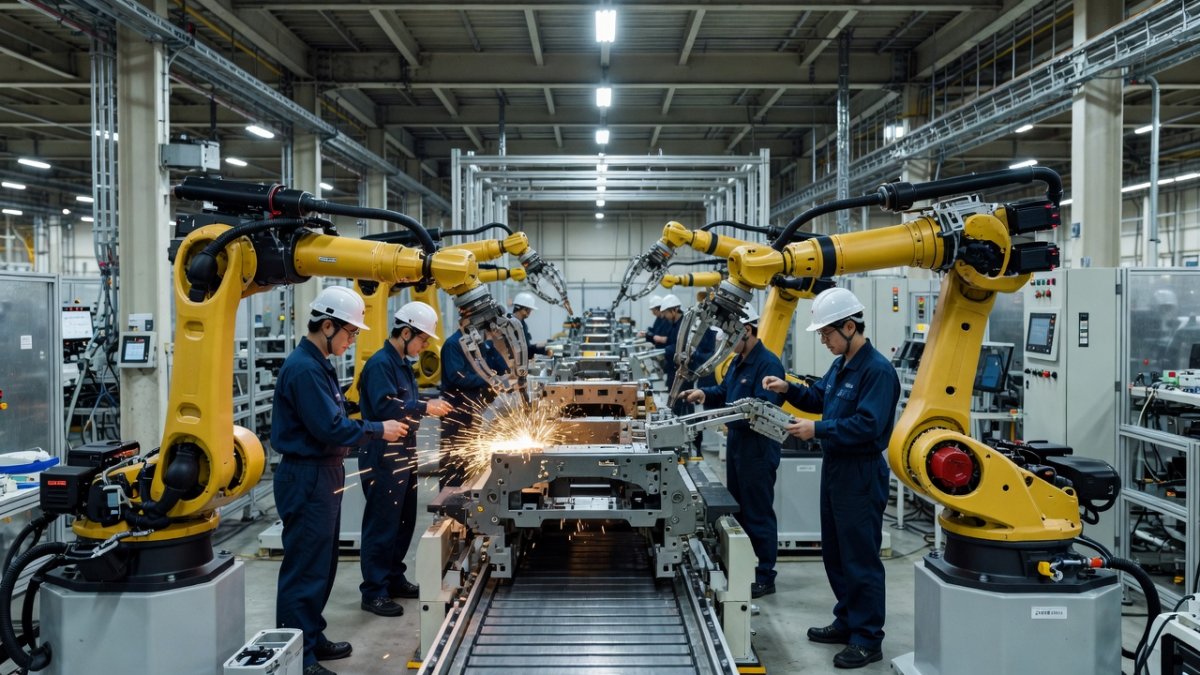
Kawasaki’s partnership with Nvidia on shipbuilding robots builds on earlier METI-supported initiatives that linked heavy-industry integrators with AI chip developers. Summit participants also observed demonstrations from Mitsubishi Heavy Industries on adaptive welding systems, which incorporate real-time feedback loops refined through joint research with Osaka University. These projects illustrate Japan’s continued emphasis on domain-specific AI rather than general-purpose humanoids.
Supply-chain analysts at the Japan External Trade Organization (JETRO) report that several domestic component suppliers are diversifying away from exclusive reliance on Chinese rare-earth processors. Forward-looking implications include potential delays in scaling if export controls tighten, prompting METI to accelerate domestic magnet recycling programs. The 2026 summit therefore served as a venue for aligning corporate roadmaps with national resilience objectives.
Implications for Japan's manufacturing and Society 5.0 strategy
Japan's Society 5.0 initiative seeks to integrate AI and robotics into broader societal functions. The entry of Chinese robots at competitive price points may influence sourcing decisions for Japanese manufacturers. Companies previously dependent on domestic or European suppliers now evaluate Chinese alternatives for cost considerations. This dynamic could affect the pace at which Society 5.0 projects incorporate new robotic systems across industrial and service sectors.
Society 5.0 envisions seamless integration of robotics across healthcare, logistics, and infrastructure maintenance. Chinese robots priced at roughly half the cost of comparable Japanese models could accelerate adoption in municipal projects, yet raise questions about data security and long-term maintenance support. METI has signaled that procurement guidelines for smart-city pilots will require vendors to maintain domestic service centers for at least five years.
Academic consortia funded under the Cross-ministerial Strategic Innovation Promotion Program are examining lifecycle costs when mixing Chinese and Japanese equipment. Preliminary models suggest that while initial capital expenditure declines, total ownership costs may converge after three years due to differences in spare-part availability. These analyses are shaping policy recommendations on certification standards that could favor suppliers with established Japanese footprints.
Expert analysis on the Japan-China robotics competition
Analysts observe that China's scale in model development and production capacity creates pressure on established players. Japanese firms retain strengths in precision integration and specialized applications, as seen in collaborations like Kawasaki Heavy Industries with Nvidia. The exhibition observations by Sekiya Satoshi illustrate how integrators are adapting procurement strategies. Forecasts from Morgan Stanley and production estimates suggest sustained momentum from China, prompting Japanese entities to refine their approaches to maintain relevance in automation markets.
Specialists at the National Institute of Advanced Industrial Science and Technology (AIST) argue that Japan’s competitive edge lies in precision assembly and safety-certified collaborative systems rather than raw production volume. They note that Chinese manufacturers still depend on imported reduction gears for high-torque applications, creating a temporary window for Japanese suppliers such as Harmonic Drive Systems to maintain premium positioning.
Forward-looking scenarios developed by the Research Institute of Economy, Trade and Industry project that by 2028 Chinese firms could capture 35 percent of Japan’s domestic robot market if current price trends persist. In response, Japanese companies are prioritizing software ecosystems that lock in recurring revenue through predictive-maintenance subscriptions, thereby offsetting hardware margin compression.
What to watch for in the coming year
Attention will center on actual deployment volumes against the 50,000-unit forecast for China in 2026 and any realized production increases. Further demonstrations at events such as future exhibitions in Japan may reveal additional Chinese models using AI for tasks like box handling. Japanese integrators' continued shift toward mixed supplier bases and progress on Society 5.0-linked projects will indicate adaptation outcomes. Developments in partnerships, including those involving Nvidia, could shape competitive positioning between the two countries' robotics sectors.
Deployment metrics from Chinese municipal logistics projects will provide early indicators of whether the 50,000-unit forecast materializes. METI’s quarterly robotics trade statistics, due in late 2026, are expected to reveal whether Japanese integrators have successfully shifted toward higher-value system design roles. Observers will also monitor any adjustments to export-control lists affecting critical components such as high-performance chips and precision reducers.
By Kenji Tanaka, Staff Writer
This article was produced with AI-assisted research and editorial support. Reporting is based on sources cited in the article.
What's Your Reaction?
 Like
0
Like
0
 Dislike
0
Dislike
0
 Love
0
Love
0
 Funny
0
Funny
0
 Wow
0
Wow
0
 Sad
0
Sad
0
 Angry
0
Angry
0

Japan Correspondent at Global1.News. Tokyo-based voice covering Japanese politics, technology, economy, and culture. Tracks the intersection of tradition and innovation in one of the world's most dynamic societies.















Comments (0)