
Gaza Winter Rains Kill Woman as War-Damaged Buildings Collapse in Sheikh Radwan
Winter rains have turned Gaza's bombed-out buildings into lethal traps, claiming the life of one woman in Sheikh Radwan as her home collapsed under the weight of seasonal storms. With nearly 80 percent of structures damaged or destroyed and reconstruction materials blocked at the border, families have nowhere safe to shelter.
Winter rains have turned Gaza's bombed-out buildings into lethal traps, claiming the life of one woman in Sheikh Radwan as her home collapsed under the weight of seasonal storms. With nearly 80 percent of structures damaged or destroyed and reconstruction materials blocked at the border, families have nowhere safe to shelter. This latest tragedy exposes how military devastation and winter weather combine to create an unrelenting cycle of death and displacement.
Gaza Winter Rains Kill Amid Shattered Infrastructure
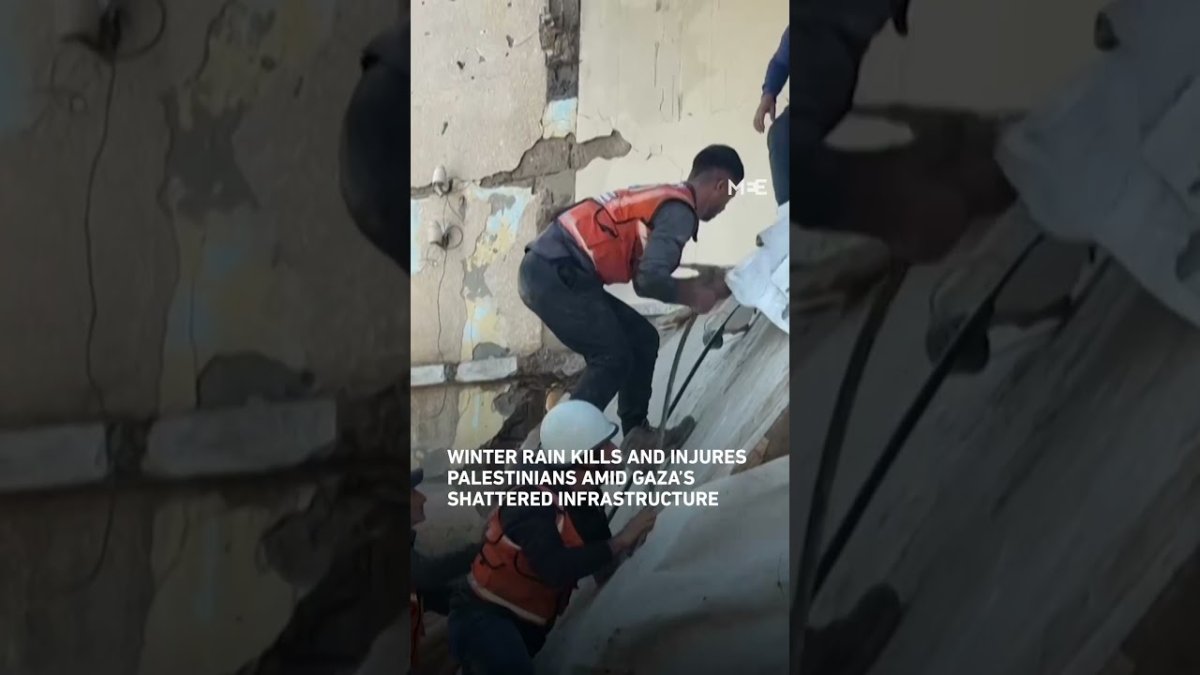
Gaza City, Palestine — Gaza's Civil Defence confirmed that a residential building in the Sheikh Radwan neighborhood of Gaza City partially collapsed under heavy rainfall. The structure had already been compromised by earlier Israeli bombing, leaving it unable to withstand the winter storms. Civil Defence spokesman Mahmoud Bassal stated that the incident resulted in one death and multiple injuries among residents who had no alternative shelter.
Authorities had issued repeated warnings against sleeping in damaged buildings, yet many families remained inside because displacement camps offered no immediate protection from the elements. The collapse highlights how prior military damage combines with seasonal weather to create lethal conditions. Rescue teams worked through the night to recover those trapped under debris.
Shattered Infrastructure
UN satellite data indicates that nearly 80 percent of buildings across Gaza have been destroyed or damaged. More than 400,000 homes were leveled during the preceding period of hostilities, leaving vast residential areas uninhabitable. These figures reflect systematic targeting of civilian infrastructure that has left entire neighborhoods without basic structural integrity.
In Sheikh Radwan and surrounding districts of Gaza City, the cumulative effect means that even moderate rainfall now triggers collapses. Reconstruction materials remain blocked at entry points, preventing any meaningful repair work. Families continue to navigate streets lined with rubble where water pools and foundations shift.
The UN satellite data revealing that nearly 80 percent of Gaza's buildings stand destroyed or severely damaged tells only part of the story; beneath the numbers lies the brutal engineering reality of structures hollowed out by repeated airstrikes, their load-bearing walls fractured and foundations undermined. When winter rains arrive, water seeps into these compromised skeletons, turning modest precipitation into catastrophic failure as weakened concrete gives way without warning. In Sheikh Radwan, families who once called these buildings home now watch them dissolve into rubble, each collapse a direct consequence of munitions designed to maximize structural devastation rather than spare civilian dwellings.
Israel's blockade compounds this engineered vulnerability by barring entry of cement, rebar, and essential reconstruction materials, leaving residents with no means to reinforce what remains. Civil Defence teams have issued repeated, urgent warnings against occupying damaged sites, yet families stay because the alternative—open-air displacement camps—offers even less protection from the elements. This forced choice exposes a calculated policy of deprivation that transforms seasonal weather into a weapon, where the absence of repair supplies ensures that every storm claims new victims among those already stripped of safety.
A Winter of Displacement
Approximately 250,000 families remain in displacement camps exposed to wind, rain, and flooding. Winter storms have already claimed over 30 Palestinian lives through building collapses, cold exposure, and related incidents. Daily survival involves seeking dry patches of ground and sharing limited blankets among multiple households.
Children under five face elevated risks of respiratory illnesses and hypothermia in these conditions. With no winter supplies entering through official crossings, camp residents rely on makeshift coverings that fail against sustained storms. The absence of alternative housing forces continued occupation of damaged sites despite official advisories.
Across Gaza, approximately 250,000 families huddle in flimsy tents that shred under sustained winds and flood with every downpour, their lives reduced to a daily scramble for dry patches of ground amid overflowing sewage and mud. Many of these households have endured multiple displacements, fleeing one bombed neighborhood only to be uprooted again when temporary shelters prove untenable, carrying little more than memories of lost homes and the clothes on their backs. Children under five shiver through nights without blankets or fuel for heating, their small bodies battling hypothermia while respiratory infections spread rapidly through overcrowded, unventilated spaces lacking any waterproof covering.
Even after the declared ceasefire, Israeli authorities continue blocking shipments of tents, winter clothing, and basic supplies, ensuring that these camps remain sites of prolonged exposure rather than refuge. Parents describe wrapping infants in whatever scraps of fabric they can find, sharing single blankets among entire families while watching helplessly as coughs deepen into life-threatening conditions. This deliberate obstruction of humanitarian goods turns winter into an extension of conflict, where the most vulnerable pay the price for policies that prioritize control over survival.
Ceasefire in Name Only
Since the ceasefire took effect in October 2025, Israel has committed over 3,689 violations according to monitoring records. Gaza's Health Ministry reports that at least 1,127 Palestinians have been killed by Israeli forces during this period. The cumulative death toll since October 2023 exceeds 73,000 killed and 171,000 wounded.
These ongoing incidents occur alongside restrictions that prevent delivery of tents, winter clothing, and building supplies. The pattern demonstrates that the truce has not translated into restored security or access for civilians. Local authorities document each violation while attempting to maintain basic services under continued pressure.
The October 2025 ceasefire was meant to halt hostilities and permit the unimpeded flow of aid, yet monitoring groups record over 3,689 violations since then, including drone strikes, artillery shelling, and targeted killings that have claimed at least 1,127 Palestinian lives and wounded thousands more. These incidents reveal a pattern of daily aggression that mocks the truce's intent, with forces continuing operations under the guise of enforcement while civilians bear the brunt. The gap between promised security and lived reality underscores how agreements without enforcement mechanisms become tools for maintaining pressure rather than restoring peace.
International bodies have issued condemnations and pursued proceedings at the ICJ, yet the absence of binding enforcement leaves Gaza's population exposed to ongoing violations amid restricted access to winter essentials. Local documentation efforts persist despite the risks, cataloging each breach to preserve evidence of a truce that functions more as a label than a lived protection. This disconnect between rhetoric and enforcement highlights the human cost when powerful actors face no consequences for undermining agreements designed to safeguard the vulnerable.
A Public Health Emergency
The World Health Organization has warned of a public health catastrophe as winter conditions compound the collapse of Gaza's health system. The UN and ICRC have described overall conditions as catastrophic and called for immediate aid access. Overcrowded camps accelerate the spread of preventable diseases among vulnerable populations.
Medical facilities already operating at reduced capacity struggle with influxes of patients suffering from exposure-related ailments. Vaccination programs and sanitation measures face disruption from damaged infrastructure and supply shortages. The combination of cold weather and limited medical resources creates compounding risks that extend beyond immediate storm events.
Analysis and Implications
The building collapse in Sheikh Radwan illustrates how destruction from earlier military operations persists as a daily threat long after active fighting subsides. Blocked reconstruction materials ensure that damaged structures remain hazards rather than being restored. This situation connects directly to broader restrictions that limit movement of essential goods into Gaza.
Local economies centered on small-scale trade and family support networks face additional strain when displacement camps become permanent fixtures. Historical patterns of restricted access following periods of intense conflict suggest that without policy shifts, winter mortality will continue. Palestinian communities have adapted through mutual aid, yet these efforts cannot substitute for large-scale material inflows.
International calls for aid corridors have not produced measurable changes in entry volumes of winter supplies. The result is a protracted emergency where seasonal weather interacts with existing damage to produce predictable casualties. Continued documentation by Civil Defence and health authorities provides the factual basis for understanding the scale of need.
Future months will test whether entry restrictions ease or remain in place. The lived experience in Gaza City neighborhoods such as Sheikh Radwan shows that policy decisions on access directly determine survival rates during winter. Sustained attention to these conditions remains essential for any assessment of regional stability.
In the coming months, Gaza's residents face a grim prospect of compounded suffering if entry restrictions persist, with projections indicating rising mortality from exposure, disease, and structural failures as another winter deepens the siege's grip. The international community's statements of concern ring hollow against the measurable inaction on aid corridors, revealing a troubling gap between diplomatic language and tangible intervention that allows predictable deaths to unfold. Palestinian families continue demonstrating remarkable resilience through mutual support networks, yet these efforts cannot offset the systemic denial of materials needed for basic survival.
This protracted emergency serves as a stark test of international law and the credibility of ceasefire frameworks, where the failure to enforce access or halt violations erodes any claim to protecting civilian life. Without decisive shifts in policy, the cycle of destruction followed by seasonal lethality will repeat, underscoring how restrictions on reconstruction and supplies function as ongoing collective punishment. Sustained global attention and accountability remain essential if the principles meant to govern conflict are to hold meaning for those enduring these conditions on the ground.
By Fatima Al-Rashid, Staff Writer
This article was produced with AI-assisted research and editorial support. Reporting is based on sources cited in the article.
What's Your Reaction?
 Like
0
Like
0
 Dislike
0
Dislike
0
 Love
0
Love
0
 Funny
0
Funny
0
 Wow
0
Wow
0
 Sad
0
Sad
0
 Angry
0
Angry
0
Gulf/MENA Correspondent at Global1.News. Based in Doha, covering Gulf politics, energy markets, diplomacy, and development across the Middle East and North Africa. Tracks the economic transformation of the Gulf states.











Comments (0)