
China and North Korea Deepen High-Level Ties as Beijing Seeks to Counter Moscow’s Growing Pull
In mid-July 2026, China and North Korea staged a carefully choreographed set of high-level exchanges that underscored Beijing’s determination to preserve its traditional primacy on the Korean Peninsula even as Pyongyang’s strategic partnership with Moscow continues to expand.
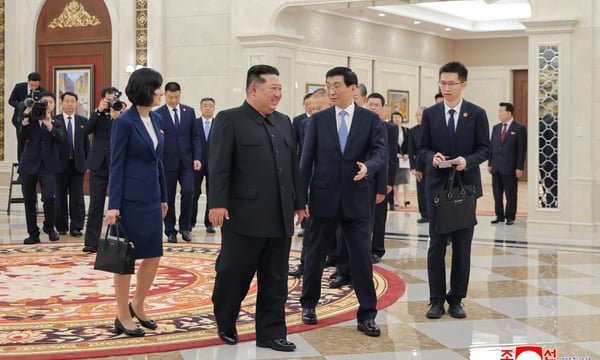
In mid-July 2026, China and North Korea staged a carefully choreographed set of high-level exchanges that underscored Beijing’s determination to preserve its traditional primacy on the Korean Peninsula even as Pyongyang’s strategic partnership with Moscow continues to expand. The centerpiece was the three-day visit to Pyongyang by Wang Huning, a member of the Chinese Communist Party Politburo Standing Committee and chairman of the Chinese People’s Political Consultative Conference, who held talks with North Korean leader Kim Jong Un. The meetings, timed to the 65th anniversary of the Sino–North Korean Treaty of Friendship, Cooperation and Mutual Assistance, form part of a broader diplomatic sequence that began with Chinese President Xi Jinping’s June 2026 visit to North Korea—his first in seven years.
These exchanges are not merely ceremonial. They reflect a calculated effort by Beijing to reassert political and strategic influence at a moment when North Korea has drawn markedly closer to Russia through a strategic defence agreement and the deployment of thousands of North Korean troops in support of Russia’s war in Ukraine. For Seoul, Tokyo, and Washington, the pattern raises enduring questions about the balance of power in Northeast Asia and the narrowing space for inter-Korean diplomacy.
Wang Huning’s Mission to Pyongyang
Wang Huning arrived in Pyongyang on July 15, 2026, leading a senior Chinese delegation. As China’s fourth-highest-ranked official and a principal ideologue within the party hierarchy, his selection signaled the political weight Beijing attached to the visit. On July 17, Kim Jong Un received Wang for formal talks. According to reporting from Al Jazeera and UPI, the two sides affirmed their intention to implement the agreements reached during Xi Jinping’s June summit with Kim. Wang conveyed “best wishes and comradely greetings” from Xi, while Kim asked that his own greetings be returned to the Chinese leader.
Before meeting Kim, Wang held discussions with Jo Yong Won, a top official of the Workers’ Party of Korea. In those talks, Wang stated that it was the “will of the Chinese party and government” to carry out the understandings reached between Xi and Kim. Jo, for his part, indicated that North Korea sought to develop both strategic communication and practical cooperation, including in areas related to public welfare, business, and culture. The Chinese delegation also paid respects at the memorial for Chinese volunteers killed in the Korean War, visited a Workers’ Party cadre training school, and went to the Kumsusan Palace of the Sun, reinforcing the historical and ideological framing of the relationship.
The 65th Anniversary of the Bilateral Friendship Treaty
The timing of Wang’s visit was deliberate. July 2026 marks the 65th anniversary of the Treaty of Friendship, Cooperation and Mutual Assistance, signed in 1961. That treaty contains a mutual defense clause obligating each party to come to the other’s aid in the event of armed attack—an arrangement that has long given the relationship a formal security dimension distinct from China’s partnerships with most other states. Kim Jong Un, in his remarks, described the treaty as having “played an important role in defending the basic interests of the two countries and ensuring regional and global peace and security.” He added that the two countries would continue to develop traditional friendly relations “on the basis of the spirit of the treaty and in line with the requirement of the changing times.”
Chosun Ilbo reported that Kim further emphasized that the treaty “defines the strategic nature of bilateral relations and presents a strategic direction.” Wang, speaking at a reception, recalled that the two countries “shared life and death and formed great militant friendship at the cost of blood in the struggle for achieving national independence,” and insisted that “the firm stand of the Chinese party and government placing great importance on China-DPRK friendship will remain unchanged.” South Korea’s Unification Ministry noted that a North Korean government delegation had been sent to Beijing for treaty anniversary events for the first time in seven years; Premier Pak Thae Song met Xi Jinping and other senior Chinese leaders on that occasion, creating a reciprocal flow of high-level traffic.
Xi Jinping’s June Visit and the “Far-Reaching Blueprint”
Wang’s July mission cannot be understood apart from Xi Jinping’s June 2026 visit to North Korea, the first by a Chinese president in seven years. During that summit, Xi and Kim adopted what official accounts described as a “far-reaching blueprint” for building the “most powerful and strategic relations.” Xi pressed for closer cooperation in diplomatic, law-enforcement, and military domains. Kim responded that it remained a “steadfast policy” of North Korea to develop traditional friendly and cooperative relations with China. Wang’s subsequent statements in Pyongyang—that China was ready to “comprehensively implement all the important common understanding and agreements” from the June meeting—were designed to demonstrate continuity and follow-through.
From an analytical standpoint, the June–July sequence represents an attempt to institutionalize a higher tempo of party-to-party and state-to-state contact after a prolonged period in which Beijing’s visibility in Pyongyang had been comparatively limited. The emphasis on implementing a joint “blueprint” suggests that both sides see value in translating summit atmospherics into more regularized mechanisms of coordination, even if the precise operational content of those mechanisms has not been fully detailed in open sources.
Beijing’s Concern: North Korea’s Deepening Alignment with Russia
The strategic backdrop is unambiguous. North Korea has, over the past several years, moved into a markedly closer relationship with Russia. The two countries have concluded a strategic defence agreement, and thousands of North Korean troops have been deployed in connection with Russia’s war in Ukraine. Moscow has become an increasingly important supplier of fuel, food, hard currency, and advanced technology to Pyongyang. Analysts have observed that this support has made North Korea less immediately responsive to Chinese preferences than in earlier periods when Beijing was the overwhelmingly dominant external partner.
China remains North Korea’s largest economic partner, and that structural fact continues to give Beijing leverage. Yet the political and military intimacy now visible in the Russia–North Korea relationship has created a competitive dynamic. Yang Moo-jin of the University of North Korean Studies in Seoul captured the logic succinctly: “North Korea wants to secure China’s vast economic and geopolitical backing, while China seeks to maintain its influence on the Korean Peninsula and avoid losing the initiative in Northeast Asian affairs.” Wang Huning’s public reaffirmation that “China’s firm support for the cause of Korean socialism… will never be changed” was, in this light, both a reassurance to Pyongyang and a signal to external audiences that Beijing does not intend to cede its role.
Implications for Northeast Asian Geopolitics
For the wider region, the intensification of China–North Korea high-level contact carries several implications. First, it complicates efforts by the United States, South Korea, and Japan to isolate or pressure Pyongyang through sanctions and diplomatic ostracism. A North Korea that can draw material support from both Russia and China possesses greater capacity to withstand external economic coercion. Second, the mutual defense language of the 1961 treaty, even if it has never been invoked in a contemporary contingency, remains a formal element of the security architecture that regional planners must take into account.
Third, the triangulation among Beijing, Pyongyang, and Moscow reduces the room for any single external actor to dictate terms on denuclearization or arms control. North Korea’s confrontational posture toward the United States, Japan, and South Korea has, according to assessments such as those published by 38 North, been maintained even as it deepens ties with both major partners. The result is a more rigid strategic environment in which crisis-management channels are thinner and the risks of miscalculation correspondingly higher.
Inter-Korean Relations and South Korea’s Position
From Seoul’s perspective, the July exchanges reinforce a sobering reality: inter-Korean relations remain subordinated to the larger great-power geometry surrounding the peninsula. When North Korea’s leadership is preoccupied with managing simultaneous partnerships with China and Russia, and when those partnerships are framed in the language of strategic and even military solidarity, the incentives for meaningful engagement with South Korea diminish. The Unification Ministry’s tracking of the reciprocal anniversary delegations illustrates that South Korean authorities are watching the diplomacy closely, yet they possess limited direct instruments to shape it.
Historically, periods of tight China–North Korea coordination have often coincided with reduced space for inter-Korean initiatives, particularly when Pyongyang feels externally secure. The current moment differs from earlier cycles in one important respect: Russia’s role as a second major patron introduces an additional variable. South Korean policymakers must therefore assess not only Beijing’s preferences but also the extent to which Moscow’s interests may diverge from China’s on questions such as regional stability, sanctions enforcement, and the management of military escalation.
Economic Interdependence and the Limits of Influence
Despite the political drama of summitry and treaty anniversaries, the economic foundation of the China–North Korea relationship remains the most durable source of Chinese influence. China absorbs the bulk of North Korea’s legitimate trade and provides critical inputs for the North Korean economy. That structural dependence is unlikely to be displaced quickly by Russian support, which, while significant in fuel, food, and certain technology categories, does not yet replicate the breadth of Chinese commercial and logistical connectivity.
For South Korean industry and policymakers, this economic reality cuts two ways. On one hand, Chinese leverage could, in principle, be exercised to restrain North Korean behavior. On the other, Beijing has repeatedly shown that it will not use economic tools in ways that risk state collapse or uncontrolled instability on its border. The July meetings’ references to expanding cooperation in business and public welfare suggest that both sides are prepared to explore additional economic engagement, even if detailed project lists have not been made public. Any such expansion would further entrench the existing asymmetry and complicate future sanctions coalitions.
Strategic Outlook
The July 2026 exchanges between China and North Korea should be read as a deliberate effort by Beijing to keep pace with, and where possible to shape, Pyongyang’s foreign-policy diversification. Wang Huning’s meetings with Kim Jong Un and Jo Yong Won, the invocation of the 65th anniversary of the friendship treaty, and the explicit commitment to implement the June Xi–Kim blueprint all serve that purpose. North Korea, for its part, appears content to extract political recognition and material benefit from both China and Russia while maintaining a hard line toward the United States and its regional allies.
For Northeast Asia, the near-term outlook is one of hardened alignments and reduced diplomatic flexibility. Inter-Korean relations are unlikely to improve in isolation from these larger currents. Scholars and policymakers in Seoul, Washington, and Tokyo will need to track not only the frequency of China–North Korea contacts but also the concrete substance of military, law-enforcement, and economic cooperation that emerges from the “blueprint” now being implemented. The coming months will test whether Beijing can translate high-level symbolism into sustained influence—or whether Pyongyang’s dual-track engagement with China and Russia will continue to erode any single partner’s ability to set the agenda on the Korean Peninsula.
By Prof. David Park, Staff WriterThis article was produced with AI-assisted research and editorial support. Reporting is based on sources cited in the article.
What's Your Reaction?
 Like
0
Like
0
 Dislike
0
Dislike
0
 Love
0
Love
0
 Funny
0
Funny
0
 Wow
0
Wow
0
 Sad
0
Sad
0
 Angry
0
Angry
0
East Asia/Technology Correspondent at Global1.News. Seoul-based voice covering Korean politics, technology, business, and culture. Analyzes how technology and geopolitics intersect across East Asia.













Comments (0)