
Drone Hits Belarus Children's Bus in Bryansk: What We Know
Folks, a drone strike slammed into a double-decker bus packed with Belarusian kids on the A240 highway in Russia's Bryansk region yesterday, killing one woman and injuring eight others including five children. This was no random hit. The bus carried a youth football team from Gomel heading to the Black Sea resort of Gelendzhik, 44 passengers total with 28 of them children from
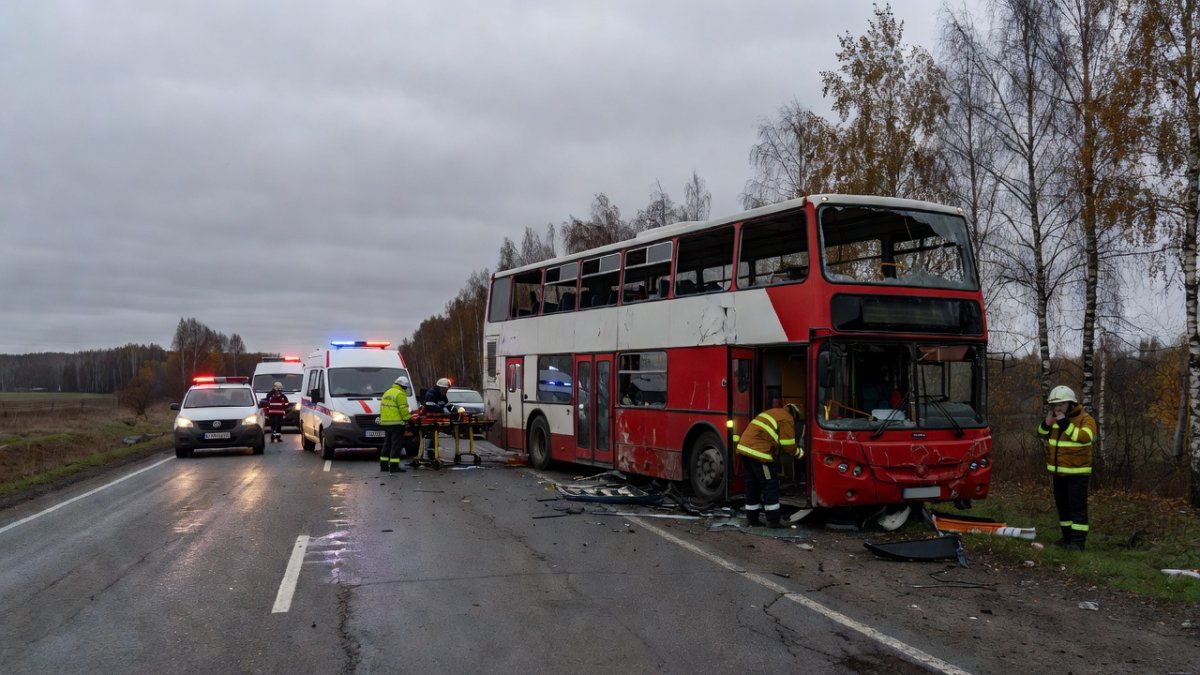
Folks, a drone strike slammed into a double-decker bus packed with Belarusian kids on the A240 highway in Russia's Bryansk region yesterday, killing one woman and injuring eight others including five children. This was no random hit. The bus carried a youth football team from Gomel heading to the Black Sea resort of Gelendzhik, 44 passengers total with 28 of them children from the local sports school. One adult chaperone died on the spot. The attack has already sparked competing narratives from Moscow, Kyiv, and Minsk, each side spinning the facts to suit their war aims while the children pay the price.
The Attack
Picture this scene on Wednesday along that quiet stretch of the A240 near the Belarus border. The double-decker bus rolled along carrying 28 young footballers and their minders toward a summer training camp in Gelendzhik. Then the drone hit. Russia's Investigative Committee immediately opened a criminal terrorism case, treating the strike as a deliberate act against civilians. One woman, the team chaperone, was killed outright. Eight people were injured, five of them children. The numbers are stark and they have not changed across any official statement: 44 passengers, 28 kids, one dead, eight hurt. This was a youth sports trip turned battlefield in an instant.
The details keep repeating because they matter. The bus was clearly marked as civilian transport. The kids came from Gomel, Belarus, not some military convoy. They were traveling through Russia's Bryansk region on their way to the Black Sea. Yet the drone found them anyway. Emergency crews worked the wreckage for hours. Hospitals in the area took in the injured. The pattern is familiar by now in this grinding conflict, but the targeting of children on a school trip crosses a line that even hardened observers are calling out.
Russia's Claim
Moscow wasted no time pinning the blame on Ukraine. The Investigative Committee labeled it terrorism and pointed to Kyiv's pattern of long-range drone strikes inside Russia. Officials noted the bus was traveling on Russian soil, in Bryansk region, when the attack occurred yesterday. They highlighted the 28 children on board and the single death of the adult chaperone as proof of deliberate targeting. Russian state media ran the casualty figures repeatedly: 44 passengers, eight injured including five kids. The message was clear. This was not an accident. It was an escalation meant to sow fear.
Yet even here the spin shows. Russia has its own record of striking civilian infrastructure and then denying intent. The same government that opened the terrorism case has used similar language after its own forces hit markets or apartment blocks. The numbers from the bus attack are real and tragic, but they sit inside a larger information war where every side repeats the same facts to different ends. The 28 children from Gomel were simply trying to reach Gelendzhik. That detail keeps surfacing because it undercuts any claim that this was a legitimate military target.
Ukraine's Denial
Kyiv's SBU pushed back hard, calling the entire incident a Russian intelligence operation designed to manufacture a pretext. They denied any involvement and suggested the drone strike was staged or misattributed to drag more players into the fight. Ukrainian statements noted the bus carried Belarusian children, not Ukrainian forces, and questioned why such an attack would serve Kyiv's interests. The casualty count they referenced matched everyone else's: one woman dead, eight injured with five children among them. The 44 passengers and 28 kids from the Gomel sports school were presented as evidence that this made no tactical sense for Ukraine.
Still, the denial carries its own problems. Ukraine has conducted deep strikes into Russian territory before and celebrated them. The pattern of long-range drone use is established. When the SBU claims this was a false flag, it asks the public to ignore that history. The children on the bus remain the clearest victims regardless of who ultimately pressed the button. Repeating the numbers, 28 kids, one chaperone killed, does not change depending on which capital issues the statement.
Lukashenko's Warning
Belarusian President Alexander Lukashenko called the strike a "war provocation" aimed at pulling Belarus deeper into the conflict. He pointed to the bus route through Bryansk region and the fact that the victims were Belarusian children traveling to Gelendzhik. Lukashenko opened his own criminal case and warned that the attack was calculated to force Minsk off the sidelines. The same figures circulated in his statements: 44 passengers, 28 children, one dead, eight injured. He framed the incident as part of a broader effort to widen the war.
Lukashenko's rhetoric is hardly neutral. Belarus has hosted Russian troops and allowed its territory to be used for operations against Ukraine. His sudden concern for the children on the A240 highway sits alongside years of political repression at home. Yet the warning about escalation carries weight. A strike this close to the Belarus border, hitting a civilian bus full of kids, raises the temperature in a way that could force Minsk's hand whether it wants to or not.
International Response
The Collective Security Treaty Organization condemned the attack in unusually direct language. Member states noted the civilian nature of the target and the presence of children. Belarus's own investigation was welcomed as a necessary step. Western outlets including RFI and Euronews reported the casualty details without endorsing any single narrative, while Meduza and The Moscow Times highlighted the competing claims from Kyiv and Moscow. TASS and BelTA stuck to the Russian and Belarusian lines respectively. The 28 children from Gomel appeared in nearly every dispatch.
These responses reveal the fractured information environment. No major power has offered independent verification on the ground. The CSTO statement focused on the terrorism angle pushed by Russia, while avoiding deeper questions about Belarus's own role in the wider war. The repetition of the same numbers across outlets, one woman killed, five children injured, serves as the only consistent thread.
Analysis: What This Means
Strip away the spin and the core facts remain brutal. A drone hit a bus carrying 28 Belarusian children and their chaperones on Russian territory yesterday. One adult died. Eight people were hurt. The destination was a Black Sea resort, not a front line. Every capital involved has reasons to twist the story. Russia wants justification for further escalation. Ukraine wants to avoid blame. Belarus wants to stay out while looking strong. The CSTO wants to show unity. None of these incentives protect the next group of kids on a similar trip.
The attack also exposes how thin the line has become between military and civilian targets. When drones can reach deep into rear areas, the risk to non-combatants rises sharply. The Gomel football team was not unique. Youth sports groups travel these routes regularly. The A240 highway runs close enough to the border that any miscalculation or deliberate provocation lands on civilians first. Repeating the passenger count, 44 total, 28 children, is not padding. It is the human ledger that gets lost when officials trade accusations.
Longer term, this incident risks pulling Belarus further into active participation. Lukashenko has resisted full commitment so far, but a strike that kills Belarusian citizens on Russian soil gives hardliners in Minsk new ammunition. Ukraine, for its part, must decide whether continued deep strikes are worth the diplomatic cost when civilian buses get hit. Russia will use the dead chaperone and injured children as propaganda fuel regardless of the truth. The pattern is self-reinforcing and the kids from Gomel are simply the latest proof.
The Bottom Line
Folks, this is what happens when every side treats information as another weapon. The drone strike on that double-decker bus yesterday left one woman dead and eight people injured, five of them children. The 28 young footballers from Gomel were heading to Gelendzhik for a normal summer trip. Now their journey ends in hospitals and morgues while capitals argue over who is responsible. The CSTO condemned it. Belarus opened its own case. Ukraine denied involvement. Russia called it terrorism. All of them are using the same numbers to different ends.
Hold every government to account. Demand independent investigation instead of competing press releases. Protect civilian routes and youth travel even in wartime. The next bus on the A240 could carry your own kids if the pattern continues. Stop the spin. Start with the facts: 44 passengers, 28 children, one dead, eight injured. That is the line that actually matters.
By Jessica Ali, Lead Anchor — Global 1 News
Sources: RFI, Euronews, Meduza, TASS, The Moscow Times, BelTA
This article was produced with AI-assisted research and editorial support. Reporting is based on sources cited in the article.
What's Your Reaction?
 Like
0
Like
0
 Dislike
0
Dislike
0
 Love
0
Love
0
 Funny
0
Funny
0
 Wow
0
Wow
0
 Sad
0
Sad
0
 Angry
0
Angry
0

Editor-in-Chief at Global1.News. Atlanta-based journalist who cuts through the BS and tells it like it is. Lead anchor, host, and the voice you hear when the spin stops and the truth starts.











Comments (0)