
An Alabama Dog Shelter Just Sued an AI Data Center — and Honestly, I Can't Blame Them
An Alabama dog shelter is suing Nebius and the City of Birmingham over a 300MW AI data center planned 1,100 feet from its animal hospital. Noise, light, and heat could endanger 44,000 animals annually. The lawsuit is part of a growing national backlash against AI infrastructure siting.
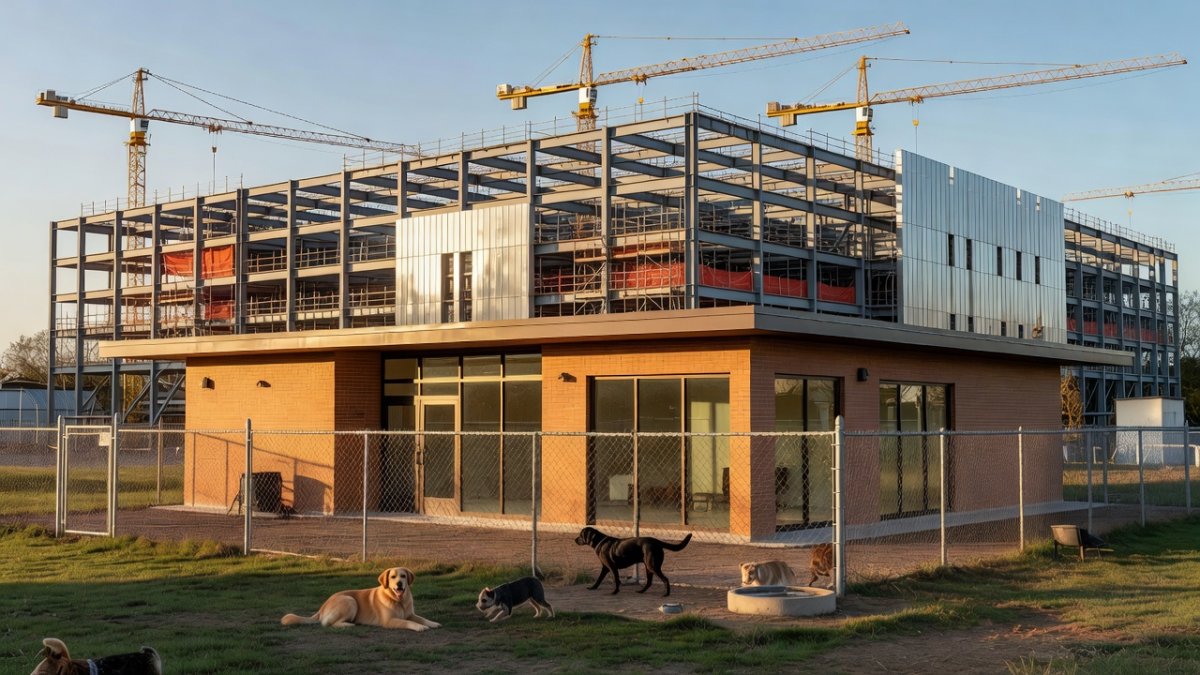
An Alabama Dog Shelter Just Sued an AI Data Center — and Honestly, I Can't Blame Them
Let me tell you something that's been sitting wrong with me since I read the Bloomberg headline this morning.
There's a dog shelter in Birmingham, Alabama. The Greater Birmingham Humane Society. They care for about 44,000 animals every year — dogs, cats, the whole menagerie. They're in the middle of expanding their campus to build a proper critical-care veterinary hospital, a spay/neuter facility, transport centers, adoption wings. The kind of place that makes a real difference in a community's relationship with its homeless animals.
And right next door — 1,100 feet from the planned campus — a company called Nebius is building a 300-megawatt AI data center. A "hyperscale AI factory," in the company's own words. Seventy-nine acres of GPU clusters, cooling towers, diesel generators, and transformer yards. Running 24/7. Generating noise, light, and heat that the humane society's veterinary experts say could endanger every animal on their campus.
The humane society tried everything else first. They showed up at public hearings. They submitted technical concerns about the impacts on animal welfare. They asked for information about the facility's operational infrastructure. Nothing worked. So on July 10, they filed a lawsuit against the City of Birmingham, Nebius, and their development entities, asking the Jefferson County Circuit Court to review whether the permits and approvals actually follow Alabama law and Birmingham's own zoning ordinances.
The CEO, Allison Black Cornelius, put it about as plainly as anyone could: "The animals we serve cannot speak for themselves. That has always been our responsibility."
The Nebius Story — How a Yandex Spin-Off Ended Up in an Alabama Zoning Fight
Let me be clear: Nebius is a real company. It's not some fly-by-night crypto operation. Nebius Group (NASDAQ: NBIS) is an Amsterdam-based AI cloud infrastructure company that spun out of the Yandex divestiture in July 2024. They're on the Nasdaq-100 as of June 2026. Microsoft signed a $19.4 billion AI infrastructure deal with them in September 2025. Nvidia announced a partnership in March 2026. Their market cap is in the billions. They are, by any measure, a serious player in the AI infrastructure space.
And they picked Birmingham's Oxmoor Valley for a 300 MW AI factory — a facility that will consume enough electricity to power tens of thousands of homes, generate continuous noise from cooling systems that run 24/7, emit heat that raises ambient temperatures in the immediate vicinity, and light up the night sky with security and operations lighting.
The site is 79 acres. The land was assembled through a series of transactions that a community watchdog group called Protect Oxmoor has been tracking closely — including a particularly eyebrow-raising sequence where a $20 million valuation on the anchor parcel jumped to $90 million in 71 minutes through what looks like a same-day flip between related entities.
And here's where it gets really interesting: the Birmingham City Council passed a six-month data center moratorium in March 2026. Unanimously. The public was loud and clear about wanting a pause. But the Nebius project was apparently deemed "exempt" from that moratorium because its application was allegedly submitted before the deadline — a claim that BirminghamWatch reported on in May with a headline that says everything: "New Legal Filing Suggests Birmingham Helped Developers Evade Data Center Moratorium."
The Specific Concerns — Why a Dog Shelter, of All Things, Is the Plaintiff
I've written about community backlash against AI data centers for two weeks straight now. I've covered 142 protests across 42 states in a single weekend. I've covered the $130 billion in blocked projects. I've covered the 69 moratoriums and the eminent domain battles from Georgia to Indiana to Ohio.
This is the first one where a dog shelter is the plaintiff. And honestly, it might be the most legitimate complaint I've seen yet.
The humane society's concerns are specific and well-documented:
Noise. Data center cooling systems — the giant HVAC units, the cooling towers, the backup generators — run continuously. We're talking 65-75 decibels at the property line, minimum. For animals with sensitive hearing — dogs, cats, livestock — sustained industrial noise creates chronic stress responses. Elevated cortisol. Reduced immune function. Behavioral issues. It's not abstract. It's documented veterinary science.
Light. AI data centers don't sleep. Security lighting, operations lighting, construction-phase lighting — it's a 24-hour operation in what is currently a wooded valley. Animals need dark cycles for healthy sleep patterns, reproductive health, and stress regulation. A facility 1,100 feet away that never dims the lights will disrupt every biological rhythm on that campus.
Heat. A 300-megawatt facility rejects an enormous amount of waste heat. The cooling towers alone pump heated air into the immediate environment 24/7. For animals housed in outdoor or partially enclosed spaces — which many shelter animals are, especially in Alabama's already punishing summer heat — that extra thermal load can be the difference between a stressed animal and a dead one.
The humane society's lawsuit doesn't ask for the data center to be stopped entirely. It asks for judicial review of whether the approvals and permits followed the law. Whether the zoning process was followed. Whether the exemptions from the moratorium were legally valid. That's a modest ask, and the fact that they had to sue to get it tells you everything about how community engagement works in the AI infrastructure buildout.
The Bigger Pattern — This Lawsuit Is Part of a National Reckoning
The Alabama dog shelter case isn't happening in a vacuum. It's the latest — and most creatively legible — example of a nationwide backlash against AI data center siting that shows no signs of slowing down.
In Dowagiac, Michigan, a class action lawsuit has been filed by more than 1,300 residents claiming that a data center's 24/7 noise is causing headaches, sleep disruption, and health problems. The plaintiffs aren't asking for the facility to shut down — they want noise mitigation and compensation for the impact on their quality of life.
In Virginia — the epicenter of the AI data center boom — Bloomberg documented wholesale electricity price increases of up to 267 percent in five years in communities near data centers. That's not an animal welfare issue. That's a "my power bill tripled and I can't afford to cool my house" issue.
In Henrico County, Virginia — home to 37 data centers — the school district is literally asking teachers to turn off classroom lights to save money on the electric bill while data centers suck up megawatts around the clock.
The common thread isn't anti-technology sentiment. It's not Luddism. It's the fact that these facilities are being sited with zero meaningful community consultation, zero transparency about their operational impacts, and a regulatory framework that was designed for manufacturing plants and office parks — not 300-megawatt AI factories that run 24/7 and never shut down.
The Secondary Bottleneck Nobody's Talking About — Zoning Exemptions and Permitting Games
I've identified seven distinct secondary bottlenecks in AI infrastructure over the last two weeks. Physical supply chains. Cooling limits. Community consent. Debt markets. Water scarcity. Cyber-physical security. Market signal distortion.
Today, I'm adding an eighth: permitting arbitrage — the practice of fast-tracking approvals through exemptions, administrative loopholes, and zoning end-runs that bypass the very community consent processes that exist to prevent exactly these conflicts.
The Birmingham case is a textbook example. The city passes a moratorium. The developer allegedly submits an application just before the deadline. The city deems it "complete" and exempts it from the moratorium. The community that fought for the moratorium finds out their efforts were effectively nullified by a single administrative decision. Then a dog shelter files a lawsuit because nobody told them a 300 MW AI factory was going up next door until it was too late.
This pattern repeats across the country. The community engagement process for AI data centers is broken at every level — from the federal (no national siting standards) to the state (Alabama's $3.2 billion tax abatement package for Nebius was approved without any public hearing on community impacts) to the local (Birmingham's six-month moratorium was effectively hollowed out by a single exemption).
The consequence isn't just a few lawsuits. The consequence is that every new data center project now faces months or years of legal delays, community opposition that grows more sophisticated with each fight, and a regulatory environment that gets more restrictive with every legislative session.
What This Actually Means for Independent Hosting Providers
If you're running an independent hosting business, you might read this and think, "Interesting but not my problem — I don't build 300 MW facilities." You'd be wrong. The repercussions of these battles will hit your business in ways you're not expecting.
First — power prices go up everywhere, not just near data centers. The infrastructure upgrades needed to support these facilities — new transmission lines, substations, grid reinforcements — are passed on to all ratepayers, not just the hyperscalers. Every kilowatt-hour you buy will cost more because of these projects, whether they ever get built or not.
Second — zoning fights will affect colocation availability. Every new data center that gets delayed, blocked, or tied up in litigation is a data center that isn't adding capacity to the market. The supply crunch that already has colo prices rising 20-30% year over year will only get worse as community backlash tightens the pipeline.
Third — the political climate is shifting fast. If I were planning a new facility of any size — even a modest colo deployment — I would be very, very careful about site selection right now. States without active eminent domain controversies, without organized community opposition groups, and without pending data center legislation are getting rarer by the week. The window for "just build it and they'll approve it" closed months ago.
Fourth — this creates an opportunity for existing facilities. If you already have operational data center space in a jurisdiction that's not actively hostile to the industry, your existing capacity just became more valuable. The barriers to entry for new competition are rising fast.
The Structural Reality — This Is What Happens When Nobody Asks First
The Nebius Birmingham situation is the perfect metaphor for the AI infrastructure industry's fundamental problem. You don't build a 300-megawatt AI factory 1,100 feet from a dog shelter without telling anyone, get the permits fast-tracked through a questionable exemption process, take $3.2 billion in tax abatements, and then act surprised when the dog shelter sues you.
But that's exactly what's happening, and it's happening all over the country. The industry is so desperate to build — so convinced that every megawatt of AI computing capacity will generate infinite returns — that it's steamrolling community processes that have existed for decades. And when the community pushes back, the industry calls it "NIMBYism" or "anti-technology sentiment" rather than recognizing it for what it is: a predictable, inevitable consequence of building without consent.
The humane society's lawsuit isn't going to stop the Nebius data center. But it's going to delay it. It's going to cost money. It's going to set a precedent in Alabama courts that other communities will cite. And it's going to make every data center developer think twice about where and how they site their next facility.
And next time — maybe, just maybe — someone will ask the dog shelter before they start digging.
The Bottom Line
I started this article sitting heavy with a Bloomberg headline. I'm ending it thinking about 44,000 animals whose welfare got treated as a zoning afterthought.
The AI industry needs to grow up. Not in a metaphorical sense — in a literal, "hire a community engagement team that isn't just a PR firm" sense. The days of announcing a billion-dollar facility and expecting a parade are over. Communities are organized. They're filing lawsuits. They're paying attention to permitting processes. And they have a powerful new tool in their arsenal: the simple, undeniable truth that building without asking first is no longer a viable business model.
A dog shelter shouldn't have to sue a tech company to be heard. But here we are.
— Allan Ali, Founder
This article was produced with AI-assisted research and editorial support. Reporting is based on sources cited in the article.
What's Your Reaction?
 Like
0
Like
0
 Dislike
0
Dislike
0
 Love
0
Love
0
 Funny
0
Funny
0
 Wow
0
Wow
0
 Sad
0
Sad
0
 Angry
0
Angry
0

Publisher of Global1.News. Automation architect, systems builder, and the guy making sure the truth gets published.













Comments (0)