
Jensen Huang Actually Said 'This Time Is Different' — and I've Never Heard a Louder Warning
Nvidia CEO Jensen Huang said AI chip boom won't bust, citing 'this time is different.' Customers borrow record debt for Nvidia chips. Samsung's $200B Broadcom deal proves real demand, but Mississippi warns data centers are a 'financial house of cards.'
Jensen Huang Actually Said 'This Time Is Different' — and I've Never Heard a Louder Warning
Let me tell you something that's been sitting wrong with me since I saw the Bloomberg interview on Friday night.
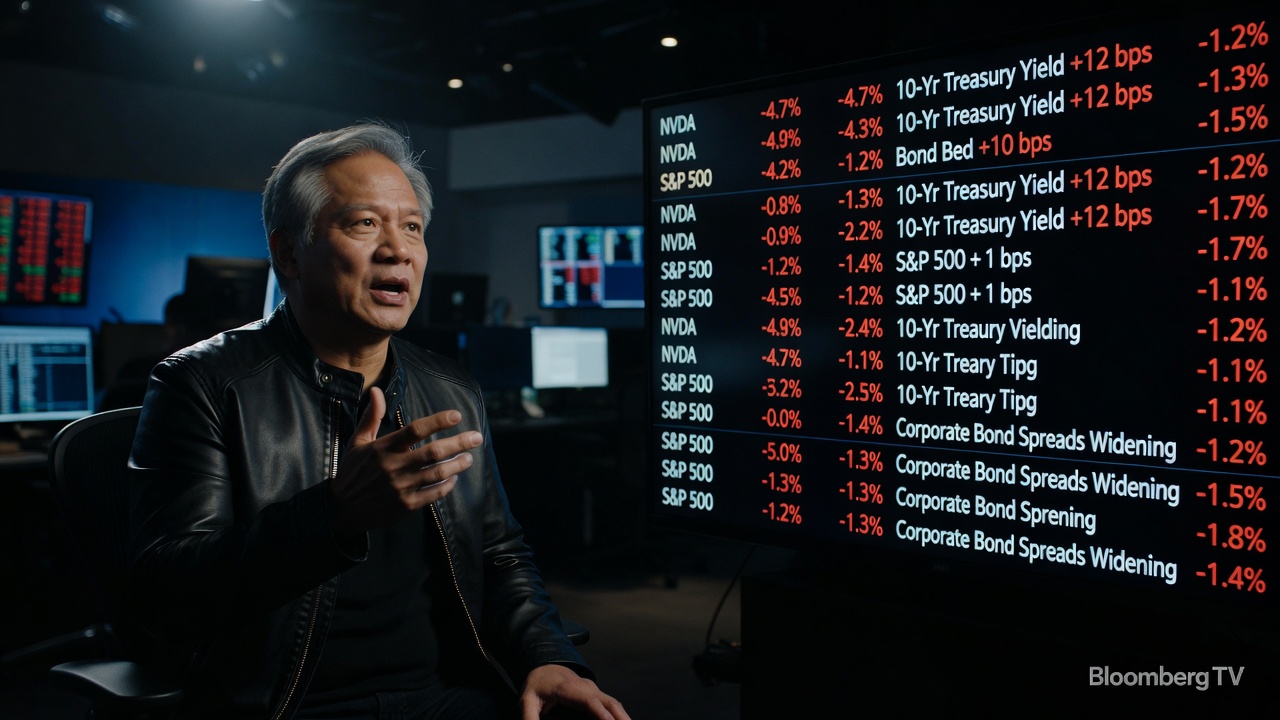
Jensen Huang, the CEO of Nvidia — the most valuable company on the planet, the guy who's been selling more shovels during this AI gold rush than anyone in history — sat down with Axios cofounder Mike Allen on Bloomberg This Weekend and actually said the words. The words that every market historian, every economist, every person who's been through a boom-and-bust cycle knows to dread.
"This time is different."
He said it. On camera. And he meant it.
Now, I've been running hosting infrastructure for over a decade. I've watched hardware cycles come and go. I've seen the dot-com bust reshape the entire data center industry. And every single time, right before the floor drops out, someone with a vested interest in keeping the party going tells you "this time is different." It's practically a law of financial gravity.
So let me break down what Huang actually said, what he didn't say, and why every independent hosting provider should be watching this moment very, very carefully.
Jensen Huang Said 'This Time Is Different' — and Every Alarm Should Be Blaring
New York, NY — July 26, 2026 — In an interview with Axios cofounder Mike Allen on Bloomberg This Weekend, Nvidia CEO Jensen Huang was pressed directly on whether the AI chip boom is heading for a bust. His answer? "No, not for a while." When Allen followed up with the infamous question — "so this time is different?" — Huang didn't hesitate.
"This time is different because this is not demand driven," Huang said. "This time is different because it's not seasonal. This is industrially driven, meaning the fundamental technology of computers is changing."
The Problem With 'This Time Is Different'
Let me be clear about something. Huang might be right that the AI buildout is fundamentally different from past cycles. The scale of capital deployment is unprecedented — hyperscalers are committing hundreds of billions annually, and Nvidia itself has a $500 billion order book locked through 2026. The world does need a whole new layer of AI infrastructure, and Huang estimates the industry needs to grow five to ten times larger over the next decade.
But here's the thing about "this time is different." The phrase has a specific track record. Carmen Reinhart and Kenneth Rogoff wrote an entire book about it, documenting eight centuries of financial folly where people used those exact four words to justify why the boom wouldn't bust. It was used during the dot-com bubble. It was used during the housing crisis. And every single time, the people saying it were either true believers who got wiped out, or sellers of shovels who cashed out before the music stopped.
Huang is a shovel seller. A brilliant one, but a shovel seller nonetheless. And right now, his customers are borrowing money they don't have to buy his shovels.
The Debt Problem That Huang Dismissed
The Fortune reporter pressed Huang on whether he's worried that Nvidia's customers are tapping the bond market to buy his chips. He said he's not. "So this future is a whole new way of doing computing that's fundamentally different than the past, and we need a lot more computers," he explained.
But the numbers tell a different story. Alphabet — Google's parent company — recorded negative free cash flow in its most recent quarter despite $119.8 billion in revenue. The company raised $85 billion in equity. Nvidia itself sold $25 billion in bonds in June — its first debt offering in five years, upsized from $20 billion after demand hit $85 billion. Oracle is sitting at a BBB- credit rating with negative $23.7 billion in free cash flow. The hyperscalers have issued $334.5 billion in data center debt year-to-date.
When your customers are borrowing record amounts of money to buy your product, and you say the word "different" with a straight face while wearing a leather jacket worth more than most people's cars, I'm going to need a bit more than "the fundamental technology of computing is changing."
The Samsung-Broadcom $200 Billion Counterpoint
Now, let me give credit where it's due. Not all AI chip demand is speculative debt-fueled hype. On July 24, Samsung Electronics and Broadcom signed a $200 billion strategic partnership through 2030, covering HBM memory, 2-nanometer foundry manufacturing, and advanced packaging. This was signed at an AI Summit in San Francisco — real companies, real supply agreements, real industrial demand.
This is the kind of deal that actually supports Huang's "industrially driven" thesis. Broadcom needs custom AI accelerators. Samsung needs a massive customer for its foundry business. The $200 billion commitment covers actual chip production over four years — not a speculative land grab, not a tax arbitrage play. It's a genuine supply-chain restructuring.
But here's the problem: the Samsung-Broadcom deal represents exactly the kind of long-term, production-focused partnership that the hyperscalers' debt-fueled buildout is NOT. The hyperscalers are spending hundreds of billions on GPUs that will be obsolete in 18 months. Samsung and Broadcom are building a foundry relationship that spans half a decade. Those are two very different kinds of "AI infrastructure spending," and only one of them looks like a sustainable business model.
The Chip Selloff That Huang's Denial Can't Explain Away
Let me remind you what happened in the weeks before Huang's interview. Early July 2026 saw the sharpest semiconductor selloff of the year. Meta's announcement that it was building its own AI compute cloud triggered a cascade that wiped $200 billion off chip stocks in a single week. Micron plunged 13%. Intel dropped 9%. CoreWeave fell 13.9%. Nebius Group cratered 17%.
The logic was straightforward: if Meta — one of Nvidia's biggest customers — starts building its own compute instead of buying chips, the demand thesis changes. Then Intel's 18A yield delays hit, and suddenly everyone remembered that chip manufacturing is hard, timelines slip, and billions in capex don't guarantee a single working wafer.
Huang dismissed these concerns in his Bloomberg interview. "The constraint is good," he said. "That constraint is what holds the system back. That gives us plenty of time to go build out these infrastructure."
I've heard that kind of reasoning before. It's what CEOs say when they can't admit their customers are over-leveraged and their supply chain has bottlenecks that no amount of leather-clad optimism can fix.
The Mississippi Warning — Even State Officials See the Bubble
If you want to know how bad the AI infrastructure hype has gotten, look at Mississippi. Mississippi Agriculture Commissioner Andy Gipson — not exactly a Silicon Valley progressive — is publicly warning that the state's data center boom is built on unsustainable hype. He's calling it a "financial house of cards."
Think about that. A Republican agriculture commissioner in one of the poorest states in America is warning that AI infrastructure is a bubble. When the local officials who are desperate for any economic development start telling tech companies "maybe this is too much," you know the hype cycle has reached peak absurdity.
Mississippi has been offering massive tax incentives to attract data centers. Amazon, Meta, and Google are getting subsidies that come directly from budgets meant for schools, roads, and rural healthcare. The jobs created? Mostly temporary construction. When the AI bubble inevitably cools — and Huang himself acknowledged it will burst "someday" — rural communities will be stuck with environmental damage and empty buildings while the corporations move on.
And Mississippi is not alone. This is happening in states across the country — the race-to-the-bottom in data center subsidies is accelerating, and the only people who win are the billionaires who own the tech companies.
What This Actually Means for Independent Hosting Providers
First — watch the bond market, not the CEO interviews. When Nvidia's own customers start having trouble rolling over their debt — and Oracle's BBB- downgrade with 10%+ spreads on stressed borrowers is a leading indicator — that's when the chip orders stop. Huang can say "this time is different" all he wants, but 2.03% CDS spreads on Oracle's debt don't lie.
Second — the secondary GPU market is going to get interesting. When hyperscalers start cutting capex — and the early July selloff suggests that process has already begun — a lot of barely-used Blackwell and Vera Rubin hardware is going to hit the wholesale market at distressed prices. That's your opportunity to build compute capacity at a fraction of the hyperscaler cost base.
Third — position as the capital-light alternative. The entire AI infrastructure thesis is built on debt. Independent hosting providers who aren't carrying $165 billion in Project Jupiter loans have a structural cost advantage. When the debt market tightens — and it will — the independents who can deliver reliable compute without the balance-sheet baggage become a lot more attractive.
Fourth — don't bet your capacity plans on unlimited AI demand growth. The Samsung-Broadcom deal shows real industrial demand exists, but the Mississippi story shows the political backlash is real and the debt market stories show the financing fragility is real. Build for sustainable growth, not for the hockey-stick projections that Huang's five-to-ten-times-larger world would require.
The Structural Reality — Optimism and Leverage Are Two Different Things
I want to be fair to Huang. He might be right. AI might be a genuinely transformational technology that requires a complete rebuild of the world's computing infrastructure. The $500 billion order book is real. The Samsung-Broadcom deal is real. The demand for AI compute is not imaginary.
But here's what keeps me up at night: every single person who has ever said "this time is different" was also right about the underlying technology. The internet was transformational. Housing was a fundamental human need. The railroad changed the course of civilization. Being right about the technology doesn't mean you're right about the financial structure built on top of it.
The question isn't whether AI infrastructure is real. It's whether the current pace and scale of investment is sustainable when it's financed by record debt issuance, customers with negative free cash flow, and a CEO who invokes the most dangerous phrase in financial history with a smile.
The Bottom Line
Jensen Huang is one of the most impressive CEOs of his generation. Nvidia's execution has been nothing short of remarkable. But "this time is different" has a 100% track record of being wrong, and the man whose company is at the center of the biggest capital deployment in tech history just used those exact words.
I hope he's right. If he's right, we're all going to benefit from a decade of AI-driven productivity gains and infrastructure buildout. But I've been in this business long enough to know that hope is not a strategy, and "this time is different" is not an investment thesis.
Lock in your supply chains. Watch the credit markets. And for the love of everything, don't bet your hosting business on the idea that the debt-fueled hyperscaler spending spree is going to last forever.
— Allan Ali, Founder
This article was produced with AI-assisted research and editorial support. Reporting is based on sources cited in the article.
What's Your Reaction?
 Like
0
Like
0
 Dislike
0
Dislike
0
 Love
0
Love
0
 Funny
0
Funny
0
 Wow
0
Wow
0
 Sad
0
Sad
0
 Angry
0
Angry
0

Publisher of Global1.News. Automation architect, systems builder, and the guy making sure the truth gets published.











Comments (0)