
Doctor Giving Life Back to Yazidi Victims of Islamic State
The Abduction from Sinjar Shireen was only nineteen when Islamic State militants stormed her village in Sinjar on 3 August 2014. The young Yazidi woman was seized along with thousands of others during the coordinated assault that targeted her community. Families were torn apart as fighters separated men for execution and women for enslavement. Shireen later recalled the terror
The Abduction from Sinjar
Shireen was only nineteen when Islamic State militants stormed her village in Sinjar on 3 August 2014. The young Yazidi woman was seized along with thousands of others during the coordinated assault that targeted her community. Families were torn apart as fighters separated men for execution and women for enslavement. Shireen later recalled the terror of that day when armed men loaded her onto a truck bound for unknown destinations across the border into Syria and Iraq.
Her journey into captivity began immediately after the raid. Transported first to Tal Afar, she was sold at a makeshift market where militants auctioned Yazidi women as property. The dehumanizing process stripped her of freedom and dignity within hours of arrival. Local buyers inspected and purchased girls like commodities in a system designed to erase Yazidi identity through systematic sexual violence and forced conversion.
From Tal Afar she was moved again to Mosul where her new owner, a man named Abu Omar, claimed her as his personal slave. The city under Islamic State control became her prison for more than two years. Daily life consisted of isolation, repeated rape, and constant fear of punishment for any perceived disobedience. Shireen survived by clinging to memories of her family while enduring unimaginable brutality inflicted by her captor.
During those long months she witnessed other women suffer similar fates. Some attempted escape only to face recapture and harsher treatment. The psychological toll mounted as news filtered in about murdered relatives. Her uncle and several friends were killed during the initial attacks, while her father and sister remained missing without any trace of their whereabouts.
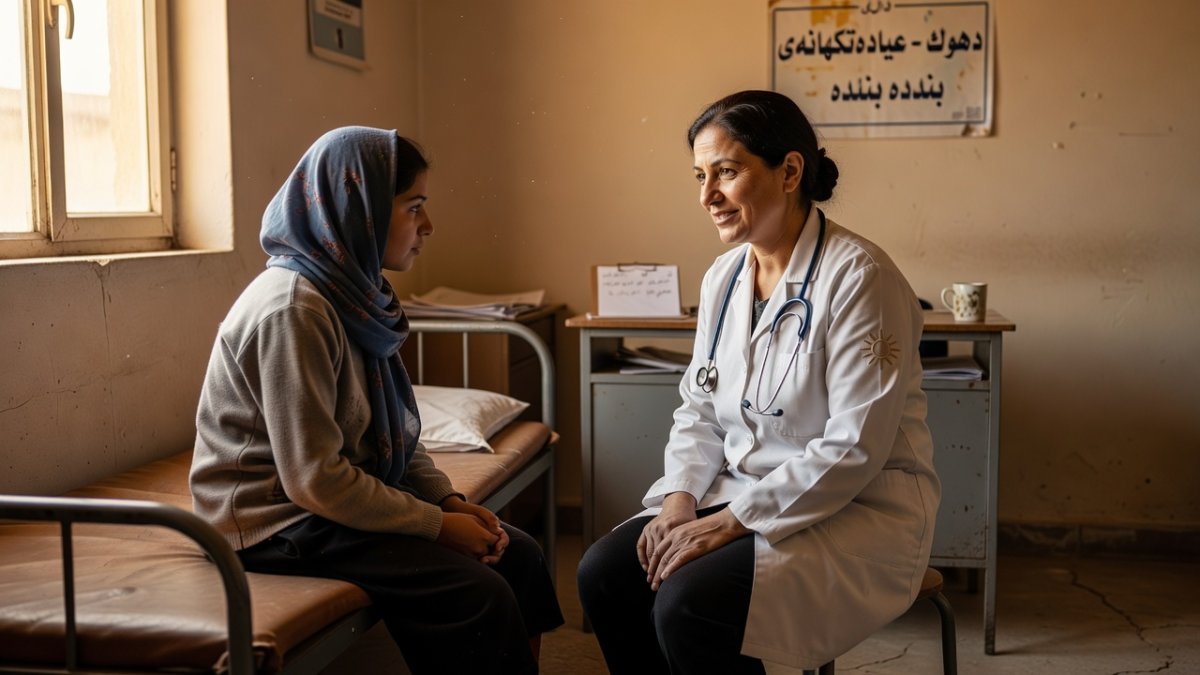
A Yazidi doctor providing care at the Duhok Survivors Centre. (Global 1 News)
Years of Enslavement in Mosul
Abu Omar enforced strict control over every aspect of Shireen’s existence in Mosul. She was confined indoors, forbidden from contacting the outside world, and subjected to sexual violence on a regular basis. The militant justified his actions through distorted religious ideology that permitted the enslavement of Yazidi women. Each day brought new humiliations designed to break her spirit and force acceptance of her status.
Shireen observed how the Islamic State maintained its network of sexual slavery across controlled territories. Women were traded between fighters as rewards or punishments. Some owners showed fleeting moments of humanity while others displayed unrelenting cruelty. The constant movement between houses prevented any stable relationships from forming among the captives who shared her plight.
Food and medical care were minimal during her imprisonment. Illness went untreated while physical injuries from abuse accumulated without attention. She learned to remain silent during assaults to avoid further violence against herself or others. The strategy helped her survive but left deep emotional scars that would require years of professional support to address.
News of advancing Iraqi forces eventually reached the household where she was held. Hope mixed with terror as the front lines drew closer to Mosul. Shireen feared her captor might kill her rather than allow liberation. When Iraqi troops finally entered the area in 2016, she was freed from Abu Omar’s control after more than two years of continuous captivity.
Return to Freedom and Family Loss
Liberation brought immediate relief but also devastating confirmation of her losses. Shireen learned that her uncle and several close friends had been executed during the Sinjar massacre. Their deaths left permanent voids in her family structure that no amount of time could fill. The absence of her father and sister continued to haunt her with unanswered questions about their possible fates.
Reuniting with surviving relatives proved bittersweet. Many Yazidi families struggled to reintegrate women who had endured sexual slavery. Stigma attached to survivors made some communities hesitant to accept them fully. Shireen faced these challenges while processing her own trauma from prolonged exposure to violence and dehumanization under Islamic State rule.
Physical health problems required urgent attention after her release. Years of abuse had caused lasting damage that demanded specialized medical intervention. Psychological wounds proved equally severe as nightmares and anxiety disrupted daily functioning. The transition from captivity to freedom required navigating both practical needs and profound emotional recovery simultaneously.
Official records later confirmed the scale of destruction inflicted on Yazidi communities. More than twelve thousand people were killed or kidnapped during the 2014 campaign according to United Nations documentation. The international body described the persecution as an ongoing genocide that demanded sustained global attention and accountability for perpetrators.
Meeting Dr. Nagham Nawzat in Duhok
After liberation Shireen traveled to Duhok where she met Dr. Nagham Nawzat at the Survivors Centre. The Yazidi gynaecologist provided both medical examinations and compassionate listening that helped survivors begin processing their experiences. Her approach combined clinical care with emotional support tailored specifically to women who had endured gender-based violence.
Dr. Nawzat had joined the facility in 2015 after completing her medical training. The centre represented the only Iraqi institution dedicated exclusively to treating survivors of such violence with funding from the United Nations Population Fund. Patients received comprehensive evaluations that addressed both physical injuries and psychological trauma resulting from prolonged captivity and sexual enslavement.
Shireen found the doctor’s method particularly effective because it allowed her to speak freely without judgment. Dr. Nawzat listened to accounts of captivity in Mosul and the repeated violations suffered at the hands of Abu Omar. This validation helped restore a sense of dignity that militants had systematically attempted to destroy during years of enslavement.
By the time Shireen arrived, Dr. Nawzat had already assisted more than one thousand two hundred of the two thousand twenty-three liberated Yazidi women documented by Hussein al-Qaidi, director of the Kurdistan Regional Government’s Kidnapped Affairs office. Her caseload reflected the massive scale of suffering inflicted upon the community during the Islamic State offensive.
Background and Dedication of the Doctor
Born in Mosul in 1976, Dr. Nagham Nawzat graduated from Mosul Medical College in 2002. Her early career focused on women’s health in a region that would later become ground zero for systematic sexual violence against Yazidis. The skills acquired during her training proved essential when she began treating survivors who had endured prolonged sexual slavery under Islamic State control.
Her decision to work at the Duhok centre stemmed from a commitment to serve her community during its darkest period. The facility offered a safe space where women could receive care without fear of further stigmatization. Dr. Nawzat developed protocols that prioritized patient autonomy and emotional safety throughout every stage of treatment and recovery.
International recognition arrived in 2016 when she received the International Women of Courage Award presented by then Secretary of State John Kerry. The honor highlighted her pioneering efforts to support survivors of gender-based violence in post-conflict Iraq. It also drew attention to the ongoing needs of Yazidi women who continued arriving at the centre seeking assistance.
Despite the accolade, Dr. Nawzat remained focused on expanding services rather than personal achievement. She identified gaps in long-term rehabilitation options available to survivors after initial medical treatment concluded. Her vision included establishing a dedicated rehabilitation centre that could provide sustained support beyond the acute phase of recovery.
Persistent Threats and Future Vision
Death threats against Dr. Nawzat continued even after the liberation of Mosul and other territories. Militants and their sympathizers viewed her work as direct opposition to their ideology. Security concerns required constant vigilance while she maintained her practice at the Survivors Centre in Duhok serving women from across the region.
The doctor persisted despite these dangers because she understood the unique role her expertise played in survivor recovery. Many women refused treatment from male physicians due to cultural sensitivities and trauma histories. Her presence ensured that critical medical and psychological services remained accessible to those who needed them most.
Plans for a new rehabilitation centre occupied much of her attention in recent years. The proposed facility would offer extended residential care combining medical treatment, vocational training, and community reintegration support. Funding challenges and security considerations slowed progress but did not diminish her determination to see the project completed.
Colleagues described her commitment as unwavering even when resources proved limited. The existing centre operated at capacity with demand continuing to grow as more women emerged from captivity. Dr. Nawzat advocated for increased international support to address the long-term consequences of the genocide that had devastated Yazidi society.
The Ongoing Genocide and Global Response
The United Nations has classified the Islamic State campaign against Yazidis as an ongoing genocide. More than twelve thousand individuals were killed or kidnapped during the 2014 attacks according to official estimates. The systematic targeting of women for sexual slavery formed a central element of the strategy to destroy the community through forced assimilation and elimination of cultural continuity.
Shireen’s testimony contributed to documentation efforts that supported these legal determinations. Her account of being sold in Tal Afar and held by Abu Omar in Mosul provided evidence of organized criminal patterns. Such individual stories helped investigators build cases against perpetrators who remained at large despite territorial losses suffered by Islamic State.
Recovery for survivors like Shireen depended heavily on sustained access to specialized care provided by professionals such as Dr. Nagham Nawzat. The gynaecologist’s post-trauma approach combined physical examinations with attentive listening that validated experiences often dismissed by society. This model proved essential for restoring agency to women whose bodies had been weaponized during captivity.
International awards and United Nations funding offered recognition but could not replace the need for comprehensive long-term strategies. Dr. Nawzat continued advocating for expanded rehabilitation infrastructure while managing daily threats to her safety. Her work represented a critical frontline response to one of the most severe humanitarian crises of the decade.
By Fatima Al-Rashid, Staff WriterThis article was produced with AI-assisted research and editorial support. Reporting is based on sources cited in the article.
What's Your Reaction?
 Like
0
Like
0
 Dislike
0
Dislike
0
 Love
0
Love
0
 Funny
0
Funny
0
 Wow
0
Wow
0
 Sad
0
Sad
0
 Angry
0
Angry
0
Gulf/MENA Correspondent at Global1.News. Based in Doha, covering Gulf politics, energy markets, diplomacy, and development across the Middle East and North Africa. Tracks the economic transformation of the Gulf states.












Comments (0)