
Springboks Hammer Wales 43-0 at Kings Park Durban
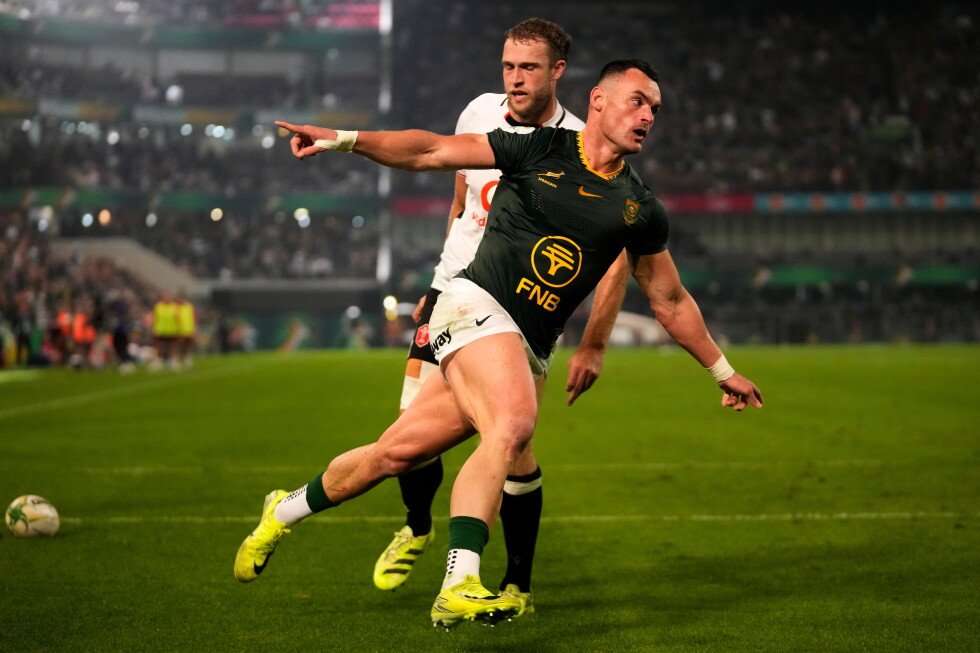
Springboks Hammer Wales 43-0 at Kings Park Durban The Springboks delivered a ruthless 43-0 victory over Wales at Kings Park, Durban on 18 July 2026 in the Nations Championship. Seven different players crossed for tries in a display that showcased both depth and attacking variety under slippery conditions. With the All Blacks looming at Ellis Park next month, this result sent a clear message across South African rugby.
Springboks Hammer Wales 43-0 at Kings Park Durban
The Springboks delivered a ruthless 43-0 victory over Wales at Kings Park, Durban on 18 July 2026 in the Nations Championship. Seven different players crossed for tries in a display that showcased both depth and attacking variety under slippery conditions. With the All Blacks looming at Ellis Park next month, this result sent a clear message across South African rugby.
Tags: springboks, wales, nations championship, kings park durban, rassie erasmus, vusi moyo, jaco williams, paul de villiers, ellis park, all blacks, south african rugby, cobus reinach, jesse kriel
Match Analysis — Springboks Flex Their Depth
Coach Rassie Erasmus made ten changes from the win over Scotland, yet the Springboks still produced seven tries through Jesse Kriel, Jasper Wiese, Cobus Reinach, Herschel Jantjies, Kurt-Lee Arendse, Paul de Villiers and Jaco Williams. The rotation tested cohesion, but the side adapted quickly to the wet ball and a Welsh defence that sat deep. Erasmus noted afterwards that the team has improved in every outing despite the disruption, and the final scoreline reflected that growing control.
The wet Durban conditions forced both sides into a kicking-heavy game where territory became everything. The Springboks thrived by keeping the ball dry through quick ruck ball and short passes, turning slippery handling into a weapon rather than a liability. This tactical discipline showed the squad’s growing maturity under Erasmus, where even ten changes could not derail the attacking shape that has become a hallmark of South African rugby at home.
Seven different try scorers sent the clearest possible statement about attacking depth. No single star carried the load; instead the tries were spread across forwards and backs, proving the Springboks can hurt opponents from multiple angles. Jasper Wiese’s early charge that brushed aside Morgan and Carre set the physical tone, while the scrum dominance anchored by new tighthead Carlu Sadie gave the backs clean ball to work with throughout the match.
Debutants Shine on Home Soil
Three new caps featured, with tighthead prop Carlu Sadie, flyhalf Vusi Moyo and wing Jaco Williams all earning their first Test jerseys. The 20-year-old Moyo, fresh from his Sharks debut and Junior Boks duty this season, showed composure at pivot. Jaco Williams announced himself just 44 seconds into the second half by finishing a sharp attacking move. Paul de Villiers, on his third cap, was named man of the match for his carrying and defensive work.
Vusi Moyo’s journey from Sharks academy to Junior Boks and straight into senior Test rugby in a single season captures the rapid pathway now open to young South African talent. Playing at flyhalf in slippery conditions, he kept the attack ticking with accurate distribution and calm decision-making that belied his age. His performance at Kings Park will be remembered as the moment another product of the Sharks system announced himself on the biggest stage.
Jaco Williams needed just 44 seconds of the second half to make his mark, finishing a sweeping move with the electric speed that has lit up domestic rugby. Paul de Villiers, already on his third cap, earned man-of-the-match honours through relentless carrying and defensive work that belied his limited experience. Meanwhile Carlu Sadie held his own at tighthead against a seasoned Welsh front row, providing the platform that allowed the Springboks to dominate set-piece exchanges all afternoon.
Defensive Dominance — Wales Shut Out
Wales failed to score against the Springboks for more than two-and-a-half hours of rugby across successive matches, the first time this has happened since 1906 and 1912. They missed 29 tackles in Durban alone and 102 across their three Nations Championship fixtures. The Springboks’ line speed and physicality turned every Welsh error into territory, keeping the visitors scoreless on a day when conditions favoured the defence.
Shutting out Wales for more than two-and-a-half hours across successive Tests marks the first time this has occurred since 1906 and 1912, a statistic that resonates deeply with South African rugby historians. The 29 missed tackles in Durban formed part of a tournament-wide total of 102 for the Welsh, highlighting how the Springboks’ aggressive line speed turned every error into attacking opportunity and kept the visitors pinned in their own half for long stretches.
The defensive strategy orchestrated by the Springboks’ coaching staff emphasised rapid line speed that disrupted Welsh timing from the first whistle. This approach, refined over recent campaigns, turned Kings Park into a fortress where even the wet ball could not blunt the physical edge. For local fans the shutout felt like a continuation of the proud tradition of Springbok defences that have defined South African rugby success for generations.
Nations Championship Context — Building Toward Ellis Park
Only South Africa and New Zealand remain unbeaten after the southern hemisphere leg. The 43-0 result keeps the Springboks on track and gives Erasmus valuable data on squad depth before the All Blacks arrive at Ellis Park on 22 August, followed by Cape Town Stadium on 29 August. The tournament then pauses until November when it shifts to Europe for the final rounds.
With only South Africa and New Zealand still unbeaten, the Springboks sit in prime position heading into the decisive double-header. The 43-0 win supplied Erasmus with concrete evidence that the squad’s depth can withstand heavy rotation, information that will prove vital when the All Blacks land at Ellis Park on 22 August and Cape Town Stadium on 29 August. Those two fixtures will test whether the current momentum can be sustained against the ultimate benchmark.
When the Nations Championship resumes in Europe during November, the Springboks will carry the confidence built on home soil. The southern leg has already demonstrated that this group can adapt to different conditions and personnel changes while maintaining high standards. South African supporters now look forward to seeing whether the same blend of youth and experience can travel successfully when the tournament moves north.
What It Means for SA Rugby
At Kings Park the crowd felt the familiar mix of pride and expectation that defines South African rugby on home soil. This performance showed the depth that has become a hallmark of the current era, with young players stepping up alongside established stars. For fans, the shutout win reinforces belief that the Springboks are building something durable ahead of the biggest Tests of the year.
The emergence of young black players such as Vusi Moyo and Jaco Williams alongside established names reflects the continued transformation of South African rugby. Their rapid rise through the Sharks and Junior Boks pathways into the senior side embodies the inclusive development model that Rassie Erasmus has championed. At Kings Park the crowd celebrated not just the scoreline but the sight of the next generation taking ownership of the green jersey.
Depth has become the defining strategy of the current Springbok era, allowing the squad to absorb ten changes and still produce a clinical performance. This approach, built over several seasons, ensures that injuries or rotation no longer derail campaigns. For the passionate Kings Park faithful, the 43-0 result confirmed that the pipeline from schoolboy and provincial rugby to Test level remains strong and vibrant.
What to Watch For
Attention now turns to the All Blacks double-header. Erasmus will look to tighten combinations while managing the same rotation that served the side well against Wales. The November European leg will test whether this group can maintain its edge when the tournament resumes away from home. South African rugby is firmly in the ascendancy.
Erasmus now faces genuine selection headaches as first-choice players return for the All Blacks series. Balancing the proven depth shown against Wales with the need for cohesion at Ellis Park on 22 August and Cape Town Stadium on 29 August will test his man-management skills. The double-header promises to be the sternest examination yet of how far this squad has come.
Beyond the men’s team, the Springboks Women’s World Cup campaign in England later this year adds another layer of excitement for South African rugby supporters. The broader calendar also includes the resumption of the Nations Championship in Europe during November, where the challenge will be to replicate home dominance on foreign soil. With momentum firmly on their side, the Springboks enter the second half of 2026 with genuine belief that the best is still to come.
By Dante Williams, Staff Writer
This article was produced with AI-assisted research and editorial support. Reporting is based on sources cited in the article.
What's Your Reaction?
 Like
0
Like
0
 Dislike
0
Dislike
0
 Love
0
Love
0
 Funny
0
Funny
0
 Wow
0
Wow
0
 Sad
0
Sad
0
 Angry
0
Angry
0

Breaking News and Investigations Correspondent at Global1.News. Based in London, covering global breaking news, security, and investigative stories. Known for digging deeper and connecting the dots across continents.














Comments (0)