
AMD Just Made Its Move — and the AI Chip Market Will Never Be the Same
— and the AI Chip Market Will Never Be the Same I spent yesterday morning with my laptop open, watching the Advancing AI 2026 keynote stream from San Francisco, and I'll tell you what I told my team: this is the moment AMD has been building toward for three years. Not a roadmap slide.
AMD Just Made Its Move — and the AI Chip Market Will Never Be the Same
I spent yesterday morning with my laptop open, watching the Advancing AI 2026 keynote stream from San Francisco, and I'll tell you what I told my team: this is the moment AMD has been building toward for three years. Not a roadmap slide. Not a press release. Silicon you can actually order, a rack you can actually price, and customers — real ones with gigawatt-scale commitments — standing on stage beside Lisa Su saying they're deploying this stuff in production.
Let me walk you through what happened, what it actually means, and why I think the AI chip supply chain just shifted under everyone's feet.
The Short Version — What AMD Actually Announced
AMD's Advancing AI 2026 ran July 22-23 at San Francisco's Moscone Center, and the headline was a clean three-part launch: the MI400 series GPU family, the Helios rack-scale system that packages them, and EPYC Venice, the first x86 server processor built on TSMC's 2nm node. But here's the thing that matters more than any single spec: every announcement had a shipping timeline, named customers, and in Helios' case, a real price tag. This wasn't a vision deck. This was a product launch.
The MI400 family breaks into three chips sharing the same CDNA 5 architecture and HBM4 memory subsystem. The MI430X targets sovereign AI programs and HPC centers that need control over where their models run, with up to 288 teraflops of FP64 for scientific computing. The MI440X packages eight GPUs with a single EPYC Venice CPU into a rack-mounted enterprise server for on-premises training and inference. And the MI455X — the flagship — packs 432 gigabytes of HBM4 per GPU with 19.6 terabytes per second of memory bandwidth. That's the chip that goes into Helios.
On the CPU side, EPYC Venice is the industry's first 2nm x86 server chip. It scales to 256 cores and delivers roughly 1.7x the performance of the prior Turin generation, built on Zen 6 architecture. It's shipping in the same second-half 2026 window as the GPUs, which means AMD can sell the platform as a coordinated launch rather than staggering availability the way past generations did.
Helios — AMD's $5.25 Million Bet on Rack-Scale AI
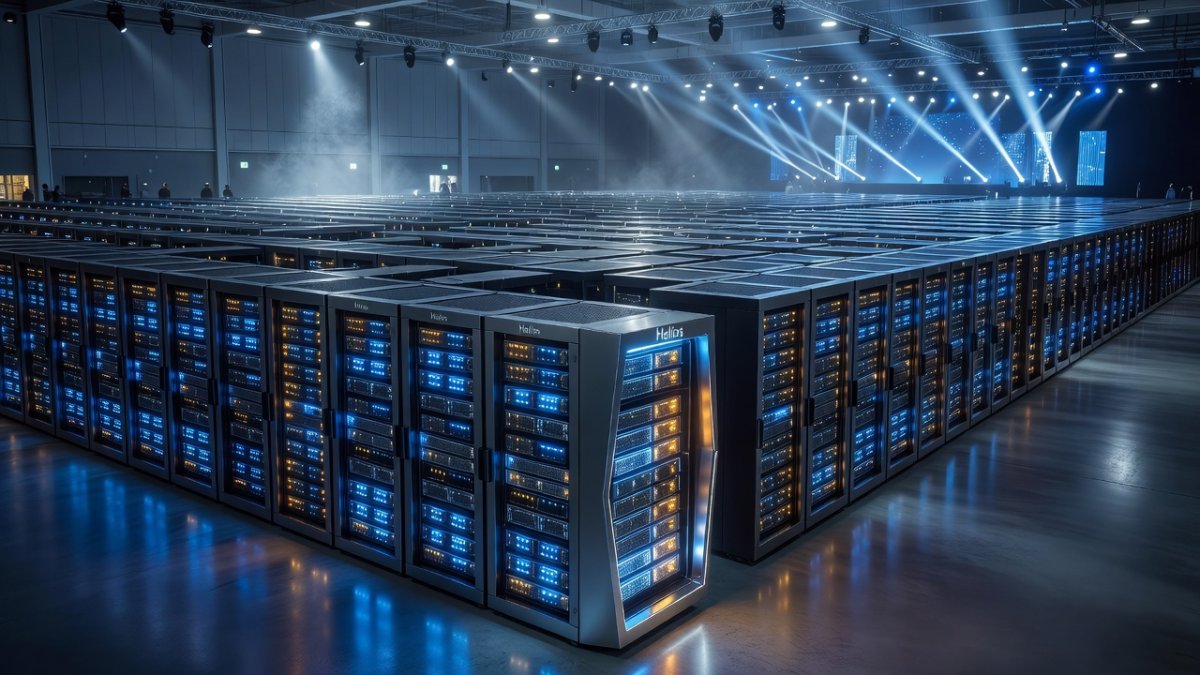
Helios is the bigger story. It's AMD's first complete rack-scale system — not accelerators for someone else to integrate, but a full rack with 72 MI455X GPUs, the EPYC Venice CPUs, and AMD's Pensando networking silicon all in one chassis. A single Helios rack carries 31 terabytes of pooled HBM4 memory and 1.4 petabytes per second of aggregate memory bandwidth. AMD rates it at 2.9 exaflops of FP4 inference throughput and 1.4 exaflops of FP8 training throughput.
And here's where it gets concrete: pricing. A Helios rack costs between $5 million and $5.5 million, averaging around $5.25 million according to analysts covering the event. That works out to roughly $73,000 per GPU once you factor in CPUs, networking, and integration. AMD hasn't broken out a separate per-chip list price, and I don't expect them to, because hyperscalers buying racks by the dozen care about total cost per exaflop, not the sticker price of any individual component.
AMD's comparison against Nvidia's Vera Rubin NVL144 is instructive. Nvidia packs 144 GPUs per rack — double AMD's count — and edges Helios out on raw FP4 inference (3.6 exaflops vs 2.9). But AMD leads on memory per GPU (432GB vs 288GB), on bandwidth per GPU (19.6 TB/s vs 13 TB/s), and on aggregate rack bandwidth (1.4 PB/s vs 260 TB/s). AMD also claims 30% more tokens per dollar than the competition. Neither rack has independent third-party benchmarks yet — both are ramping toward broad availability this half — but the positioning war is already on.
A double-wide Helios variant arriving in the third quarter pushes a single rack to 3 AI exaflops, which Su described on stage as a blueprint for "yotta-scale compute."
The 12-Gigawatt Question — Who's Actually Buying
This is the part that should make every independent hosting provider sit up and pay attention. AMD confirmed 12 gigawatts of committed accelerator demand across two customers: OpenAI at 6 gigawatts and Meta at another 6 gigawatts. Let me put that in perspective. Industry estimates put one gigawatt at roughly 25,000 to 50,000 high-end GPUs, depending on chip generation and cooling design. Twelve gigawatts is potentially hundreds of thousands of AMD accelerators being deployed over the next few years.
OpenAI's deal includes the most unusual feature of the entire event: a warrant giving OpenAI the right to buy up to 160 million AMD shares at one cent each, vesting through October 2030 as deployment milestones are hit. If OpenAI exercises in full, it would hold roughly 10% of AMD's outstanding shares. The structure ties OpenAI's upside directly to AMD's execution — they only get cheap shares if AMD actually ships the compute.
Meta has separately committed its own 6 gigawatts across multiple AMD chip generations, starting with about a gigawatt of MI450-class hardware in the second half of 2026. Microsoft Azure and Oracle were named as anchor Helios customers for front-end model inference. And AMD announced a separate but related partnership with Anthropic on Wednesday — up to 2 gigawatts of Instinct MI455X GPUs in Helios racks, plus a multiyear engineering collaboration to use Claude for ROCm software development.
None of these customers has dropped Nvidia as a supplier. They're all treating AMD as a second source at a moment when Nvidia GPU allocation remains the primary bottleneck constraining how fast every major AI lab can train and serve models. That's the key insight: this isn't about replacing Nvidia. It's about having leverage in GPU price and supply negotiations for the first time since this AI buildout began.
The Secondary Bottleneck Nobody's Talking About — Software Maturity
AMD's hardware specs have rarely been the bottleneck in its competition with Nvidia. The gap has historically been software: how well frameworks like PyTorch run out of the box, how many pre-tuned kernels exist for common model architectures, and how much engineering time customers have to spend porting CUDA-optimized code.
AMD addressed this head-on at Advancing AI. ROCm 7 claims 3.5x the performance of ROCm 6 and has deepened integration with open inference frameworks including vLLM, SGLang, and llm-d. AMD also introduced ROCm.ai, an AI-driven development platform that enables popular coding agents — Claude, Codex, Cursor — to understand AMD hardware natively. That last part matters more than most people realize. If developers can optimize for AMD GPUs using the same tools they already use, the switching cost drops dramatically.
But here's the honest take: whether ROCm 7's claimed gains close the practical gap with CUDA will show up in independent benchmarks over the next few quarters, not in keynote slides. AMD has made software promises before. This time, the customer list — OpenAI, Meta, Anthropic, Microsoft, Oracle — suggests the software story is advancing faster than the street acknowledges. These aren't pilot programs. These are gigawatt-scale deployment commitments.
Wall Street's Verdict — It's Bullish, With One Holdout
AMD shares closed at $544.43 on July 21, up 8% as investors positioned ahead of the conference. By the time Su took the stage on July 23, AMD was trading around $553 — more than double its level at the start of 2026 and about 14% below its June high of $584.73. Analysts largely used the event to raise price targets: KeyBanc at $725, UBS at $700, Rosenblatt at $655, Goldman Sachs at $640, Stifel at $635. Morgan Stanley remains the most notable holdout at Equal Weight — roughly 82% of analysts covering AMD rate it a buy.
The next test comes August 4, when AMD reports Q2 earnings. Wall Street consensus calls for $11.2 billion in revenue, up 46% year over year, with non-GAAP earnings of $1.67 per share. The data center segment will be the number to watch — that's where AMD's AI revenue lives, and it's where the market's reaction will be most sensitive.
What This Actually Means for Independent Hosting Providers
I've been writing about the AI infrastructure buildout for twelve days straight now, and every article comes back to the same theme: structural shifts create opportunity for the people who aren't placing billion-dollar bets. Here's what Advancing AI 2026 tells us:
First — GPU supply is loosening, but don't expect a fire sale. AMD having 12 gigawatts of committed demand means Nvidia has a competitor that hyperscalers can use as leverage. That should moderate GPU pricing growth across the board. But AMD's own chips are also fully allocated for the next 12-18 months to the largest customers. Independent hosting providers won't see cheap AMD accelerators anytime soon. The loosening happens in negotiations between hyperscalers, not in the wholesale market.
Second — the two-vendor dynamic changes infrastructure planning. If you're building AI hosting capacity, you can now plan around two GPU architectures instead of one. That means dual-stack cooling, dual software stacks, and dual supply chains. It's more complexity, but it's also less single-vendor risk. AMD's support for UALink and open Ethernet-based scale-out networking means the networking side also gets more flexible — you're not locked into NVLink's proprietary ecosystem.
Third — keep watching the software gap. ROCm 7 and ROCm.ai are real improvements, but the ecosystem takes time. If you're deploying AMD hardware in your own infrastructure, budget extra engineering time for compatibility testing and kernel tuning. The gap is closing, but it's not closed.
Fourth — the inference market is where the action will be. AMD's entire Advancing AI pitch was built around capturing inference growth rather than the training market Nvidia still dominates. The AI accelerator market is projected to exceed $500 billion by 2028, with inference growing more than 80% annually as agentic AI multiplies model calls. If you're positioning your hosting business for the next two years, inference is where you should be investing, not training.
The Structural Reality — A Two-Vendor Market Changes Everything
AMD just did what everyone has been waiting for since the current AI buildout began: it turned a monopoly into a duopoly. Not overnight — Nvidia still has an enormous software and deployment advantage — but the trajectory is clear. Every gigawatt AMD ships to OpenAI or Meta is compute that doesn't have to come from Nvidia. Even a modest double-digit percentage of hyperscale workloads shifting to AMD changes the negotiating dynamic for the workloads that stay on Nvidia hardware.
The AI accelerator supply chain has been the biggest bottleneck in the entire AI infrastructure story. GPU allocation lists determined which startups could compete, which labs could train frontier models, and which cloud providers could offer competitive AI services. That bottleneck just developed a second lane. It's narrower than the first lane, and construction isn't finished, but it exists.
The Bottom Line
I've been running hosting infrastructure long enough to know that tectonic shifts in the hardware supply chain don't show up overnight. AMD's Advancing AI 2026 won't change the GPU market in the next quarter. But it marks the point where a credible second source entered the conversation with real products, real pricing, and real customers. For independent hosting providers planning capacity for 2027 and beyond, that changes the calculus — and that's worth paying attention to, even if you can't buy a Helios rack today.
— Allan Ali, Founder
This article was produced with AI-assisted research and editorial support. Reporting is based on sources cited in the article.
What's Your Reaction?
 Like
0
Like
0
 Dislike
0
Dislike
0
 Love
0
Love
0
 Funny
0
Funny
0
 Wow
0
Wow
0
 Sad
0
Sad
0
 Angry
0
Angry
0

Publisher of Global1.News. Automation architect, systems builder, and the guy making sure the truth gets published.













Comments (0)