
Displaced Yemeni Women Confront Harassment and Cultural Barriers in Rural Camps
Displaced Yemeni Women Confront Harassment and Cultural Barriers in Rural Camps The Flight from Taiz Amid Houthi Advances Afnan al-Soroori, 22, once enjoyed a middle-class life in Taiz, Yemen's third-largest city, where she studied at Taiz University and assisted her family with the support of modern appliances. As Houthi rebels approached her neighborhood a year ago, her famil
Displaced Yemeni Women Confront Harassment and Cultural Barriers in Rural Camps
The Flight from Taiz Amid Houthi Advances
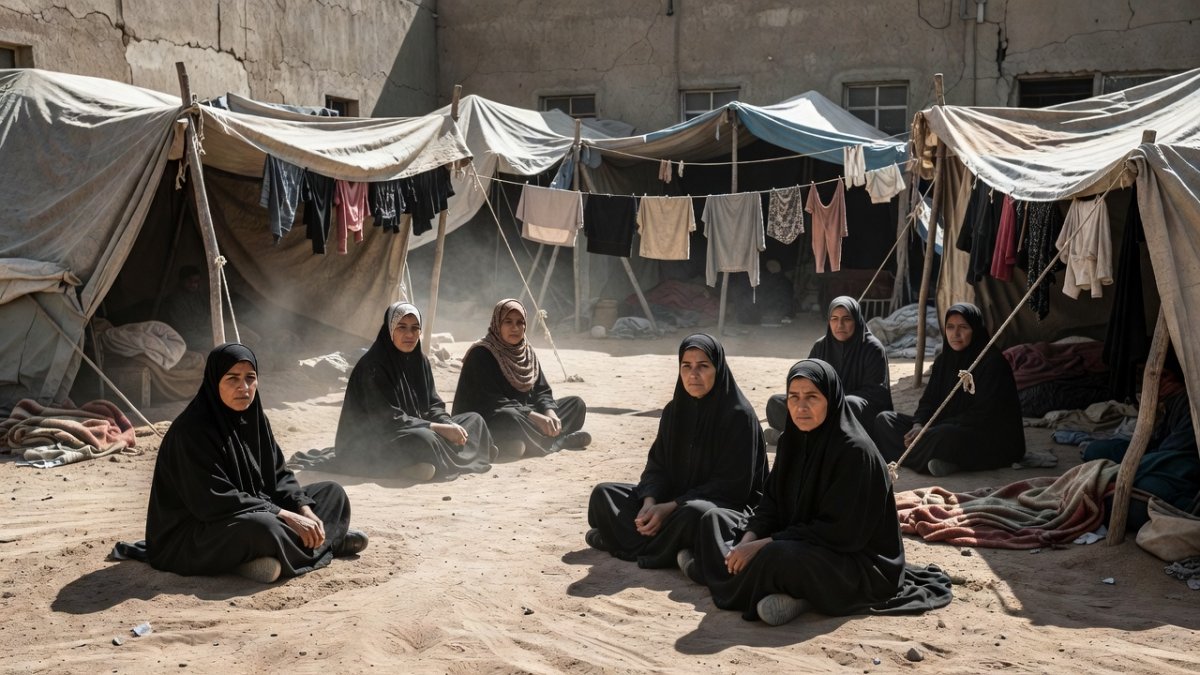
Afnan al-Soroori, 22, once enjoyed a middle-class life in Taiz, Yemen's third-largest city, where she studied at Taiz University and assisted her family with the support of modern appliances. As Houthi rebels approached her neighborhood a year ago, her family abandoned their home and sought shelter in a makeshift camp inside a school in the al-Safia area, 65 kilometers away. They left behind all possessions, and her father has been unable to secure employment since the move.
The transition replaced electric ovens and washing machines with firewood and hand washing in a courtyard bowl. Soroori's hands have hardened from repeated manual labor that stretches from dawn into the night. This displacement reflects patterns seen across Yemen's conflict, where families flee urban centers only to encounter new forms of hardship in rural settings.
Loss of Independence and Daily Confinement
Soroori described the greatest difficulty as the inability to leave the camp freely. Attempts to step outside the gates result in groups of young men shouting abuse or making sexual advances. She noted that such encounters, especially in the afternoon, force women to remain inside to avoid further incidents. Her urban clothing style, including fitted abayas common in Taiz, has drawn particular attention in the more conservative countryside.
Her father appealed to local tribal elders and religious leaders at village mosques to request respectful treatment of city women. Instead, many responses criticized the women's attire and behavior as inappropriate. The family concluded that staying within the camp boundaries was the only immediate option until return to Taiz becomes possible.
Similar Experiences Among Other Camp Residents
Mariam Abdul-Qader, 23, also residing in the al-Safia camp, attempted to adopt local dress including traditional coverings. She reported that youths still identified her by her sandals and walking style, leading to continued verbal harassment. Women in the camp have tried traveling in groups for protection, yet name-calling and aggressive gestures persist regardless.
Abdul-Qader expressed frustration with the war that displaced them into an environment where their suffering receives little recognition. These accounts illustrate how displacement compounds existing vulnerabilities for women who must navigate unfamiliar social expectations while coping with the absence of prior support systems.
Cultural Tensions and Local Reactions
Local residents have voiced concerns that the arrival of urban families disrupts longstanding rural customs. Sheikh Mohammed Gobah stated that sexual harassment had become a notable issue in the area and attributed it to the immodesty of city women. Earlier, he noted he had not encountered such problems before the influx of displaced families.
City families view these interpretations as skewed versions of Islam and Yemeni traditions, yet they lack leverage in the host community. The situation leaves women confined, unable to access nearby green spaces or perform routine tasks without risk. This dynamic highlights the friction that arises when conflict forces different cultural groups into close proximity.
Broader Patterns of Gender-Based Violence in Displacement
Stories from the al-Safia camp connect to wider experiences of women in Yemen's conflict, where flight from fighting often leads to secondary forms of victimization. Gender-based harassment emerges as a recurring barrier that restricts movement and reinforces isolation. Similar pressures appear in other displacement settings across the Middle East, including those affecting Palestinian communities under occupation, where women face overlapping threats from conflict and restrictive social environments.
The double burden involves both the loss of home and the imposition of new controls on daily life. Without external intervention or improved security, women remain trapped between the violence that prompted their move and the harassment that follows them into temporary shelters. Figures on the scale of such incidents in rural camps were not immediately available from official sources.
Paths Toward Recognition and Protection
Efforts by camp residents to seek mediation through mosques and elders have so far yielded limited results. The women continue to document their restrictions while maintaining routines within the school grounds. Their accounts emphasize the need for responses that address both the root conflict driving displacement and the immediate safety concerns in host areas.
Continued coverage of these experiences serves to record the specific challenges faced by displaced Yemeni women and to place them within regional discussions of human rights during prolonged instability. Return to Taiz remains the stated goal for families like Soroori's, though the timeline depends on developments in the wider fighting.
By Fatima Al-Rashid, Staff WriterThis article was produced with AI-assisted research and editorial support. Reporting is based on sources cited in the article.
What's Your Reaction?
 Like
0
Like
0
 Dislike
0
Dislike
0
 Love
0
Love
0
 Funny
0
Funny
0
 Wow
0
Wow
0
 Sad
0
Sad
0
 Angry
0
Angry
0

Gulf/MENA Correspondent at Global1.News. Based in Doha, covering Gulf politics, energy markets, diplomacy, and development across the Middle East and North Africa. Tracks the economic transformation of the Gulf states.















Comments (0)