
ASEAN Fragmentation and South Korea's Strategic Recalibration in the Mekong Region
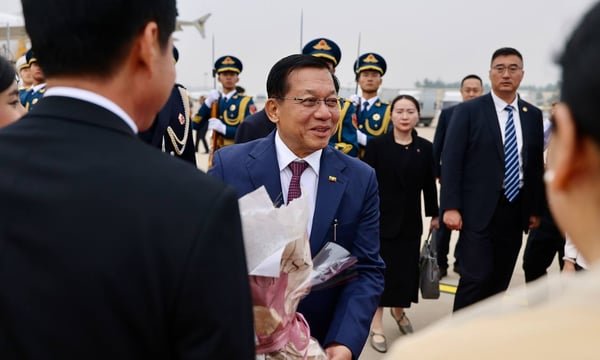
(The Diplomat) The Laos Visit: Legitimacy Seeking and ASEAN's Credibility Test The July 3-5 2026 visit by Myanmar’s Min Aung Hlaing to Laos marks the first official ASEAN-country trip by the self-anointed president since the 2021 coup. Announced in the Global New Light of Myanmar on July 1 and confirmed by the Vientiane Times, the itinerary commemorates the 70th anniversary of
(The Diplomat)
The Laos Visit: Legitimacy Seeking and ASEAN's Credibility Test
The July 3-5 2026 visit by Myanmar’s Min Aung Hlaing to Laos marks the first official ASEAN-country trip by the self-anointed president since the 2021 coup. Announced in the Global New Light of Myanmar on July 1 and confirmed by the Vientiane Times, the itinerary commemorates the 70th anniversary of diplomatic relations between the two states following an invitation from Lao President Thongloun Sisoulith. The timing is deliberate: shortly after Naypyidaw rejected the ASEAN chair’s request for access to Aung San Suu Kyi and dismissed the proof-of-life campaign led by her son Kim Aris, the regime converted diplomatic isolation into a bilateral showcase. This sequence exposes ASEAN’s enforcement deficit. The Five-Point Consensus, originally adopted in April 2021, has remained unimplemented for more than five years; the junta’s limited prisoner releases and Suu Kyi’s transfer to a designated residence have been cited by Philippine spokesperson Dominic “Dax” Imperial as tentative steps, yet the broader political dialogue envisioned in the consensus stays stalled. By hosting Min Aung Hlaing, Laos grants de facto recognition that undercuts the summit ban still in force. ASEAN’s credibility therefore hinges on whether maritime members can prevent further erosion of collective positions. The episode illustrates how bilateral hospitality can substitute for regional consensus, leaving the organization’s non-interference doctrine exposed when one member state prioritizes sovereign prerogative over institutional cohesion. South Korean observers at MOFA note that such fractures complicate coordinated responses to humanitarian crises and economic sanctions regimes alike.
Mainland Versus Maritime: ASEAN's Enduring Structural Divide
The CLM Club—Cambodia, Laos, and Myanmar—entered ASEAN in the late 1990s, introducing persistent fault lines between mainland and maritime states. These divisions crystallized around the South China Sea Code of Conduct negotiations, where CLM members frequently aligned with Chinese preferences, delaying progress and diluting language on dispute settlement. Vietnam, despite its own territorial claims, has occasionally found itself isolated within the bloc when Cambodia and Laos withhold support for joint statements. The 2021 Myanmar coup intensified these rifts: maritime states led calls for enforcement of the Five-Point Consensus, while CLM capitals maintained economic and political engagement with the junta. Thailand, geographically squeezed between these neighbors, has seen its Cambodian border remain closed, turning bilateral tensions into a regional flashpoint. The July 2026 Laos visit extends this pattern, positioning one-party solidarity above ASEAN-wide norms. Historical precedent shows that enlargement without institutional safeguards produced veto coalitions rather than deeper integration. For external partners, the divide necessitates differentiated diplomacy: engagement with maritime capitals on rules-based issues must coexist with calibrated outreach to CLM states on connectivity and development. Without mechanisms to reconcile these orientations, ASEAN risks becoming a venue for proxy competition rather than a coherent regional actor.
South Korea's New Southern Policy in an Era of ASEAN Fragmentation
South Korea’s New Southern Policy, launched in 2017 and later expanded under the Yoon administration, sought to diversify economic and diplomatic ties away from traditional Northeast Asian dependencies by elevating ASEAN to the level of a strategic partner. The policy targeted trade, investment, and people-to-people exchanges across all ten member states, with quantitative targets set by KIEP for doubling two-way investment by 2025. ASEAN disunity now directly undermines these diversification goals. When CLM states extend legitimacy to Myanmar’s junta while maritime members uphold the Five-Point Consensus, Seoul encounters contradictory signals on sanctions compliance, supply-chain resilience, and regional infrastructure projects. MOFA officials have acknowledged that fragmented ASEAN responses complicate the negotiation of region-wide agreements, forcing bilateral workarounds that raise transaction costs. The July 2026 Laos visit exemplifies the problem: any Korean participation in Mekong sub-regional initiatives risks association with a regime still excluded from ASEAN summits. KDI analyses further indicate that political instability in Myanmar has already delayed several Korean-backed industrial parks, illustrating how internal ASEAN fractures translate into concrete project-level uncertainty. Maintaining the New Southern Policy’s momentum therefore requires Seoul to develop parallel tracks that preserve collective frameworks while managing selective engagement with individual CLM capitals.
The Korea-ASEAN Solidarity Initiative (KASI): Mechanisms Under Pressure
The Korea-ASEAN Solidarity Initiative was designed to institutionalize cooperation through capacity-building programs, digital economy partnerships, and public-health collaboration administered via ASEAN Secretariat channels. KASI funding allocations tracked by KIEP have emphasized collective rather than bilateral modalities to reinforce ASEAN centrality. Selective engagement by Laos and Cambodia with Myanmar’s military authorities, however, erodes the initiative’s premise of unified regional ownership. When Vientiane hosts Min Aung Hlaing in July 2026, Korean-supported training modules on governance and rule of law risk being perceived as tacitly endorsed by a host that has chosen bilateral legitimacy over ASEAN consensus. MOFA has responded by inserting conditional clauses into KASI project documents that tie disbursements to progress on the Five-Point Consensus, yet enforcement remains difficult without ASEAN-wide agreement. The structural result is a gradual shift toward project-by-project vetting that increases administrative overhead and slows implementation. Historical comparison with earlier Korean initiatives in the Mekong region shows that bypassing collective mechanisms in favor of bilateral deals reduces long-term leverage on normative issues. Consequently, KASI’s effectiveness now depends on whether Seoul can persuade CLM states that sustained Korean engagement requires demonstrable alignment with ASEAN positions rather than unilateral hospitality toward excluded regimes.
Myanmar's Civil War and South Korea's Economic and Humanitarian Calculus
Myanmar’s civil war, triggered by the February 2021 coup, has produced an estimated death toll approaching 100,000 according to multiple monitoring organizations. Korean firms maintain exposure through energy and manufacturing investments concentrated in the Yangon and Thilawa special economic zones. These projects, supported by earlier New Southern Policy financing, now face heightened political and reputational risk. MOFA guidelines issued after the coup urged companies to conduct enhanced due-diligence reviews, yet complete divestment has proven impractical given sunk costs in gas pipelines and garment supply chains. Humanitarian concerns compound the dilemma: the junta’s refusal to grant access to Aung San Suu Kyi and its rejection of proof-of-life requests have drawn renewed international scrutiny. KDI scenario modeling suggests that prolonged conflict could reduce Korean FDI inflows to Myanmar by 35-40 percent through 2028, with spillover effects on regional value chains that include Vietnamese and Thai production nodes. At the same time, Seoul’s humanitarian assistance channel remains open through multilateral organizations, creating a dual-track posture that separates economic engagement from political signaling. The July 2026 Laos visit underscores the limits of this separation, as any visible Korean presence alongside CLM hosts may be interpreted as indirect recognition of the regime. Balancing commercial interests against normative commitments therefore requires clearer criteria for when economic recalibration becomes necessary.
Strategic Implications for Seoul's Indo-Pacific Framework
South Korea’s Indo-Pacific Framework positions the country as a contributor to a rules-based regional order, emphasizing freedom of navigation, inclusive economic governance, and support for ASEAN centrality. The widening ASEAN divide challenges this positioning by forcing Seoul to navigate competing expectations from maritime states seeking stronger normative alignment and CLM capitals prioritizing sovereignty and connectivity. Great-power competition amplifies the stakes: Chinese influence in Laos and Cambodia has already produced infrastructure dependencies that Korean initiatives must counterbalance without appearing to replicate bloc politics. The July 2026 Laos visit demonstrates how Myanmar’s isolation can be leveraged by Beijing-aligned networks, potentially drawing CLM states further from ASEAN consensus positions on the South China Sea. KIEP assessments warn that sustained fragmentation could reduce ASEAN’s collective bargaining power in trade negotiations, indirectly affecting Korea’s ability to secure high-standard digital and green economy provisions. Seoul’s response must therefore reinforce multilateral mechanisms while developing contingency options for differentiated engagement. Failure to adapt risks diluting the Indo-Pacific Framework’s credibility among partners who view ASEAN unity as a prerequisite for effective middle-power diplomacy.
The Path Forward: Selective Engagement and Institutional Adaptation
Going forward, South Korea should pursue calibrated bilateral engagement with Laos and Cambodia on non-political development projects while conditioning broader KASI participation on measurable steps toward Five-Point Consensus implementation. MOFA can expand existing trilateral formats with maritime ASEAN members to maintain momentum on rules-based issues even when consensus at ten proves elusive. KDI recommends establishing an ASEAN contingency fund that ring-fences humanitarian assistance from political recognition concerns, thereby preserving Korean credibility across divided capitals. Institutional adaptation also includes updating New Southern Policy metrics to account for sub-regional variation rather than treating ASEAN as a monolithic partner. By anchoring engagement in transparent criteria tied to ASEAN documents, Seoul can navigate the current fault lines without abandoning its commitment to regional centrality. Such an approach acknowledges that the July 2026 visit and its aftermath represent structural features of ASEAN rather than temporary anomalies, requiring sustained diplomatic flexibility grounded in documented institutional practice. By Prof. David Park, Staff Writer
This article was produced with AI-assisted research and editorial support. Reporting is based on sources cited in the article.
What's Your Reaction?
 Like
0
Like
0
 Dislike
0
Dislike
0
 Love
0
Love
0
 Funny
0
Funny
0
 Wow
0
Wow
0
 Sad
0
Sad
0
 Angry
0
Angry
0

East Asia/Technology Correspondent at Global1.News. Seoul-based voice covering Korean politics, technology, business, and culture. Analyzes how technology and geopolitics intersect across East Asia.












Comments (0)