
Bangkok Closes Roads After MRT Tunnel Water Intrusion at Wongwian Yai
MRTA engineers work to seal the groundwater leak at the southern Purple Line construction site in Wongwian Yai, Bangkok. (Khaosod English) The Incident at Wongwian Yai Construction Site Authorities closed all traffic lanes between Ban Khaek Intersection and Wongwian Yai after water leaked into a construction shaft of the southern Purple Line MRT project. The closure follows an
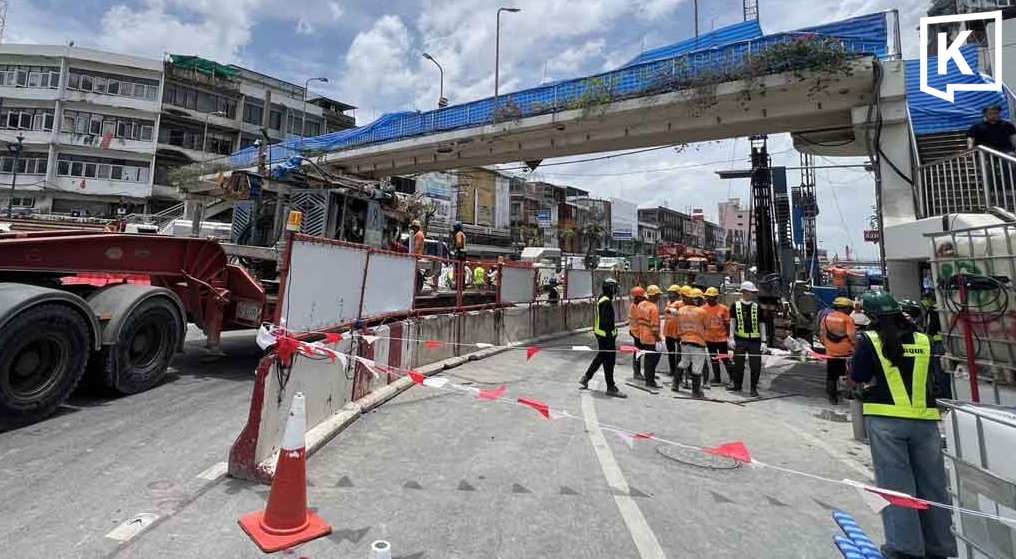
MRTA engineers work to seal the groundwater leak at the southern Purple Line construction site in Wongwian Yai, Bangkok. (Khaosod English)
The Incident at Wongwian Yai Construction Site
Authorities closed all traffic lanes between Ban Khaek Intersection and Wongwian Yai after water leaked into a construction shaft of the southern Purple Line MRT project. The closure follows an incident in which groundwater seeped into a sump pit beneath the underground railway construction site at Wongwian Yai. On the night of 8 July 2026, engineers began working to pump out water and repair the damaged section while monitoring conditions around the clock.
When reporters visited the site on the morning of 9 July 2026, officials from the Mass Rapid Transit Authority of Thailand remained on site. The leak originated from a defect in the project's sump pit, where groundwater is collected before being pumped out. This event occurred in a busy part of Thonburi that many Bangkok residents cross daily on their way to work or to visit family temples.
The situation drew immediate attention because Wongwian Yai sits at the heart of local commuting routes. Residents in nearby communities rely on Prajadhipok Road for quick access to the river ferry piers and markets. The sudden appearance of water inside the tunnel shaft reminded many of how delicate underground construction can be in a city built on soft soil near the Chao Phraya River.
Prime Minister Anutin's Visit and Government Response
On the night of 8 July 2026, Prime Minister Anutin Charnvirakul visited the site to monitor the situation. He stated that the accumulated water remained under control while instructing relevant agencies to resolve the problem quickly to ensure public safety. His presence underscored the government's commitment to protecting both workers and nearby communities during major infrastructure projects.
Thai leaders often visit construction sites during incidents to reassure citizens that their daily lives will not be disrupted for long. Prime Minister Anutin's instructions focused on rapid repairs and continuous monitoring. Government agencies coordinated with the Mass Rapid Transit Authority of Thailand to keep the public informed through regular updates.
The response reflects Bangkok's ongoing effort to balance rapid transit development with the safety of long-established neighbourhoods. Residents appreciate when senior officials appear in person because it signals that concerns from ordinary people will reach decision makers. The visit helped calm nerves in an area where many families have lived for generations.
Engineering Details of the Leak and Repairs
MRTA Chairman Montri Dechasakulsom said preliminary assessments indicate the leak originated from a defect in the project's sump pit. Engineers immediately began sealing the leak while continuously pumping water to prevent additional inflow. According to the MRTA, groundwater entered the construction site at a rate of about 70 cubic metres per hour overnight.
By the morning of 9 July 2026, the inflow had fallen to approximately 50 cubic metres per hour, indicating that the situation was improving. Montri stressed that the incident is unrelated to a previous groundwater leak reported at another construction site in Samsen, describing the latest case as a construction defect. The contractor has been instructed to complete repairs as quickly as possible.
To reduce groundwater pressure, the MRTA ordered additional dewatering measures, including drilling 50-metre-deep wells to draw groundwater away from the site. Grouting work to seal the leak has already been completed, while construction of an underground curtain wall is underway to prevent further seepage and minimise impacts on surrounding properties. The additional groundwater pumping system is expected to begin operating on 9 July 2026, with water extraction scheduled to start on 10 July 2026.
Construction of the underground curtain wall is expected to be completed within about one week. Officials said inspections have found no additional ground subsidence, structural tilting or new cracks. A nearby pedestrian bridge remains structurally sound, while district engineers have been asked to inspect surrounding buildings to reassure residents.
Traffic Impact and Road Closures on Prajadhipok Road
To facilitate repair work, authorities initially closed the two leftmost outbound lanes on Prajadhipok Road. From 11:00 on 9 July 2026, all traffic from Ban Khaek Intersection to Wongwian Yai via Prajadhipok Road was closed, with vehicles diverted onto the inbound carriageway. The full closure affects thousands of commuters who use this stretch daily to reach offices in central Bangkok or the Thonburi side markets.
Local traffic police worked with MRTA officials to set up clear diversion signs so drivers could adjust their routes without confusion. Many residents who normally travel this road by motorcycle or songthaew had to find alternative paths through smaller sois. The change added time to morning journeys for office workers heading toward the river crossings.
Prajadhipok Road serves as a vital link between the Wongwian Yai roundabout and the Ban Khaek area, carrying both private vehicles and public buses. The temporary diversion onto the inbound carriageway created a one-way flow that required careful coordination at intersections. Officials expect the full reopening once the underground curtain wall work finishes within the coming week.
Local Resident Concerns Near the Construction Site
Nearby residents expressed concern following the incident. Beam, a 28-year-old beverage vendor whose shop is close to the construction site, said he worries that the leak could worsen existing structural damage after the recent earthquake. He has operated his business in the area for about a year and has noticed gradual ground settlement, heavy dust from construction and strong vibrations during excavation and piling work.
Beam urged authorities to thoroughly inspect the area and ensure public safety, noting that the road is heavily used by commuters. He also showed reporters a crack beside a nearby building, saying it had appeared only recently after water seeped into the tunnel construction site. Many vendors like Beam depend on steady foot traffic along Prajadhipok Road for their daily income.
Residents in the Wongwian Yai community often gather in the evenings to discuss local matters over grilled snacks from street carts. The appearance of new cracks has made some families anxious about the safety of their homes, especially those living in older shophouses. Community leaders have asked district officials to hold meetings so everyone can hear the inspection results directly.
MRTA Safety Reassurances and Building Inspections
Responding to reports of cracks in nearby buildings and roads, Montri said some cracks predated the incident. However, contractors have been instructed to conduct detailed inspections of every building in the affected area alongside district engineering officials. These inspections aim to separate pre-existing issues from any new effects caused by the water intrusion.
MRTA teams continue to monitor the site around the clock to ensure conditions remain stable. Officials confirmed that no additional ground subsidence or structural tilting has been detected. The pedestrian bridge near the construction shaft was checked and found to be structurally sound, providing reassurance to people who cross it daily.
District engineers have begun walking through surrounding buildings to speak with residents and document any concerns. This hands-on approach helps build trust between the project team and the local community. MRTA Chairman Montri emphasised that public safety remains the top priority while repairs continue.
Broader Context of Purple Line Completion and Bangkok Infrastructure
The southern Purple Line MRT project remains on schedule for completion by the end of 2027, officials said, adding that the situation remains under control. Once finished, the line will connect Thonburi communities more efficiently with central Bangkok, reducing travel times for students, office workers and market vendors who cross the river every day.
Bangkok's expanding MRT network plays a central role in easing traffic congestion on major roads like Prajadhipok Road. The Purple Line extension will serve growing residential areas on the western side of the Chao Phraya, supporting both economic activity and daily commutes. Residents look forward to the convenience of new stations near Wongwian Yai once construction concludes.
Incidents like the recent water intrusion highlight the challenges of building underground infrastructure in a city with high groundwater levels and soft soil conditions. The MRTA's swift response, including the installation of deeper wells and the underground curtain wall, shows the agency's experience in managing such issues. Commuters hope the repairs will allow normal traffic flow to resume soon while the overall project stays on track for 2027.
Many Bangkok families already plan their routines around future MRT stations, imagining shorter journeys to work or visits to relatives across the river. The current road closure serves as a temporary reminder of the construction work required to bring those benefits. Officials continue to assure the public that safety measures and inspections will protect both the project timeline and the surrounding neighbourhoods.
By Ann Srisawat, Staff WriterThis article was produced with AI-assisted research and editorial support. Reporting is based on sources cited in the article.
What's Your Reaction?
 Like
0
Like
0
 Dislike
0
Dislike
0
 Love
0
Love
0
 Funny
0
Funny
0
 Wow
0
Wow
0
 Sad
0
Sad
0
 Angry
0
Angry
0

Southeast Asia Correspondent at Global1.News. Based in Bangkok, covering Thai and Southeast Asian politics, economy, technology, and culture. Deep regional perspective on one of the world's most dynamic regions.












Comments (0)