
Mexican Cartels Expand Meth Labs from Mexico into Nigeria
Mexican cartels have long dominated the methamphetamine trade through tightly controlled production networks inside their home country. Now those same organizations are shifting key operations thousands of miles away, planting sophisticated laboratories deep inside West African forests. This move allows them to tap new chemical supply routes and local labor while keeping their signature high-purity product flowing to global markets.
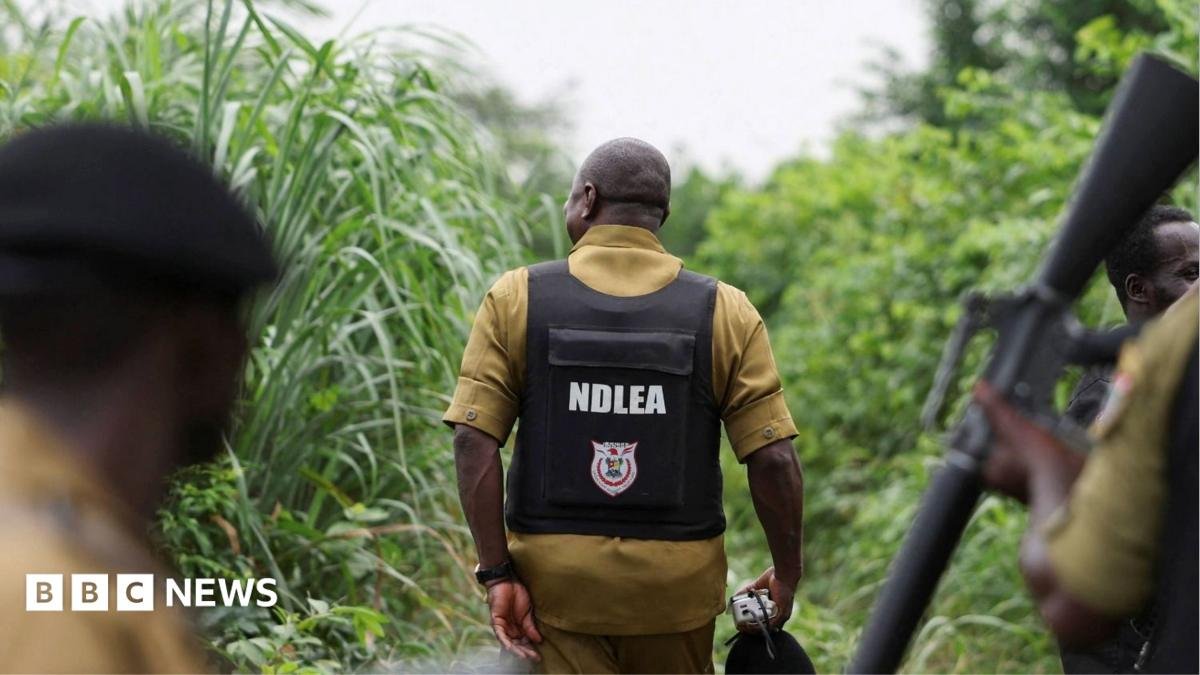
Cartels Expand Meth Labs from Mexico into Nigeria
Lagos, Nigeria — Anti-narcotics agents with the National Drug Law Enforcement Agency led a federal high court judge through an unfinished building hidden in dense forest two hours from Lagos. Three Mexican nationals and seven Nigerian suspects stood in handcuffs while the court examined drums of crystallizing methamphetamine and open vats of crude product. The raid, carried out in May, yielded more than two tonnes of the drug valued at roughly 360 million dollars and was described by the agency as the largest methamphetamine seizure in Nigerian history.
Raids Reveal Industrial-Scale Production
The makeshift laboratory contained propane cylinders, bags of caustic soda, and large quantities of precursor chemicals. A bitter, pungent odor hung over the site from the liquid methamphetamine still crystallizing in drums. Justice Musa Kakaki conducted the hearing on location so that the scale of the equipment and the sophistication of the process could be documented directly. One month later, agents uncovered a second laboratory in neighboring Oyo State and detained five more suspects, including a Mexican described as a methamphetamine expert.
Mexican Specialists Bring Technical Expertise
Law-enforcement agencies across Africa and Europe report that Mexican “cooks” are now working alongside local operators in multiple countries. These specialists have refined production methods over decades to achieve the highest purity and potency levels available on the market. James Griego of US-Africa Command noted that consumers seeking methamphetamine recognize Mexican product as the benchmark for quality. The same expertise that once operated inside Mexico is being deployed in new locations where oversight is lighter and raw materials can be sourced more discreetly.
The discovery of a courtroom-in-a-forest during the Nigerian raid underscores the brazen scale of these operations. Cartel-backed teams establish not just production sites but entire parallel infrastructures deep in remote areas. This level of organization reveals an industrial-scale enterprise capable of churning out vast quantities of methamphetamine, far beyond small-time efforts. The lab's $360 million valuation highlights the immense profits at stake for groups willing to export their expertise across continents.
Historically, the first Mexican-linked lab surfaced in Nigeria in 2016 and was already labeled a "super lab," marking the shift from mere transshipment points to full manufacturing hubs. Cartels have evolved dramatically since the Colombia-era days of simply moving cocaine through Africa. Today they embed technical experts to oversee end-to-end production, transforming the continent into a new frontier for synthetic drugs and challenging traditional supply chains that once relied on Latin American soil alone.
Fourteen Laboratories Linked to Cartel Networks
Since 2023, authorities have raided fourteen Mexican-operated laboratories across the continent. One appeared in Mozambique in 2023, six more surfaced the following year, two additional sites were found the year after that, and five were dismantled this year, four of them inside Nigeria. Intelligence shared by US-Africa Command and the US Drug Enforcement Administration has connected several of these facilities to the Sinaloa Cartel and the Jalisco New Generation Cartel. The pattern shows a deliberate strategy of outsourcing production while retaining technical control.
Synthetic Drugs Enable Rapid Global Scaling
Unlike cocaine or heroin, which require specific growing conditions and established agricultural networks, methamphetamine can be manufactured wherever the necessary chemicals and know-how are present. This flexibility lets criminal organizations move production quickly to regions with lower enforcement pressure. West Africa has shifted from a transit corridor to an active manufacturing zone, mirroring earlier moves into parts of Europe. The change reduces reliance on vulnerable land routes through Latin America and spreads risk across multiple jurisdictions.
Since 2023, authorities have uncovered fourteen Mexican-operated laboratories across Africa, with precise tallies showing one in Mozambique that year, six in 2024, two in 2025, and five in 2026 — including four in Nigeria. These figures point to accelerating expansion, driven by Sinaloa and CJNG networks that dispatch skilled "cooks" under cartel protection, ensuring technical control remains firmly in Mexican hands even as local labor handles the grunt work.
This pattern raises urgent questions for Latin America: are cartels diverting resources from domestic production to these overseas ventures? The mobility of these experts, backed by powerful organizations, suggests a strategic pivot that could strain home operations while spreading violence and corruption to new regions, echoing the global reach these groups have long pursued.
Financing Links Raise Regional Security Concerns
General Dagvin Anderson of US-Africa Command testified before Congress that militant groups in Africa are receiving increasing financial support from narcotics traffickers. The resulting revenue strengthens the operational reach and lethality of those armed organizations. For communities already struggling with weak state presence, the arrival of cartel-backed laboratories adds another layer of instability. The same dynamic that has long affected rural areas in Mexico and Central America is now appearing in West African forests.
Implications for Latin American Economies and Security
Cartels headquartered in western Mexico have spent years perfecting methamphetamine formulas that command premium prices worldwide. By relocating segments of that production, they free up resources at home while maintaining supply. The shift also complicates efforts by Mexican agencies such as SEDENA and SEMAR to interdict laboratories inside national territory. Meanwhile, the economic pull of high-value synthetic drugs continues to draw young people in both Latin America and West Africa into criminal networks that promise quick returns but deliver long-term violence and social damage.
Coordinated Enforcement Efforts Underway
US-Africa Command has supplied intelligence that supported several recent raids, including the large seizure near Lagos. National agencies in Nigeria, Kenya, Mozambique, and South Africa have each dismantled sites where Mexican personnel were present. These operations demonstrate that production can be disrupted when information is shared across borders. Yet the underlying demand for high-potency methamphetamine remains strong, ensuring that cartels will continue searching for new locations as soon as one laboratory is closed.
Mexico's domestic methamphetamine crisis continues to ravage communities with devastating health consequences, even as SEDENA and SEMAR interdiction successes appear to push production abroad. This displacement mirrors the earlier Colombian strategy of relocating cocaine processing to Ecuador and Central America, where weaker oversight allowed operations to flourish away from intensified pressure at home.
Precursor chemicals flowing from Asia through Latin American ports remain the critical lifeline sustaining these networks, fueling both local consumption and the outsourced labs now appearing in Africa. The long-term violence and social damage inflicted on the region demand coordinated responses, lest cartels further erode economies already burdened by addiction and instability.
By Elena Vasquez, Staff WriterThis article was produced with AI-assisted research and editorial support. Reporting is based on sources cited in the article.
What's Your Reaction?
 Like
0
Like
0
 Dislike
0
Dislike
0
 Love
0
Love
0
 Funny
0
Funny
0
 Wow
0
Wow
0
 Sad
0
Sad
0
 Angry
0
Angry
0
Latin America Correspondent at Global1.News. Based in Mexico City, covering politics, economics, energy, and culture across the region. Brings an on-the-ground perspective to stories spanning from the Rio Grande to Patagonia.










Comments (0)