
Pope Leo XIV: Don't Abandon Elderly This Summer
Pope Leo XIV's open letter from Castel Gandolfo urges families and parishes to include elderly relatives in summer plans to avoid isolation during August heat waves. The first American pope, born Robert Francis Prevost in Chicago and elected in 2025, draws on his Augustinian background to stress care for the vulnerable. His message coincides with traditional papal retreats at the lakeside estate, where he also plans a peace concert featuring Andrea Bocelli.
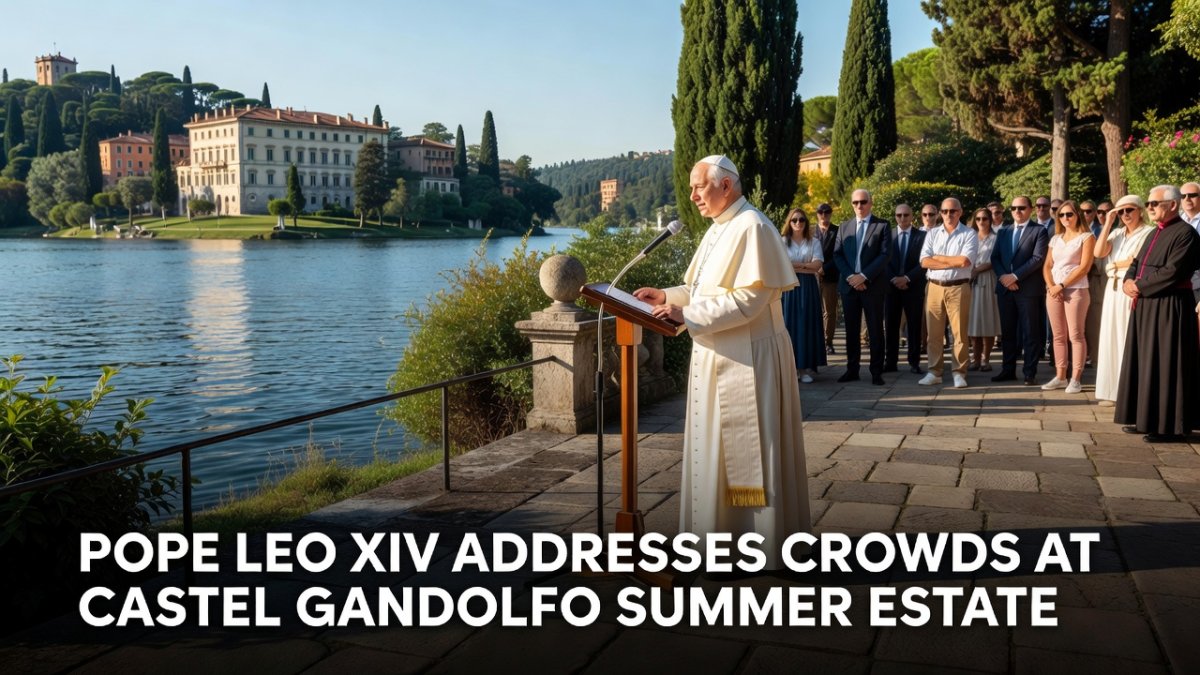
In a blunt open letter issued from Castel Gandolfo, Pope Leo XIV has warned families against leaving elderly relatives isolated in empty cities during August heat. The first American pope demands they be included in summer plans and calls on parishes to organize visits. His message lands amid centuries-old papal tradition at the lakeside estate.
Pope Leo XIV: Don't Abandon Elderly This Summer
Castel Gandolfo, Italy — July 29, 2026 — Pope Leo XIV used his summer residence to deliver a direct rebuke to families who sideline aging relatives during vacation season. In the July-August issue of Piazza San Pietro magazine, directed by Fr. Enzo Fortunato, the pope described elderly people “left alone in the city, forgotten by everyone in the heat of August.” He urged relatives to fold seniors into holiday arrangements and pressed parishes to launch companionship programs.
The Pope's Direct Appeal
The letter, published while Leo remains at the 135-acre Castel Gandolfo estate overlooking Lake Albano, stresses practical action over vague sentiment. Families must plan around elderly members rather than treating them as afterthoughts, the pope wrote. He also tasked local churches with creating structured visits so isolation does not become the default for those left behind when cities empty.
In language that echoes the directness of his Chicago upbringing, Pope Leo XIV writes of “summer abandonment,” describing elderly citizens “left alone in the city, forgotten by everyone in the heat of August.” The phrase captures a phenomenon that has grown more acute as Italy experiences increasingly severe heat waves; medical data show seniors over seventy-five suffer disproportionately from dehydration, cardiovascular strain, and social isolation when temperatures climb above 35 degrees Celsius. The pope’s letter therefore frames inclusion in family holidays not as optional courtesy but as a moral imperative.
Italian tradition once assumed that extended families would vacation together, with grandparents accompanying children and grandchildren to the seaside or mountains. Economic pressures, smaller households, and changing work patterns have eroded that custom, leaving many parishes to fill the resulting gaps. Leo explicitly tasks local churches with organizing structured visitation programs, arguing that the Church’s social mission must adapt to demographic realities rather than rely on outdated assumptions about family cohesion.
Profile of the First American Pope
Born Robert Francis Prevost on September 14, 1955, in Chicago, Leo XIV was elected on May 8, 2025, succeeding Pope Francis. His background as an Augustinian with decades of missionary and administrative experience shaped an early focus on social justice, care for the vulnerable, and environmental stewardship. Observers note these priorities now extend to concrete summer warnings about the elderly.
An American Pope's Vision for the Vulnerable
Born Robert Francis Prevost in Chicago in 1955, Leo XIV entered the Augustinian order and spent decades in missionary and administrative roles across Latin America and the United States before his elevation to cardinal in 2023. His election on May 8, 2025, marked the first time an American had ascended to the papacy, bringing an outsider’s perspective to an institution long dominated by European sensibilities. Observers note that his Augustinian formation—emphasizing communal living and care for the marginalized—has shaped a pontificate attentive to concrete social needs.
The 2025 encyclical on artificial intelligence and human dignity already demonstrated Leo’s willingness to link moral teaching to emerging technological risks. The summer letter on elderly isolation extends the same logic to a more immediate, seasonal crisis. Together the two documents reveal a consistent priority: defending human dignity wherever it is threatened by neglect, whether through algorithmic abstraction or the simple failure of families to remember their oldest members.
Castel Gandolfo's Historic Role
Popes have used the Castelli Romani retreat since the 17th century. Leo arrived on July 5, 2026, continuing that pattern while maintaining a lighter schedule. The estate provides space for reflection, yet the pope has kept public engagement alive through the magazine letter and scheduled events rather than full seclusion.
Popes have retreated to the Castelli Romani hills since Urban VIII purchased the estate in 1623, establishing a summer residence that offered escape from Rome’s stifling heat while maintaining proximity to the Eternal City. Over four centuries the 135-acre property evolved into a self-contained papal domain featuring formal Italianate gardens, a working farm that supplies fresh produce to the papal table, and sweeping views across Lake Albano. Successive pontiffs from Pius IX to John Paul II used the villa for both rest and discreet diplomacy, underscoring its dual role as sanctuary and seat of influence.
Pope Francis broke with precedent in 2016 by opening the gardens and apostolic palace to the public, transforming the once-exclusive retreat into a site of educational tours and cultural events. Leo XIV has signaled a return to a more traditional pattern of use. Since arriving on July 5, 2026, he has kept a lighter public schedule yet preserved the estate’s contemplative atmosphere, balancing private reflection with targeted outreach such as the open letter on elderly isolation.
Planned Concert for Peace
Among the summer activities, Leo is organizing a “Concert for Peace” at Castel Gandolfo featuring tenor Andrea Bocelli alongside a children's choir. The event aligns with his emphasis on human dignity and community ties. Details remain forthcoming, but the choice of performers signals an effort to draw broad participation beyond traditional Vatican audiences.
Tenor Andrea Bocelli’s participation in the “Concert for Peace” at Castel Gandolfo underscores the event’s ambition to reach beyond traditional Vatican audiences. Bocelli, whose blindness has made him a symbol of resilience, will perform alongside a children’s choir drawn from parishes across the Castelli Romani region. The juxtaposition of an internationally celebrated artist with young voices emphasizes intergenerational solidarity—the very theme animating the pope’s letter on the elderly.
Scheduled during the traditional summer pause, the concert functions as a form of cultural diplomacy that keeps the Vatican visible while most Roman institutions close. By staging the event at the lakeside estate rather than inside the Apostolic Palace, Leo signals openness to the wider community and a desire to model the inclusive spirit he advocates. Details of the program remain forthcoming, yet the choice of performers already conveys a message that peace begins with the deliberate inclusion of the vulnerable at every stage of life.
Recent Travels and Engagements
Before departing for the summer, Leo made an apostolic journey to Lampedusa on July 4. He also hosted U.S. Secretary of State Marco Rubio at the Vatican in May 2026. On July 26 he delivered the Angelus from Castel Gandolfo, reflecting on the Kingdom of God. These moves show continuity in addressing migration, diplomacy, and spiritual themes even during the traditional break.
Encyclical on AI and Human Dignity
Leo’s 2025 encyclical centered on AI ethics and the protection of human dignity amid rapid technological change. That document reinforced his pattern of linking moral teaching to contemporary risks, a thread now visible in the summer letter’s focus on physical and social isolation of the elderly. The same concern for the vulnerable runs through both texts.
By Jessica Ali, Staff Writer
This article was produced with AI-assisted research and editorial support. Reporting is based on sources cited in the article.
What's Your Reaction?
 Like
0
Like
0
 Dislike
0
Dislike
0
 Love
0
Love
0
 Funny
0
Funny
0
 Wow
0
Wow
0
 Sad
0
Sad
0
 Angry
0
Angry
0

Editor-in-Chief at Global1.News. Atlanta-based journalist who cuts through the BS and tells it like it is. Lead anchor, host, and the voice you hear when the spin stops and the truth starts.









Comments (0)