
AI and Assistive Tech Help Japan Meet Disability Quota
Keywords: Japan disability employment quota, assistive technology Japan, Society 5.0 accessibility, JEED support plans, generative AI workplace Japan, shrinking workforce Japan Japan Raises Disability Employment Target Amid Persistent Shortfalls Effective July 2026, Japan raised the statutory employment quota for persons with disabilities in the private sector to 2.7 percent, b
Japan Raises Disability Employment Target Amid Persistent Shortfalls
Effective July 2026, Japan raised the statutory employment quota for persons with disabilities in the private sector to 2.7 percent, building on the April 2024 adjustment from 2.3 percent to 2.5 percent. The revised rule now applies to all companies with 40 or more employees, down from the previous threshold of 43.5. Government data indicate that roughly 48 percent of covered firms still fell short of the 2.5 percent mark in fiscal 2025, with shortfalls most pronounced in retail, construction, and hospitality. Non-compliant employers face a monthly levy of 60,000 yen per unfilled position, while firms exceeding targets receive 27,000 yen per additional worker and an extra 21,000 yen incentive when hiring individuals with severe disabilities. These figures are collected and redistributed through the levy-incentive system administered by the Ministry of Health, Labour and Welfare, creating a direct financial mechanism that channels resources toward small and medium-sized enterprises demonstrating above-quota performance.
Technology's Role in Workplace Accessibility Across Japan
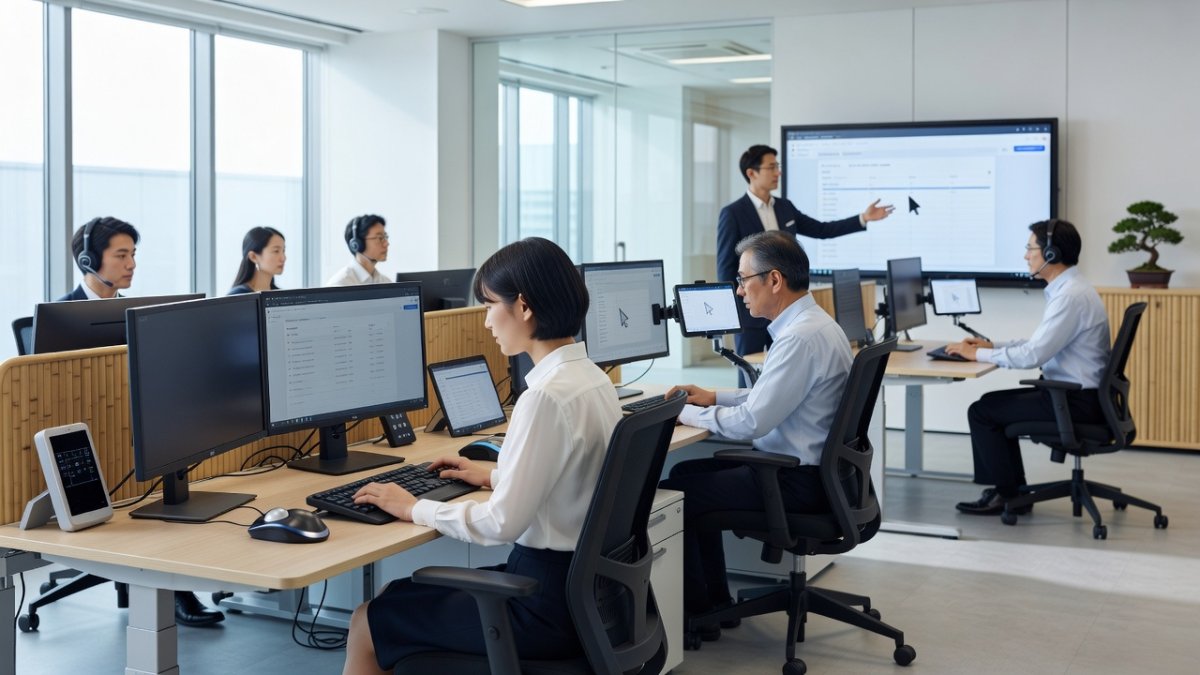
Japanese corporations are accelerating deployment of specialized assistive technologies to meet both quota obligations and operational needs. Panasonic has integrated its proprietary screen-reader software into internal document platforms used by 12,000 employees, enabling real-time conversion of visual content into audio or braille output. Fujitsu's voice-recognition suite, deployed across 45 client sites in manufacturing and finance, supports hands-free operation of enterprise resource planning systems with 94 percent accuracy for standard Japanese business vocabulary. Sony's eye-tracking hardware, piloted at its Atsugi research facility, allows employees with severe mobility limitations to navigate digital whiteboards and control robotic assembly arms through gaze patterns alone. AI transcription services from Hitachi Vantara convert meeting audio into synchronized text and sign-language avatars, reducing the administrative burden on staff with hearing impairments. Digital whiteboards equipped with collaborative annotation layers from Sharp are now standard in 320 government-linked offices, permitting remote participants to contribute without physical presence. These tools are frequently paired with JEED-provided devices, ensuring smaller firms without dedicated IT teams can adopt solutions previously limited to large enterprises.
Generative AI Breaks Down Complex Tasks for Mental Disabilities
Software firm SHIFT has scaled its generative AI workflow decomposition platform to more than 180 client organizations since 2024. The system ingests existing project management data and produces individualized task sequences that isolate discrete deliverables, typically reducing cognitive load by 35 to 40 percent according to internal SHIFT metrics. AKKODiS Consulting complements this approach with a manager-support AI trained on anonymized accommodation records from 92 companies. The model recommends concrete adjustments such as asynchronous meeting formats, extended review periods, or reduced meeting durations, achieving a 28 percent improvement in retention rates for employees with mental disabilities in pilot cohorts. Both platforms operate within existing compliance frameworks, preserving core business processes while generating audit trails required for levy-incentive claims.
VR Simulations Build Colleague Understanding and Workplace Readiness
Recruitment agency Leverages has distributed 1,200 VR headset units to client firms since fiscal 2023. Each simulation replicates auditory hypersensitivity by amplifying ambient office noise to 85 decibels and models ADHD-related attention fragmentation through randomized visual interruptions. Participating teams report a 41 percent increase in willingness to adjust seating arrangements or lighting after completing the 25-minute sessions. The same headsets are used during pre-hire workspace audits, allowing facilities teams to identify acoustic or visual barriers before new employees arrive. Data collected from these sessions feed into individualized Support Plans for Employers prepared by local Vocational Centers.
JEED Expands Access to Assistive Devices and Support Planning
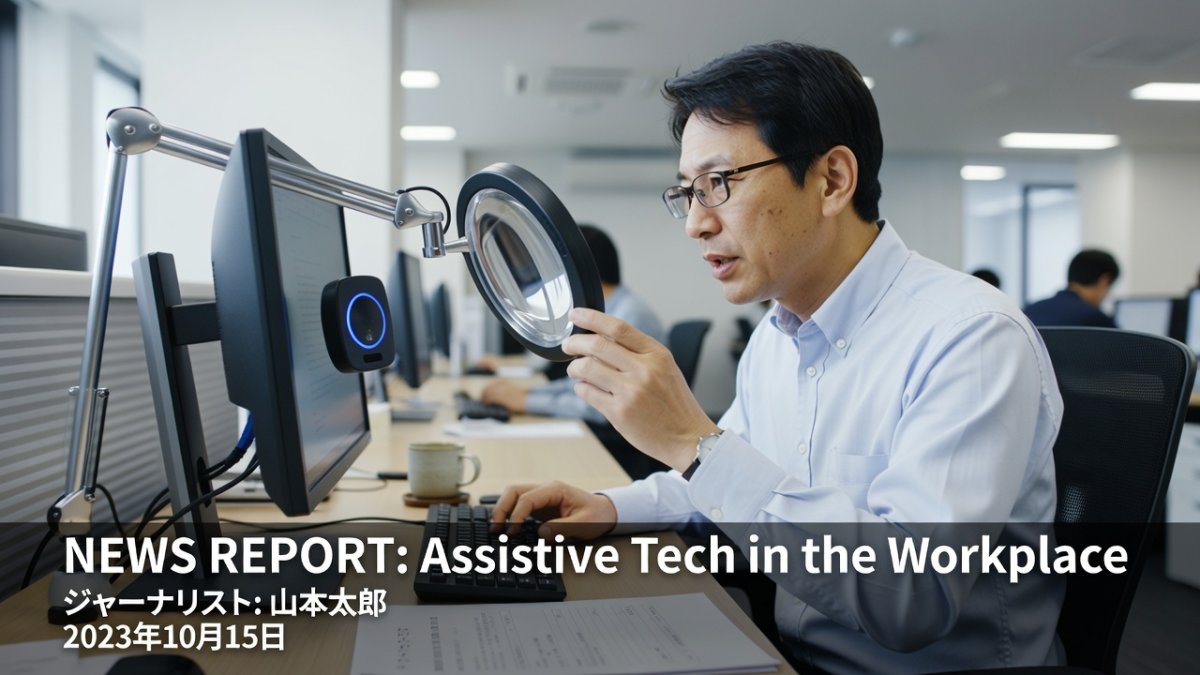
The Japan Organization for Employment of the Elderly and Persons with Disabilities maintains a national lending pool of 18,000 noise-cancelling headphones, screen magnifiers, and ergonomic input devices available at no cost to qualifying employers. In fiscal 2025, 6,400 new Support Plans for Employers were issued, each integrating at least two assistive devices with workflow modifications. Disability Employment Management Supporters conducted 2,100 on-site visits, focusing on firms with fewer than 100 employees that lack internal accessibility specialists. These visits have produced documented reductions in accommodation implementation time from an average of 14 weeks to 7 weeks.
Implications for Japan's Workforce and Economy
Japan's working-age population is projected to decline by 6.8 million people between 2025 and 2035. Raising the disability employment rate from the current 2.5 percent effective level toward the new 2.7 percent target could add approximately 140,000 additional workers to the labor force, partially offsetting this contraction. The aging population further intensifies pressure, with the ratio of persons aged 65 and older expected to reach 30 percent by 2030. Maximizing participation among individuals with disabilities therefore constitutes a structural necessity rather than a compliance exercise. Sectors already experiencing acute shortages—information technology, advanced manufacturing, and professional services—stand to gain the most from technology-enabled task modularization that converts previously inaccessible roles into viable positions.
Policy Framework Links Quota Compliance to Society 5.0 Objectives
Japan's Digital Agency has embedded accessibility standards into the Society 5.0 digital transformation roadmap, requiring all new government-funded platforms to meet WCAG 2.2 AA criteria by March 2027. METI has aligned its DX certification program with these requirements, granting preferential financing to firms that demonstrate inclusive technology adoption. The levy-incentive system was refined in April 2025 through a 10 percent reduction in the exclusion rate applied to industries classified as difficult to accommodate, thereby broadening the pool of positions subject to quota calculations. These policy linkages treat accessibility as an integral component of national digital strategy rather than an isolated labor-market measure.
Flexible Career Structures at Kirin Holdings Demonstrate Scalable Models
Kirin Holdings introduced a dual-track career system in 2024 that allows newly hired employees with disabilities to select either standard career-track positions involving mandatory geographic transfers or area-restricted roles that eliminate relocation requirements. The program is supported by cloud-based collaboration platforms that maintain project continuity across locations. As of mid-2026, 187 employees have exercised the area-restricted option, with internal mobility data showing no statistically significant difference in promotion rates compared with the standard track. The model is now under review by three additional manufacturing conglomerates seeking similar adjustments.
Record Employment Figures Signal Gradual Progress
Official statistics recorded 677,461 workers with disabilities in 2024, representing the 21st consecutive annual increase. Technology-enabled accommodations appear to be widening the range of viable roles, particularly in software development, consulting, and precision manufacturing where task decomposition and remote interfaces are already established practices. The continued upward trajectory suggests that the combination of quota pressure, financial incentives, and assistive technology is producing measurable labor-market expansion.
What to Watch For
Observers should monitor the April 2027 scheduled review of the exclusion rate for difficult industries and any further tightening of the employee threshold below 40 workers. The Digital Agency's forthcoming accessibility certification framework for private-sector platforms, expected in late 2026, may introduce new compliance costs and opportunities. Expansion of eye-tracking and AI transcription pilots into mid-sized manufacturers will indicate whether current large-enterprise advantages diffuse more broadly. Finally, the effectiveness of VR-based empathy training in reducing accommodation-related disputes will be tested as more firms publish retention metrics tied to these programs.
By Kenji Tanaka, Staff Writer
This article was produced with AI-assisted research and editorial support. Reporting is based on sources cited in the article.
What's Your Reaction?
 Like
0
Like
0
 Dislike
0
Dislike
0
 Love
0
Love
0
 Funny
0
Funny
0
 Wow
0
Wow
0
 Sad
0
Sad
0
 Angry
0
Angry
0

Japan Correspondent at Global1.News. Tokyo-based voice covering Japanese politics, technology, economy, and culture. Tracks the intersection of tradition and innovation in one of the world's most dynamic societies.














Comments (0)