
Trump Turns 80, Drops Iran Deal Framework — Netanyahu Connection Ignites Debate
The 80th Birthday That Broke the Mold President Donald Trump marked his 80th birthday on June 14, 2026, with a spectacle that turned the White House South Lawn into a temporary UFC arena. Fighters traded blows inside an octagon erected just yards from the Rose Garden while thousands of guests, including military veterans and donors, watched from bleachers under the June sun. Th
The 80th Birthday That Broke the Mold
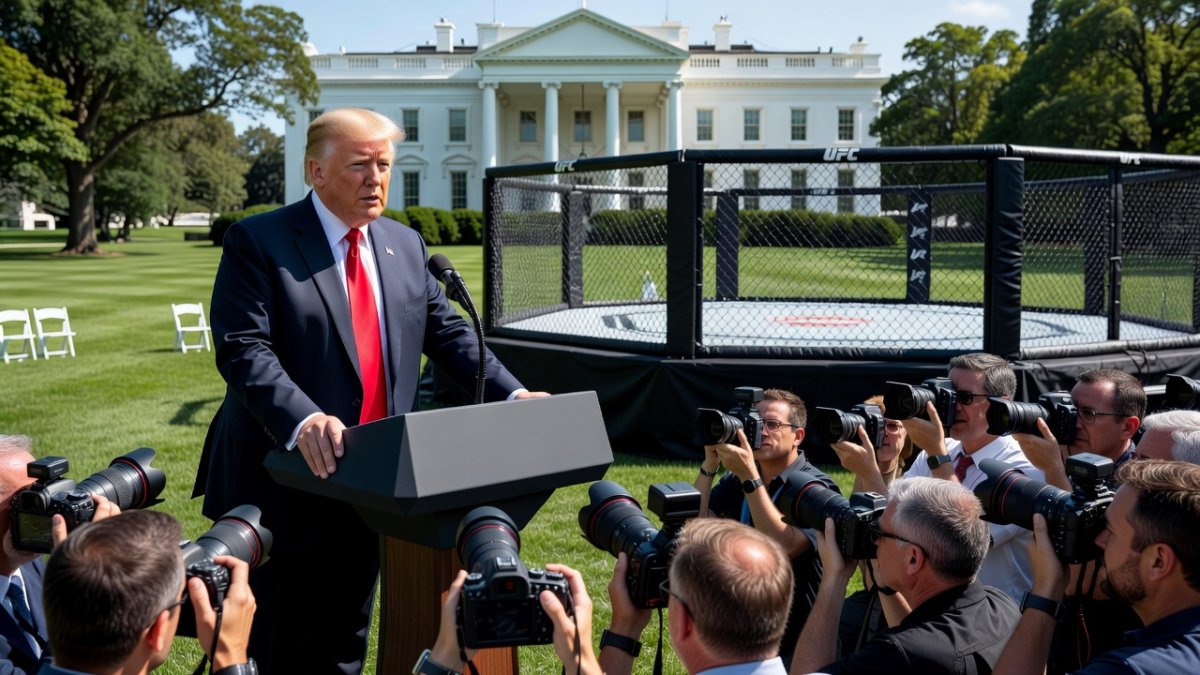
President Donald Trump marked his 80th birthday on June 14, 2026, with a spectacle that turned the White House South Lawn into a temporary UFC arena. Fighters traded blows inside an octagon erected just yards from the Rose Garden while thousands of guests, including military veterans and donors, watched from bleachers under the June sun. The event featured headline bouts streamed live and heavy security that kept protesters at a distance along Pennsylvania Avenue. Trump entered the cage wearing a red cap and boxing gloves, soaking in the chants before shifting the tone from entertainment to policy.
The deliberate messaging about strength came through every detail of the production. Organizers positioned the octagon to face the Washington Monument, creating a visual that blended combat sports with presidential power. Trump repeatedly referenced his own “fighting spirit” in remarks between rounds, tying personal longevity to national resolve against foreign adversaries. The choice of venue and format sent a clear signal that this birthday would not follow tradition but instead project dominance at home and abroad.
From inside the cage, Trump announced the preliminary Iran framework to a roaring crowd. He held up a single sheet of paper and declared an 18-month freeze on Iranian enrichment above 20 percent in exchange for phased sanctions relief. The moment blended political theater with statecraft as aides quickly distributed the text to reporters gathered ringside. The announcement caught even some senior officials off guard and immediately shifted the day’s focus from celebration to foreign policy.
Inside the Iran Framework — What It Does and Doesn't Do
The framework freezes Iranian uranium enrichment above 20 percent for 18 months while allowing Tehran to maintain its existing stockpile below that threshold. Phased sanctions relief would begin with limited oil export waivers and progress only if Iran meets quarterly reporting requirements verified by the IAEA. AP News reported that the deal explicitly avoids any requirement for Iran to dismantle centrifuges or ship out advanced equipment. Ballistic missile development remains untouched, leaving a major Israeli concern unaddressed in the text. The framework is a pause, not a solution, and labeling it otherwise would be dishonest.
Supporters inside the administration argue the pause buys time for diplomacy and reduces immediate breakout risk. Opponents counter that limited IAEA access and the absence of centrifuge restrictions leave Iran with a fast restart capability once the 18 months end. Reuters cited State Department sources confirming that inspectors would receive only 30 days’ notice for certain sites rather than the more intrusive snap inspections sought in earlier negotiations. The gap between what the deal achieves and what critics demand has already fueled sharp debate in Washington and Tel Aviv.
The agreement also leaves Iran’s regional proxy networks and conventional military programs outside its scope. No new restrictions appear on funding for Hezbollah or the Houthis, and sanctions tied to human rights or terrorism financing stay in place. This narrow focus reflects a deliberate choice to prioritize one technical threshold over a broader containment strategy. Both the administration and its detractors agree the text is a temporary measure rather than a comprehensive settlement.
Why Netanyahu Is Trending
Israeli Prime Minister Benjamin Netanyahu issued a statement from Jerusalem emphasizing the need for “ironclad security guarantees” beyond the current text. He welcomed the enrichment freeze but stressed that Israel would not rely solely on the 18-month pause. The remarks quickly dominated Israeli media and social platforms, pushing Netanyahu’s name worldwide. His measured tone masked deeper private concerns shared with aides about the deal’s durability.
Israeli intelligence had been briefed on the framework days before the public announcement, according to two officials in Tel Aviv who spoke to Reuters. The coordination allowed Netanyahu’s team to prepare talking points and avoid an immediate public rupture with Washington. Still, the prime minister faces domestic pressure from coalition partners who view any sanctions relief as a strategic error. The political calculation appears to be one of cautious engagement rather than outright rejection.
Netanyahu’s trending status also stems from his history of confronting Iran policy directly. Past clashes with the Obama administration over the 2015 deal gave him a ready audience both in Israel and among U.S. conservatives. This time the approach mixes public diplomacy with back-channel coordination, reflecting a more pragmatic stance ahead of Israeli elections. The result is intense scrutiny on how Israel will respond once the framework’s details are fully negotiated.
Israel's Security Calculus After the Deal
Israeli defense planners now assess that Iran’s breakout timeline remains roughly three months once the 18-month period ends, assuming no additional constraints on centrifuges. Covert operations targeting Iranian nuclear sites and supply chains are expected to intensify in the interim. Military officials in Tel Aviv have already requested accelerated U.S. deliveries of munitions and missile-defense interceptors to prepare for potential retaliation. The calculus prioritizes maintaining qualitative military edges while the diplomatic clock runs.
Pressure is mounting inside Israel’s security cabinet for formal written assurances from Washington on future sanctions snapback mechanisms. Defense officials are gaming multiple scenarios, including Iranian cheating and proxy attacks timed to the deal’s expiration. The absence of ballistic-missile limits in the current text remains the largest gap in their view. These calculations will shape Israel’s lobbying strategy in Congress over the coming months.
Regional Fallout — Who Wins, Who Loses
Sunni Arab states including Saudi Arabia, the UAE, and Bahrain have quietly questioned U.S. reliability after the announcement. Officials in Riyadh expressed concern that phased sanctions relief could strengthen Iran’s economy without curbing its regional ambitions. The Abraham Accords, already strained by Gaza fighting, face additional pressure as Gulf capitals reassess the value of close alignment with Washington. Several diplomats told AP News they may slow normalization efforts until clearer guardrails emerge.
Iran’s proxies gain immediate breathing room under the framework. Hezbollah can redirect resources previously tied up by sanctions enforcement, while Houthi forces in Yemen receive indirect financial relief through Iranian oil revenues. Hamas leaders in Gaza have already signaled they view the pause as an opportunity to rebuild capabilities. The narrow scope of the deal leaves these networks largely untouched.
China and Russia stand to benefit from any loosening of secondary sanctions that restricted their energy and arms dealings with Tehran. European governments have expressed cautious support but privately worry about enforcement gaps. The regional balance tilts toward short-term de-escalation at the nuclear level while conventional and proxy tensions remain unresolved.
Washington Reacts — Bipartisan Skepticism Meets MAGA Cheers
Democrats quickly labeled the announcement political theater designed to distract from domestic issues. House Foreign Affairs Committee members announced plans for hearings within weeks, citing the lack of congressional consultation. Several Republicans joined the criticism, arguing the framework repeats past mistakes without permanent limits. The split within the GOP reflects ongoing tension between Trump loyalists and national-security traditionalists.
MAGA-aligned voices celebrated the deal as proof of Trump’s deal-making strength and his willingness to bypass conventional diplomacy. Social media amplified clips of the cage announcement, framing it as a cultural victory over elite foreign-policy norms. Congressional offices on both sides report a surge in constituent calls, many focused on the culture-war framing rather than technical details. Hearings are expected to stretch into the fall.
What Happens When the 18 Months Expire
The 18-month period functions as a deferral rather than a resolution. Iran can use the window to rebuild economic resilience through renewed oil sales and investment inflows. By late 2027, Tehran could enter the final six months with stronger finances and an intact nuclear infrastructure, positioning itself for renewed leverage. U.S. officials acknowledge the timeline places any follow-on agreement squarely in the 2028 presidential cycle.
No permanent solution is embedded in the current text. Absent new negotiations, enrichment above 20 percent could resume in December 2027 with limited warning. Both sides have incentives to treat the pause as a tactical pause rather than a strategic endpoint. The absence of missile or proxy constraints ensures the underlying regional contest continues regardless of the nuclear calendar. This is kicking the can down a very long road, and the can has a tendency to roll back uphill.
The Bottom Line
June 14, 2026, showed how completely spectacle and statecraft have merged in Trump's second term. The UFC octagon on the South Lawn delivered a memorable visual, yet the Iran framework that emerged from it remains a narrow, time-limited instrument with clear expiration risks. Netanyahu's coordination with Israeli intelligence bought political breathing room, but the underlying security questions for Israel and its neighbors persist. The birthday display was a masterclass in stagecraft, but stagecraft does not stop centrifuges or secure borders.
The deal’s real test will come not on the birthday stage but in the quiet months of verification and proxy maneuvering that follow. Whether the 18-month freeze becomes a bridge to something more durable or simply another deferral depends on decisions still ahead in Washington, Jerusalem, and Tehran. The blend of cage-side announcements and incremental diplomacy defines the current moment more than any single clause in the text.
By Jessica Ali, Global 1 NewsThis article was produced with AI-assisted research and editorial support. Reporting is based on sources cited in the article.
What's Your Reaction?
 Like
0
Like
0
 Dislike
0
Dislike
0
 Love
0
Love
0
 Funny
0
Funny
0
 Wow
0
Wow
0
 Sad
0
Sad
0
 Angry
0
Angry
0

Editor-in-Chief at Global1.News. Atlanta-based journalist who cuts through the BS and tells it like it is. Lead anchor, host, and the voice you hear when the spin stops and the truth starts.













Comments (0)