
AMD Just Told Us the AI Hardware Market Will Hit $1.4 Trillion — and Nobody's Ready
AMD's Advancing AI 2026 keynote in San Francisco unveiled Helios rackscale production, $1.4 trillion AI accelerator TAM by 2030, and major customer wins from OpenAI, Anthropic, and Meta. Lisa Su's biggest show ever signals a structural shift in AI hardware competition.
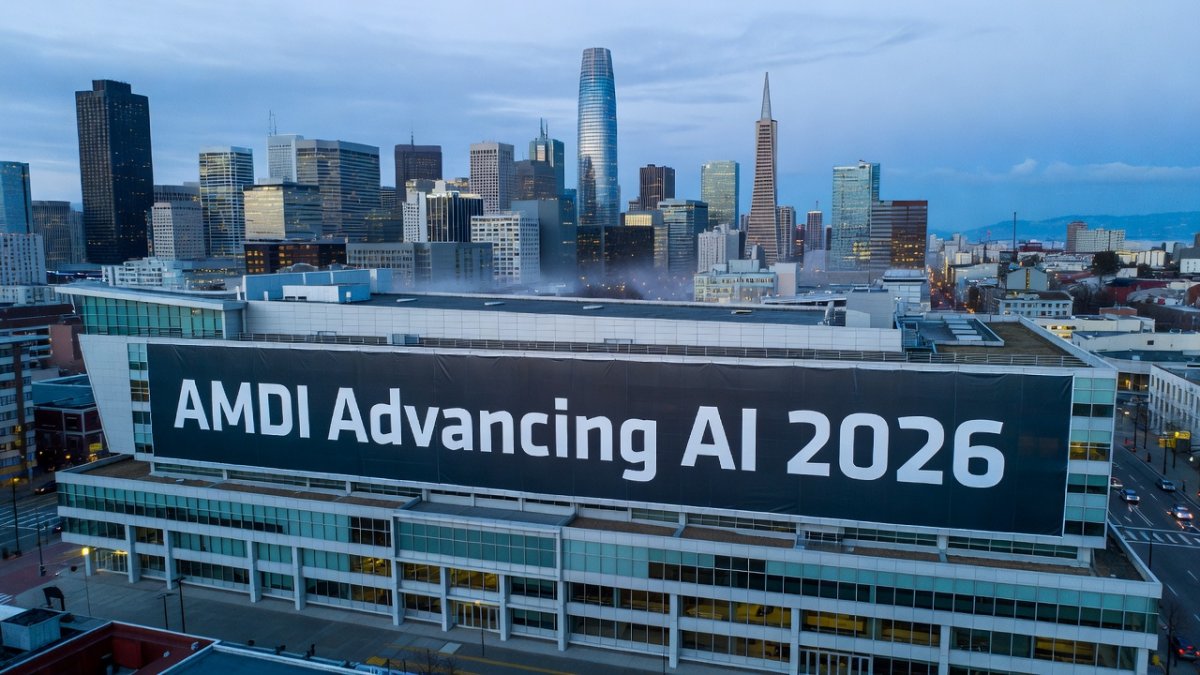
AMD Just Told Us the AI Hardware Market Will Hit $1.4 Trillion — and Nobody's Ready
I spent this morning with my laptop open to ServeTheHome's live blog of AMD's Advancing AI 2026 keynote in San Francisco, and I've been chewing on what I saw ever since. Let me tell you what happened: Lisa Su stood on stage at the Moscone Center, looked at a room so full they had to open an overflow section, and told the world that AMD now expects the AI accelerator market to hit $1.4 trillion by 2030. That is not a typo. That's the size of the entire semiconductor market today — just for AI accelerators. And here's the part that's been rattling around my head all afternoon: I think she might be right.
This wasn't a hype event. This was AMD's biggest show ever — filling the entire Moscone Center West — and they came with real hardware, real customers, and real timelines. Helios is in production. Venice is shipping. OpenAI and Anthropic both took the stage to say they're buying. Let me walk you through what actually happened and what it means for anyone running hosting infrastructure.
The Helios Moment — AMD's Answer to NVIDIA's NVL72
The centerpiece of the keynote was Helios, AMD's first rackscale AI system. This is their answer to NVIDIA's NVL72 — a complete rack that functions as a single machine, fusing MI455X GPUs, EPYC Venice CPUs, and Pensando Vulcano DPUs into one unified system. AMD has been teasing this for over a year, but today they made it real: Helios is in full production. Shipments start in Q3 2026, ramping through the second half of 2027.
The numbers are serious. The MI455X at the heart of Helios uses 2nm compute chiplets with 432GB of HBM4 memory. AMD claims up to 34x faster token throughput than the previous MI355X generation. That's not an incremental improvement — that's a generational leap that changes the economics of inference deployment. And they're claiming 30% more tokens per dollar than the competition, which in this context means NVIDIA's Blackwell racks.
But here's what caught my attention more than the specs: the customer lineup. OpenAI's Katti was on stage confirming they got a pre-production Helios rack months ago and expect to start deploying Helios by end of this year. Anthropic's Tom Brown announced a 2-gigawatt purchase of Helios hardware — that's 2,000 megawatts of AMD-powered compute for one customer. Meta's Santosh Janardhan was there talking about co-designing rackscale OCP standards with AMD and calling CPUs "just as important as GPUs, if not more."
Three of the biggest AI consumers on the planet all took the stage to say they're buying AMD. That is not nothing.
The $1.4 Trillion Question — Is the TAM Real or Just Stage Hype?
Let me be the guy who asks the uncomfortable question: a $1.4 trillion accelerator market by 2030 means AI hardware spending grows at something like 40% CAGR for the next four years. That's an extraordinary call. But Lisa Su didn't just throw out a number — she walked through the reasoning, and it's worth paying attention to.
The key insight from the keynote was the shift to agentic AI. Lisa made the point that inference has now overtaken training in total compute consumption. More AI compute capacity is used for running models than for building them. And agentic AI — where AI systems don't just answer questions but actually execute tasks — requires significantly more compute than the chatbot-style inference we've been doing. AMD's internal data shows the rate and pace of agentic AI adoption is much faster than they were expecting even six months ago.
Then there's the CPU angle. AMD expects the server CPU market to hit $220 billion by 2030, driven entirely by agentic AI workloads. Here's the logic: agents need CPUs to handle the orchestration layer — managing tasks, interacting with APIs, coordinating multiple GPU calls. Every agent you deploy needs CPU cycles to decide what to do before it asks the GPU to do it. The more agents, the more CPUs you need. AMD sees a world where every layer of the compute stack scales together, not just the GPU layer.
Put it all together and AMD is calling for a $2 trillion total silicon TAM by 2030 at 40% CAGR. That's the kind of number that makes hyperscaler capex plans look conservative.
Venice and the Return of CPU Importance
The most surprising part of the keynote for me wasn't the GPU news — it was how much time they spent on CPUs. AMD's new EPYC Venice architecture, built on Zen 6 at TSMC 2nm, delivers up to 256 cores per socket. Lisa called it "one of the largest generational gains in the history of EPYC." And they're making a direct comparison to NVIDIA's Vera CPU, claiming 2.2x performance per socket.
Now, I've been running servers for over a decade, and I've watched the CPU slowly become a commodity afterthought in the AI narrative. Everything has been about GPUs for two years straight. But AMD is making a credible argument that the CPU matters more than ever, and they have the roadmap to prove it. The Venice HF variant ships inside Helios racks. A 256-core dense version is coming for high-throughput workloads. Venice-X with 3D-stacked cache is on the roadmap. And after Venice comes Verano, which will go into AMD's next rackscale system in 2028.
For independent hosting providers, this matters more than the GPU news. AMD's CPU roadmap means we're going to see a flood of high-core-count server hardware hitting the market over the next 18 months. That means more options for compute workloads, better density for virtualization hosts, and potential downward pressure on older EPYC Turin hardware as Venice ramps. If you're planning a server refresh for late 2026 or early 2027, Venice-compatible platforms should be on your radar.
The Software Story — ROCm.AI and the Open Platform Bet
AMD also made their biggest software play yet. They introduced ROCm.AI, a new AI-driven development platform built on top of their ROCm stack. The idea is simple: instead of requiring developers to write low-level GPU kernels by hand, AI agents — powered by Codex and Claude — do the optimization automatically. They showed a demo where Hyperloom, their new code optimization tool, improved inference token throughput by 38% on AMD hardware without any manual tuning.
This is AMD's long-term bet on openness winning over lock-in. Every guest on that stage — Anthropic, OpenAI, Meta, Cerebras, AT&T, Cisco — talked about AMD's open platform strategy as a feature, not a bug. Anthropic's Tom Brown explicitly said AMD's open approach was "helpful for them." AT&T's Jeremy Legg talked about data sovereignty and "not being tied to specific hardware, models, or tools."
For a hosting provider, this matters because an open ecosystem means you're not locked into a single vendor's pricing model. If AMD's ROCm.AI makes it easier to deploy models on AMD hardware, and if the open platform attracts enough developer mindshare, we could see real GPU competition for the first time since CUDA became dominant. Competition means better pricing. Better pricing means better margins for hosting providers who offer GPU compute as a service.
What This Actually Means for Independent Hosting Providers
First — AMD's production ramp means GPU supply diversification is finally real. MI455X in production, MI350P PCIe launching for enterprise inference, MI430X for HPC coming in H1 2027, and MI500 promising "the largest generational leap" in 2028. If you've been waiting for an alternative to NVIDIA to build your GPU compute offerings, the window is opening. Start testing AMD hardware in your stack now, because the ecosystem takes time to mature and early movers will have an advantage when customers start asking for AMD-powered instances.
Second — The Venice CPU roadmap gives you a clear upgrade path for virtualization and general compute. Turin is already the best server CPU on the market. Venice will be significantly better — 256 cores on 2nm with Zen 6 IPC improvements. If you're running a hosting operation, plan your 2027 hardware budget around Venice-compatible platforms. The density gains alone will transform your colocation economics.
Third — The agentic AI thesis means CPU demand isn't going away. If AMD is right about agents needing lots of CPU orchestration, then the hyperscalers will be buying CPUs in unprecedented volumes alongside GPUs. That could tighten supply for enterprise and hosting customers. Lock in your CPU supply agreements earlier than you think you need to.
Fourth — Watch the inference market carefully. The MI350P PCIe card is a direct play for enterprise inference workloads — companies that want to run models locally without buying a full rackscale system. If AMD gets traction here, it opens a new market for hosting providers to offer on-prem or near-prem inference services. The PCIe form factor means existing colocation customers can drop these into their current racks without a data center redesign. That's a services opportunity worth exploring.
The Bottom Line
AMD's Advancing AI 2026 was not a hype event. It was a company that has spent five years building a credible data center portfolio showing up with real products, real customers writing checks, and a roadmap that goes all the way to 2030. The $1.4 trillion TAM number is going to get quoted endlessly in the financial press, but the real story for hosting providers is simpler than that: there is finally a real alternative in the AI hardware market.
Whether that alternative gains enough ecosystem traction to challenge NVIDIA's dominance is still an open question. But after today, it's a much more credible one than it was yesterday. And in a market where GPU availability has been the single biggest constraint on growth for two years running, having a second option — even an imperfect one — changes the math for everyone.
— Allan Ali, Founder
This article was produced with AI-assisted research and editorial support. Reporting is based on sources cited in the article.
What's Your Reaction?
 Like
0
Like
0
 Dislike
0
Dislike
0
 Love
0
Love
0
 Funny
0
Funny
0
 Wow
0
Wow
0
 Sad
0
Sad
0
 Angry
0
Angry
0

Publisher of Global1.News. Automation architect, systems builder, and the guy making sure the truth gets published.














Comments (0)