
Guterres Urges Full Sanctions Lift in Historic Syria Visit
UN Secretary-General Antonio Guterres made a landmark return to Syria after 17 years, urging the swift removal of all remaining sanctions to unlock the country’s recovery. His visit highlights a fleeting opportunity for the post-Assad government to stabilize the nation and address reconstruction costs estimated between 250 and 400 billion USD. Failure to act quickly risks deepening poverty, accelerating migration, and allowing regional rivals to shape Syria’s future.
Guterres Calls for Immediate Sanctions Relief During First UN Visit to Syria in 17 Years Damascus, Syria — Article continues...
Guterres Historic Return
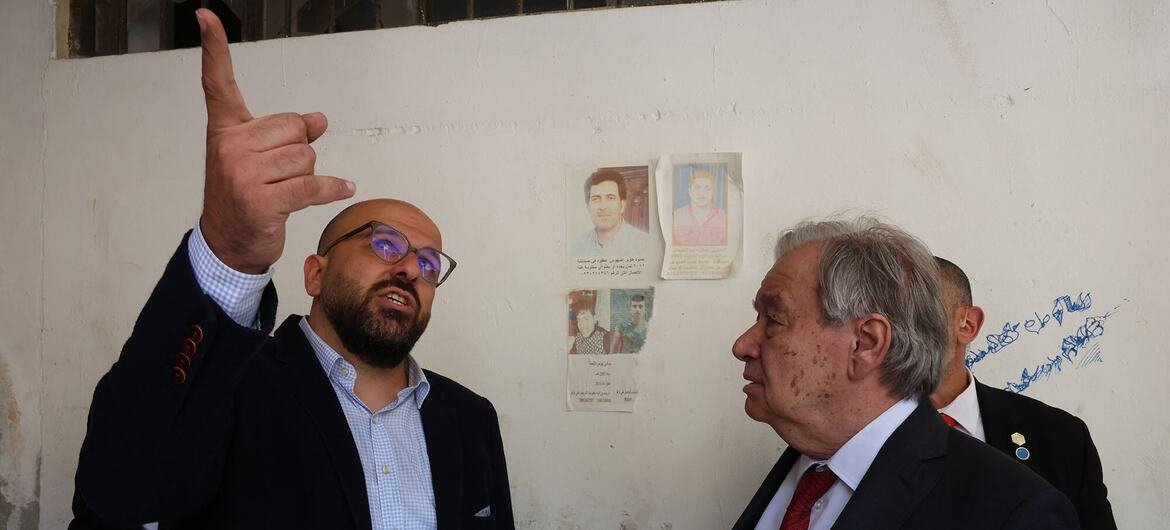
Damascus, July 27, 2026 — Antonio Guterres stepped onto Syrian soil for the first time as United Nations Secretary-General on July 25, marking the first such visit by any UN chief since Ban Ki-moon in 2009. The two-day trip unfolded against the backdrop of a country still reeling from the ouster of Bashar al-Assad in December 2024 after 24 years in power. Guterres met President Ahmad al-Sharaa and Foreign Minister Asaad al-Shibani in the capital, delivering a clear message: the international community must lift all remaining sanctions without delay.
In private sessions and public statements, Guterres framed the moment as a narrow window for national renewal. “After so much suffering, this period of transition is a rare moment in the life of a nation,” he said. He stressed that Syrians “should not have to carry the burden of recovery alone.” The language reflected both the scale of destruction and the political calculations now reshaping the Levant.
Ban Ki-moon never set foot in Syria during the height of the civil war despite repeated appeals from humanitarian agencies, underscoring how isolated the conflict zone had become after the 2011 Arab Spring uprisings. Guterres’s arrival therefore carried symbolic weight as the first visit by a UN chief in seventeen years, signaling renewed international engagement with a post-Assad order. During his stay he also held closed-door meetings with civil society representatives and women’s organizations in Damascus, including the Syrian Women’s Network and local human-rights defenders who presented detailed reports on missing persons and gender-based violence. These encounters highlighted the UN’s intent to broaden its outreach beyond official channels and incorporate grassroots perspectives into the reconstruction dialogue. Observers noted that such consultations could help legitimize the transitional authorities while addressing long-standing grievances that fueled the original uprising.
Sanctions Relief Debate
Guterres explicitly called for the immediate removal of the US Caesar Act sanctions enacted in 2019 and all European Union restrictive measures. He argued that these tools, once intended to pressure the Assad regime, now hinder the very recovery that could stabilize the region. World Bank estimates place reconstruction costs between 250 and 400 billion USD. The power grid stands 75 percent destroyed; water infrastructure across major basins remains devastated.
Diplomats in Damascus told this correspondent that Washington and Brussels are studying phased relief tied to verifiable steps on governance and security. Yet Guterres pushed for faster action, warning that prolonged restrictions risk entrenching poverty and driving further migration. Gulf states have already begun re-engaging: the UAE reopened its embassy in June 2025, while Saudi Arabia continues normalization talks. These moves suggest that regional capitals see economic opportunity in a sanctions-free Syria.
The Caesar Act’s Section 7411 specifically bars foreign banks from facilitating transactions involving Syrian energy, construction, and engineering sectors, effectively freezing most large-scale projects. The European Union maintains sanctions on more than 300 entities and individuals, including asset freezes and travel bans that extend to dual-use technology transfers. Iranian and Russian officials have publicly urged Damascus to resist any concessions that would dilute their economic footholds, with Moscow warning that premature relief could undermine existing reconstruction contracts. Meanwhile, IMF projections estimate that lifting primary sanctions could unlock 40 to 60 billion USD in annual foreign direct investment within three years, provided governance benchmarks are met. European diplomats stress that any phased approach must include independent audits of central-bank operations to prevent diversion of funds.
Saydnaya Prison and Accountability
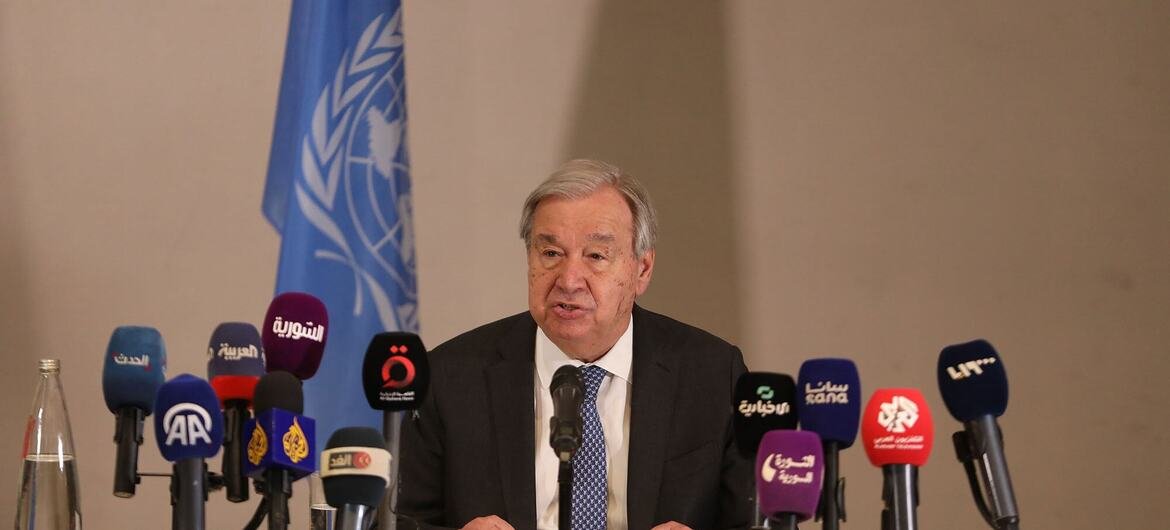
On July 26, Guterres toured Saydnaya military prison, guided by former detainee Diab Seriyeh. The facility, long notorious under the Assad government, was described by the Secretary-General as a “symbol of regime brutality.” Amnesty International estimates that roughly 13,000 people were executed there between 2011 and 2018. Guterres walked through cells and execution areas, pausing to speak with survivors who had returned as guides.
The visit underscored the new government’s willingness to open previously sealed sites. President al-Sharaa’s administration has invited international observers to document conditions, though questions remain about the pace of prosecutions and the handling of mass graves. Guterres noted that accountability mechanisms must accompany reconstruction if Syria is to avoid cycles of revenge.
Amnesty International’s 2017 report labeled Saydnaya a “human slaughterhouse,” documenting systematic hangings carried out after sham trials and detailing how prisoners were forced to stand for days in overcrowded cells before being led to execution chambers at night. Survivor testimonies collected by the organization describe guards using metal pipes and electric shocks as routine punishment, with bodies disposed in unmarked pits outside the facility. The transitional government has announced plans to establish a Truth and Dignity Commission modeled on Tunisia’s post-2011 body, yet legal experts note that Syria’s non-signatory status to the ICC Rome Statute limits direct referral options. International jurists therefore advocate hybrid tribunals or expanded UN investigative mechanisms to prosecute crimes against humanity while respecting Syrian sovereignty over domestic courts.
Regional Dynamics Shift
While Guterres met Syrian officials, Israel launched a limited military incursion into southern Syria on July 26, citing security concerns along the disengagement line. The Secretary-General reaffirmed that the Golan Heights remain Syrian territory under UN Security Council Resolution 497, a position that drew quiet approval from Damascus and criticism from Tel Aviv. The timing illustrated how quickly external actors are testing the post-Assad order.
Russia retains its Tartus naval base and Khmeimim airbase under new agreements with the transitional authorities. The United States continues a presence in northeast Syria focused on counter-ISIS operations. Turkey maintains influence in northern zones through local partners. China has signaled interest in Belt and Road projects once sanctions ease. These overlapping footprints create a crowded chessboard where any sanctions decision will ripple across multiple capitals.
Egypt has quietly re-established diplomatic channels with Damascus, dispatching trade delegations in early 2026 to explore agricultural and pharmaceutical exports that were curtailed under Assad. Jordanian officials have voiced concerns over border security, citing increased smuggling of captagon and weapons across the 375-kilometer frontier since the regime’s collapse. Hezbollah’s operational footprint in southern Syria has diminished markedly following Assad’s fall, reducing Iranian supply lines and prompting Israeli strikes on remaining depots. Gulf states are competing for influence through reconstruction tenders, with Qatar and the UAE offering competing financing packages for infrastructure while Saudi Arabia positions itself as the primary political broker. These overlapping interests complicate any unified sanctions strategy at the Security Council.
Reconstruction and Refugee Crisis
UNHCR figures show 5.5 million Syrian refugees still in neighboring countries and 7.2 million internally displaced. Many fled during the civil war that began in March 2011 and killed nearly half a million people. Guterres visited a Damascus reception center where returnees described destroyed homes and absent services. He urged donors to fund both immediate stabilization and long-term infrastructure repair.
Power shortages force factories to run at a fraction of capacity. Hospitals rely on generators whose fuel supplies remain erratic. The new government has prioritized electricity restoration in Aleppo and Homs, yet financing gaps persist. Chinese and Gulf investors have expressed interest in port and rail projects, but private capital is waiting for clearer sanctions relief and legal protections.
Sector assessments by the World Bank identify an immediate need for 35 billion USD in energy rehabilitation, 22 billion USD for water networks, and 48 billion USD for housing reconstruction across Aleppo, Homs, and Idlib. The European Commission has pledged 2.4 billion euros since 2024 yet has disbursed only 680 million euros, citing verification delays. Lebanon and Jordan together spend an estimated 4.1 billion USD annually on refugee services, straining public budgets and fueling domestic political tensions. Syrian professionals continue to emigrate at a rate of roughly 15,000 per month, accelerating brain drain in medicine, engineering, and education that could delay recovery by a decade if not reversed through targeted incentives.
Strategic Outlook
Guterres left Damascus on July 26 with commitments from al-Sharaa to allow expanded UN access for humanitarian monitoring. The Secretary-General’s office will now press the Security Council for a resolution linking sanctions suspension to measurable progress on detainee releases and basic services. European diplomats indicated that any such text would face scrutiny over verification mechanisms.
For Lebanon, the stakes are immediate. Porous borders have long allowed weapons, fighters, and refugees to move in both directions. A stable, sanctions-light Syria could ease pressure on Lebanese infrastructure and open trade corridors that have been closed for years. Conversely, renewed instability would export further shocks across the region.
Regional analysts note that the coming months will test whether the al-Sharaa government can convert international goodwill into tangible reconstruction funds. The UN visit has spotlighted both the humanitarian imperative and the geopolitical competition now unfolding over Syria’s future. How quickly sanctions are adjusted may determine whether this transition becomes a genuine turning point or another missed opportunity.
Comparisons to Iraq’s post-2003 reconstruction and Lebanon’s 1990s civil-war recovery reveal that both cases suffered from fragmented donor coordination and elite capture of funds, lessons Syrian officials are now studying. International financial institutions such as the World Bank and Islamic Development Bank are preparing standby facilities contingent on governance reforms, with initial disbursements possibly available within nine months if sanctions relief advances. European diplomats anticipate a Security Council sanctions review by March 2027, though any timeline will depend on documented progress in detainee releases and service restoration. Failure to meet these benchmarks risks repeating the prolonged stagnation seen in other post-conflict settings.
By Malik Hassan, Staff Writer
This article was produced with AI-assisted research and editorial support. Reporting is based on sources cited in the article.
What's Your Reaction?
 Like
0
Like
0
 Dislike
0
Dislike
0
 Love
0
Love
0
 Funny
0
Funny
0
 Wow
0
Wow
0
 Sad
0
Sad
0
 Angry
0
Angry
0
Middle East Correspondent at Global1.News. Based in Beirut, covering politics, conflict, energy, and society across the Middle East. Brings context and depth to a region often reduced to headlines.









Comments (0)