
270,000 evacuated amid devastating wildfires in Europe
More than a quarter of a million people have been forced from their homes as wildfires tear across three countries simultaneously, stretching emergency services to breaking point and prompting unprecedented military deployments on both sides of the English Channel. But for the first time, the UK itself is no longer watching from a safe distance.
More than a quarter of a million people have been forced from their homes as wildfires tear across three countries simultaneously, stretching emergency services to breaking point and prompting unprecedented military deployments on both sides of the English Channel. But for the first time, the UK itself is no longer watching from a safe distance.
Europe's Inferno: 270,000 Evacuated as Wildfires Engulf France, Spain and Scotland
London, UK – 26 July 2026 — The scale of the disaster unfolding across western Europe is almost impossible to get your head around. Nearly 200,000 people have fled their homes in southwestern France alone. Spain has declared its first ever national emergency over wildfires. And here in the UK, the Scottish government has been forced to request military assistance from Westminster as a blaze in the Cairngorms enters its eleventh day. This is not some distant European crisis. This is here.
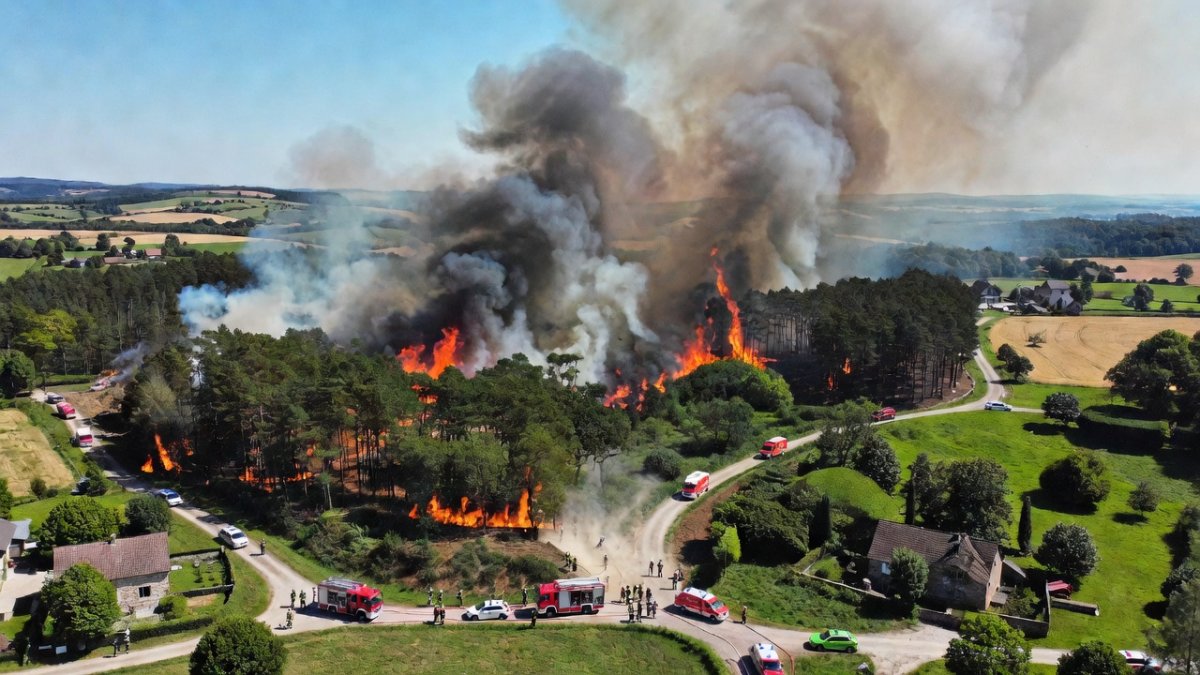
The Gironde Inferno — France's Military Mobilisation
The worst of the devastation is in France's Gironde department, where a massive fire fuelled by shifting winds and a climate-charged heatwave has advanced to within striking distance of Bordeaux itself. The French Interior Minister's warning of a "long and very difficult battle" now looks understated. As of Friday, more than 197,000 people in the southwest had been evacuated — a figure that rose by a further 55,000 on Saturday alone as the blaze jumped containment lines.
In an escalation that underscores just how severe this fire season has become, France has deployed its A400M military transport aircraft to support firefighting operations for the first time in the nation's history. Thousands of soldiers and security personnel have been mobilised alongside the Sécurité Civile, with the French government describing the situation in the Gironde as "unprecedented in the modern era." Entire suburbs of Bordeaux — the city's western flank — were ordered to evacuate as winds pushed the fire front towards urban areas. The Parc des Expositions de Bordeaux has been transformed into a makeshift shelter, housing thousands of displaced families with little more than the clothes on their backs.
Spain's First National Emergency — 70,000 Flee Madrid
Across the border in Spain, the government of Prime Minister Pedro Sánchez has taken the unprecedented step of declaring a national emergency over wildfires for the very first time. The declaration, made late on Thursday 23 July, placed the regions of Madrid and the neighbouring province of Ávila under central government coordination, with the Military Emergency Unit (UME) assuming operational command.
The numbers are staggering. Around 70,000 people have been evacuated from areas near the Spanish capital, with a single fire north-west of Madrid having scorched more than 35,000 hectares of land. A separate fast-moving blaze in the province of Ávila forced a further 11,500 people from their homes. Spain has formally requested assistance from the European Union's civil protection mechanism. Sánchez himself has warned that "difficult hours lie ahead," with high temperatures and low humidity forecast to persist through the weekend.
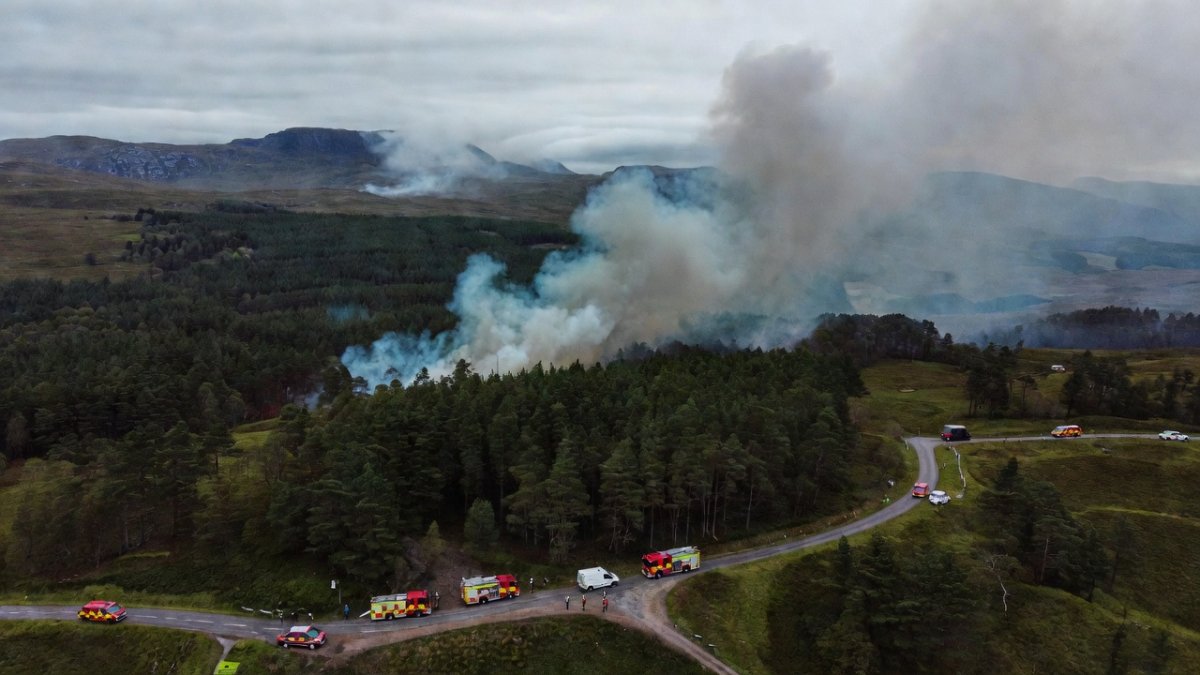
Scotland's Apocalyptic Landscape — The Cairngorms Fire
But the story that hits closest to home for UK viewers is unfolding in the Cairngorms National Park, where a wildfire has been burning for ten days with no end in sight. First Minister John Swinney has formally requested military aid from the UK Government — a significant step that reflects the severity of a blaze that has already consumed vast tracts of ancient Caledonian forest and forced the compulsory evacuation of the Highland village of Nethy Bridge.
Police Scotland declared a major incident on Friday 24 July after a sudden shift in wind conditions accelerated the fire's spread. More than 500 firefighters have been deployed to the region, with the Scottish Fire and Rescue Service drawing resources from across the country. Residents who were ordered to leave described the scene as "apocalyptic" — thick orange smoke blanketing the landscape, ash falling like snow, and the constant roar of flames consuming centuries-old woodland. The villagers of Nethy Bridge were permitted to return home on Saturday, but authorities have warned that the situation remains volatile and further evacuations cannot be ruled out.
The 'Firewave' — Why This Is Different
UK climate scientists and wildfire experts have been warning for years that Britain is not immune to the sort of landscape-scale fires that have historically been associated with the Mediterranean. That warnings has now become a lived reality. The UK is in what experts are calling a "firewave" — a sustained period of extreme heat and dry conditions that creates the ideal environment for wildfires to ignite and spread with terrifying speed.
Lindon Pronto, a fire management expert from the International Centre for Environmental Management, told Channel 4 News that the response to the current crisis reveals systemic failures in preparedness. "We have failed firefighters," Pronto said, pointing to chronic underinvestment in aerial firefighting capability and a lack of joined-up planning between devolved administrations and Whitehall. The Scottish government's request for military aid is, in Pronto's assessment, a symptom of a broader structural problem — emergency services across the UK simply do not have the equipment or capacity to handle fires of this scale.
European Context — A Continent on Fire
The fires currently burning across France, Spain and Scotland are part of a broader pattern of escalating wildfire risk across Europe. Data from the World Health Organisation's European Region shows that 2.2 million hectares of land were destroyed by wildfires in 2025 — a sharp increase from 1.4 million hectares in 2022 and part of a steady upward trend driven by rising global temperatures. In Spain and Portugal, the number of wildfires recorded this year has more than doubled compared with the same period in 2025.
At least 14 people have been killed by wildfires across Europe so far in 2026, with the worst-affected regions concentrated in the Mediterranean basin. But the spread of significant fires to northern latitudes — including Scotland and parts of Scandinavia — has alarmed experts who had previously considered such events unlikely. The climate models, it turns out, were conservative.
What This Means for the UK — Policy and Preparedness
The political implications of the Cairngorms fire are already reverberating through Westminster and Holyrood. The fact that the Scottish government had to formally request military assistance from the UK Government — and that such a request was deemed necessary at all — raises serious questions about the state of the UK's domestic emergency response infrastructure. The Home Office, which oversees the Fire and Rescue Service in England, has faced growing calls to commission a comprehensive review of wildfire preparedness across all four nations.
In the Scottish Parliament, opposition MSPs have accused the SNP-led government of being caught off-guard by the scale of the blaze despite repeated warnings from environmental agencies and fire experts. The debate over who pays for climate adaptation — and how quickly — is about to become a great deal more urgent. Meanwhile, residents of Nethy Bridge and other affected communities are left counting the cost of a disaster that many feel could have been mitigated with better planning and investment.
The Bottom Line — What Comes Next
The immediate priority for France, Spain and the UK remains containment. Weather forecasts offer little comfort: high pressure continues to dominate western Europe, with temperatures expected to remain above seasonal averages and no significant rainfall in sight. Firefighting operations in all three countries are likely to continue for days, if not weeks. The A400M deployment in France, the national emergency in Spain, and the military aid request in Scotland are not one-off responses — they are the new normal.
The question that now confronts governments across Europe is whether the pace of climate adaptation can catch up with the speed of climate breakdown. On current evidence, the answer is far from reassuring.
By Erica Thornton, Staff Writer
This article was produced with AI-assisted research and editorial support. Reporting is based on sources cited in the article.
What's Your Reaction?
 Like
0
Like
0
 Dislike
0
Dislike
0
 Love
0
Love
0
 Funny
0
Funny
0
 Wow
0
Wow
0
 Sad
0
Sad
0
 Angry
0
Angry
0

US Politics and Policy Correspondent at Global1.News. Based in Washington DC, covering American politics, policy, elections, and the courts. Knows how the system works and tells you what it actually means.














Comments (0)