
Putin's Closest Central Asian Ally Breaks Ranks — Kazakhstan's Tokayev Urges Russia to Freeze Ukraine War
OMSK, Siberia — July 26, 2026 In a development that could fracture the post-Soviet security architecture, Kazakhstan's President Kassym-Jomart Tokayev publicly challenged Vladimir Putin to freeze the Ukraine war, exposing rare daylight between Moscow and one of its most reliable allies.
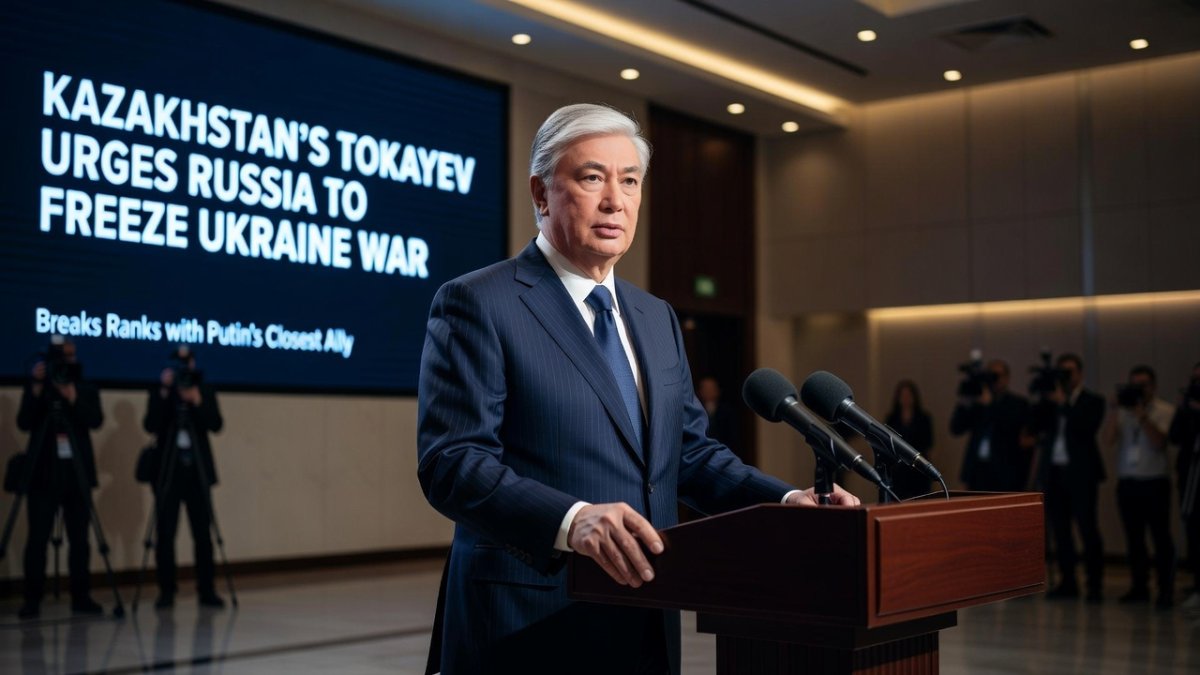
The Public Plea That Exposed Cracks in the Alliance
Picture the scene at the Kazakhstan-Russia Interregional Cooperation Forum. Tokayev didn't mince words. "It is a shame, young people are dying," he declared directly to Putin, urging a return to the Istanbul framework that once floated a possible off-ramp, as reported by Euronews and the Moscow Times. For years, Tokayev has tiptoed around the conflict, dodging recognition of Russia's land grabs while keeping economic ties tight. Not anymore. This rare public appeal lands like a grenade in the Kremlin's lap, signaling that even loyal satellites are fed up with the endless meat grinder.
Kremlin spokesman Dmitry Peskov tried to spin it later, telling Bloomberg and Interfax that Putin just laid out the "military operation" details and dismissed any ceasefire because of Kyiv's "current stance." Translation? Moscow's doubling down, but the mask is slipping. When your supposed best friend in the region calls you out live, it screams desperation. This isn't diplomacy theater — it's a warning shot that Russia's isolation is deepening faster than the body count.
Ukraine's Response: Cautious Welcome with Firm Conditions
Kyiv's reaction came swiftly through Foreign Minister Andrii Sybiha, who described Tokayev's intervention as a "constructive signal from an unexpected quarter" while stressing that any freeze must not reward aggression. Sybiha emphasized that Ukraine would only engage talks guaranteeing full Russian withdrawal from occupied territories and ironclad security assurances, rejecting neutrality without NATO path options. The statement signals Kyiv's openness to third-party mediation from Central Asia but also its hardened resolve against partial deals that could freeze the conflict on unfavorable lines. Analysts note this positions Ukraine to leverage growing allied fatigue without appearing intransigent.
Tokayev: From Soviet Diplomat to Independent Voice
Tokayev's diplomatic career began in the Soviet era, where he served as a foreign ministry official before representing Kazakhstan at the United Nations in the 1990s. This experience shaped his preference for multilateral engagement over outright alignment with any single power. Since assuming the presidency in 2019 following Nursultan Nazarbayev's resignation, he has pursued a careful balancing act among Russia, China, and the United States, securing investment from Beijing while maintaining energy ties with Moscow and seeking Western partnerships. Constitutional reforms enacted in 2022 reduced presidential powers and strengthened parliament, signaling a shift toward institutional stability rather than personal rule.
His refusal to recognize Russia's 2022 annexation of Donetsk and Luhansk further illustrated this independence, positioning Kazakhstan as a neutral actor capable of mediating without alienating key neighbors. These moves have allowed Tokayev to preserve Kazakhstan's sovereignty amid regional pressures, drawing on his UN-honed expertise in conflict resolution. By urging a freeze in Ukraine, Tokayev leverages this background to advocate for de-escalation that protects Central Asian stability and energy routes.
The Human Cost: Why Tokayev's Words Carry Unique Force
Russian casualties have surpassed 650,000 killed or wounded by mid-2026 according to Western intelligence estimates, with daily losses averaging 1,200 amid intensified Ukrainian drone and artillery strikes. Ukrainian resistance remains fierce, fueled by national mobilization and Western weapons that have blunted multiple Russian offensives. Tokayev's blunt reference to "young people dying" resonates powerfully precisely because it comes from a Russian ally rather than a Western critic, highlighting the war's demographic devastation on both sides and the futility of attritional fighting that drains future generations. This framing amplifies domestic Russian discontent over conscription and exposes how prolonged conflict erodes the very alliances Moscow relies upon for legitimacy.
Economic Pressure: Drones Choke Kazakhstan's Oil Lifeline
Don't buy the line that this is pure altruism. Kazakhstan's economy is bleeding because of Ukraine's Operation MoLoChKa, launched July 6. Ukrainian drones have hammered tankers at Russia's Caspian Pipeline Consortium terminal in Novorossiysk, disrupting the flow that carries 80% of Kazakhstan's oil exports. Production cuts followed fast, hitting hard currency reserves and exposing how Putin's war is now collateral damage for his neighbors. Tokayev's appeal carries the weight of self-preservation — keep the war grinding, and his country's energy sector tanks further.
This economic squeeze turns Tokayev's words into hard power politics. Kazakhstan can't afford to watch its main export route get strangled while Putin plays empire builder. The drone strikes prove Ukraine isn't just defending — it's projecting force deep into Russian logistics, forcing allies to choose sides. When oil money dries up, even CSTO loyalty frays.
Operation MoLoChKa: Ukraine's Drone Campaign in the Black Sea
The Ukrainian drone campaign known as Operation MoLoChKa, launched on July 6, 2026, under Colonel Robert Brovdi, codenamed Magyar, has intensified pressure on Russia's maritime logistics, as documented by multiple sources including Wikipedia and OilPrice.com. Targeting the shadow fleet operating in the Sea of Azov and Black Sea, the strikes aim to disrupt oil exports that fund Moscow's war effort. On July 19, drones hit the tankers ASIA and NISSOS IOS near Novorossiysk, damaging loading infrastructure and highlighting vulnerabilities in Russia's southern supply lines, according to the Moscow Times.
The CPC pipeline, which carries 1.2 million barrels per day from Kazakhstan through Russia, faces indirect risks from such disruptions. Kazakhstan's subsequent production cut announced on July 23 reflects the economic ripple effects, forcing Astana to recalibrate output amid heightened regional tensions. Analysis of the campaign shows how asymmetric tactics can constrain conventional naval power, with Brovdi's unit employing low-cost drones for high-impact results. Data from satellite tracking indicates reduced tanker traffic post-strikes, amplifying calls for negotiated pauses.
The Istanbul Framework: A Peace Plan Revived?
The Istanbul framework, proposed in early 2022, envisioned Ukrainian neutrality in exchange for international security guarantees, including limits on NATO expansion and protections for Russian-speaking populations. Negotiations collapsed in April 2022 following revelations of atrocities in Bucha, which hardened Ukrainian resolve and eroded trust. Reviving this outline now carries significance as a potential off-ramp, allowing both sides to claim partial victories without total capitulation.
A practical freeze would likely involve a demilitarized zone along current front lines, monitored by international observers from the OSCE or UN, alongside phased withdrawals and economic sanctions relief tied to compliance. Data on similar frozen conflicts, such as in Transnistria, suggest that sustained monitoring reduces flare-ups but requires robust enforcement mechanisms. Tokayev's endorsement highlights the framework's enduring relevance for de-escalation.
NATO's Ankara Summit: €70 Billion Pledge Reinforces Pressure for Talks
At the Ankara Summit, NATO allies committed EUR70 billion in additional military and economic aid to Ukraine through 2027, including advanced air defenses and long-range strike capabilities, according to the NATO Ankara Summit Declaration published July 8. This pledge directly aligns with Tokayev's call by sustaining Kyiv's defensive capacity, thereby raising the costs of continued Russian advances and incentivizing Moscow to consider a negotiated pause. The package signals unified Western determination to avoid a frozen conflict that leaves Ukraine vulnerable, complementing Central Asian mediation efforts with material support that prevents outright capitulation.
CSTO Cracks: Allies Watching the Kazakhstan Precedent
CSTO members including Armenia, Belarus, Kazakhstan, Kyrgyzstan, and Tajikistan have long formed Russia's primary security alliance in the post-Soviet space. Armenia's recent drift away from Moscow, marked by reduced military cooperation and overtures to the West, signals eroding cohesion within the bloc. This shift challenges Russia's influence in Central Asia, where economic dependencies on Moscow are increasingly weighed against diversification opportunities with China and the EU.
Kazakhstan's stance could embolden Kyrgyzstan or Tajikistan to pursue similar autonomy, particularly if energy and trade incentives align. Historical patterns of alliance fatigue in the region indicate that perceived Russian weakness accelerates realignments. Monitoring data from regional summits shows declining joint exercises, underscoring the potential for a broader reconfiguration of influence dynamics if the Ukraine conflict persists.
What Happens Next: Negotiation Scenarios, Escalation Risks, and Global Stakes
Long-term, this signals the conflict entering a phase where economic pain and alliance fractures outweigh battlefield gains. NATO's €70 billion aid pledge from the Ankara Summit keeps Ukraine in the fight, while Russian losses fuel domestic mobilization risks. Tokayev's stance proves even energy-dependent partners won't subsidize Putin's adventure forever. A freeze could lock in current lines with negotiated buffers, but only if both sides swallow hard truths — Ukraine gets security assurances, Russia avoids total collapse.
Scenarios range from a monitored armistice along current lines to renewed escalation if talks collapse, potentially drawing in wider Black Sea or Central Asian instability. Global stakes include disrupted grain and energy flows affecting food security in the Global South, heightened nuclear risks from prolonged fighting, and a precedent for alliance erosion that could embolden other revisionist powers. Ignore the Kremlin's bluster. This public break from a key ally, combined with targeted strikes disrupting vital exports, points to a war grinding toward stalemate or worse for Moscow. The young lives lost on both sides demand an end, and Tokayev just made that case where it hurts most — right next to Putin. The question now is whether the Kremlin listens before more dominoes fall.
By Jessica Ali, Staff Writer
This article was produced with AI-assisted research and editorial support. Reporting is based on sources cited in the article.
What's Your Reaction?
 Like
0
Like
0
 Dislike
0
Dislike
0
 Love
0
Love
0
 Funny
0
Funny
0
 Wow
0
Wow
0
 Sad
0
Sad
0
 Angry
0
Angry
0

Editor-in-Chief at Global1.News. Atlanta-based journalist who cuts through the BS and tells it like it is. Lead anchor, host, and the voice you hear when the spin stops and the truth starts.









Comments (0)