
Trump Tells Israel and Iran to Stop Shooting After Strikes
In a recent BBC News report, US President Donald Trump directly urged Israel and Iran to cease their exchanges of fire, as the two countries traded direct strikes for the first time since the fragile April ceasefire. The escalation unfolded with unusual speed across multiple fronts, pushing the Middle East to the edge of a wider regional war. Trump Tells Israel and Iran to Stop
In a recent BBC News report, US President Donald Trump directly urged Israel and Iran to cease their exchanges of fire, as the two countries traded direct strikes for the first time since the fragile April ceasefire. The escalation unfolded with unusual speed across multiple fronts, pushing the Middle East to the edge of a wider regional war.
Trump Tells Israel and Iran to Stop 'Shooting' as Direct Strikes Threaten April Ceasefire
Moscow, Russia – June 8, 2026 — The fragile April 2026 ceasefire between the United States and Iran had held for nearly two months, offering a brief respite after months of intense military exchanges that began in late February. But that pause shattered over the weekend when Israel carried out airstrikes on Hezbollah targets in the southern suburbs of Beirut, Lebanon's capital, on Sunday. The Israeli military said the strikes were a direct response to Hezbollah rocket fire into northern Israel, part of the ongoing cross-border exchanges that had simmered beneath the ceasefire's surface. At least two people were killed and twenty wounded in the Beirut strikes, according to Lebanese officials. What followed was a rapid and dangerous escalation: Iran's Islamic Revolutionary Guard Corps launched multiple waves of ballistic missiles toward northern Israel, targeting the Ramat David airbase. It marked the first direct Iranian attack on Israeli territory since the ceasefire was signed in April, effectively collapsing the diplomatic framework that Washington had spent weeks constructing.
Escalation After the April Ceasefire
The IRGC characterized its missile barrage not as a one-off response but as the start of a sustained campaign. In a statement that sent shockwaves through diplomatic circles, the IRGC declared the launches were "the beginning of a full week of continuous strikes" aimed at punishing Israel for its operations in Lebanon. Israeli air defense systems — including the Iron Dome and David's Sling — intercepted the majority of the incoming ballistic missiles, with the IDF confirming that most projectiles were neutralized before they could reach populated areas. No immediate casualties were reported on the Israeli side, a fact that Israeli officials cited as evidence of the effectiveness of their multi-layered defense network. Nevertheless, the psychological and strategic impact of Iran launching direct ballistic attacks on Israeli soil for the first time in months was profound, sending civilians across northern Israel into shelters and forcing a reassessment of the security situation.
Israel's Largest Retaliatory Operation
Israel's response came swiftly on Monday morning, as the Israel Defense Forces launched what it described as the largest aerial attack ever conducted by the Israeli Air Force. Warplanes struck multiple military targets across western and central Iran, with explosions reported in Tehran, the capital, as well as Isfahan, Karaj, and Tabriz. The IDF confirmed the strikes targeted Iranian surface-to-surface missile sites, air defense batteries, and Islamic Revolutionary Guard Corps military infrastructure. The scope of the operation was unprecedented — previous Israeli strikes on Iranian territory had been limited in scale and carefully calibrated to avoid provoking a full-scale response. Monday's operation signaled a shift in Israeli doctrine, demonstrating both the willingness and the capability to strike deep inside Iran with significant force.
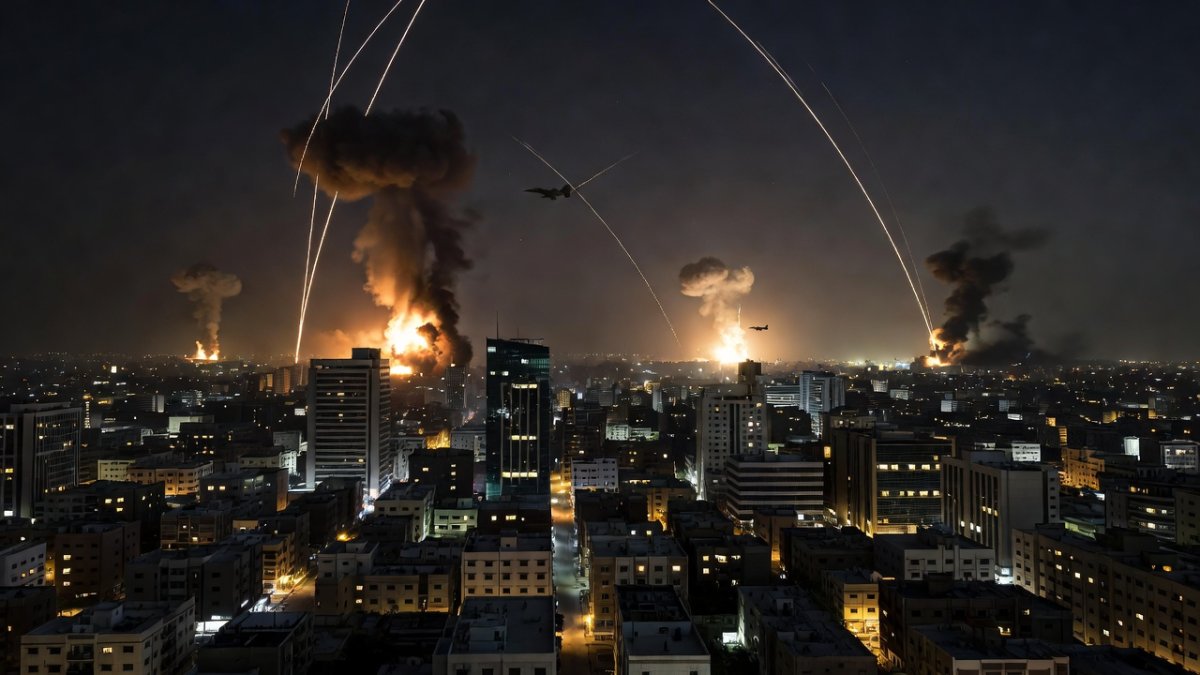
The human toll of the operation was substantial. According to The Jerusalem Post, Iran's defense minister and several IRGC generals were killed during the strikes, representing one of the most significant decapitation blows against Iranian military leadership in the conflict's history. Iranian state television confirmed explosions in multiple cities but provided limited details on casualties. The Iranian response was not confined to a bilateral exchange with Israel. Reports indicated that Iranian forces also fired missiles at Gulf nations and US military bases in the region, widening the geographic scope of the confrontation. Meanwhile, Yemen's Houthi rebels — an Iranian-backed group — announced a ban on Israeli vessels using Red Sea shipping lanes and declared they had launched a missile attack on Israel, raising the prospect of a multi-front crisis that could disrupt global trade routes and draw in additional regional actors.
Trump's Intervention: "Stop Shooting" and a Rift with Netanyahu
US President Donald Trump inserted himself into the escalating crisis with characteristic bluntness. In a post on his Truth Social platform early Monday, Trump wrote that "Israel and Iran must immediately stop 'shooting'," urging both sides to step back from the brink. But it was his interview with the Financial Times that drew the most attention. "I call the shots. I call all the shots. He [Netanyahu] doesn't call the shots," Trump told the newspaper, in an extraordinary public assertion of American authority over Israeli decision-making. He added that Netanyahu "won't have any choice" but to accept an agreement between the US and Iran, suggesting that Washington's diplomatic track with Tehran took priority over Jerusalem's security calculations. The remarks represented a stark departure from the traditional US posture of publicly backing Israel's right to self-defense.

Behind the scenes, the tension was even more pronounced. According to Axios, Trump had personally urged Netanyahu on Sunday not to retaliate against Iran following the missile barrage, hoping to preserve the diplomatic channel with Tehran. A US official told Axios that Trump was "pretty adamant that we are close to a deal with Iran," and did not want military escalation to derail negotiations. Despite this pressure, Israel proceeded with its massive strikes on Monday — a direct defiance of the president's request. The disconnect exposed a widening rift between Washington and Jerusalem over how to handle Iran. Trump later softened his tone, stating that both sides were "looking to do an immediate CEASEFIRE" and that "final negotiations on Peace are proceeding."
Iran Halts Operations — A Tactical Pause
Later on Monday, Iran's central military command — the Khatam Al-Anbia headquarters — announced a halt to military operations. In a carefully worded statement, it said Iranian forces had "delivered a painful response" to what it called "the atrocities of the brutal Zionist regime in southern Lebanon" and that Israel "and its supporters must learn a lesson" from the strikes. The announcement was framed as a mission accomplished: Iran had retaliated for the Beirut strikes, demonstrated its willingness to strike Israeli territory directly, and restored a measure of deterrence. But the statement also contained an unmistakable threat. "In the event of continued aggression and provocations, including in southern Lebanon," it read, "much stronger and more crushing actions will follow."
The decision to halt operations suggests a calculated choice by Iran's leadership. The IRGC's initial declaration of "a full week of continuous strikes" was effectively walked back within hours, replaced by the Khatam Al-Anbia's more measured language. This shift may reflect internal Iranian debates between hardliners who favor sustained escalation and pragmatists who recognize the risks of a full-scale war with the United States and Israel. Iran succeeded in sending a message — that it can and will strike directly at Israel — without triggering the kind of catastrophic response that all-out war would bring.
The Beirut Dimension and Regional Fallout
Any analysis of this week's escalation must begin with Beirut. Israel's decision to bomb Hezbollah targets in the Lebanese capital's southern suburbs on Sunday was the spark that ignited the entire cycle. The Israeli military described the operation as a proportionate response to Hezbollah rocket attacks on northern Israel, part of the low-intensity conflict that has persisted along the Lebanon-Israel border throughout the ceasefire period. But the location and timing were significant: striking Beirut carried obvious risks of escalation. Hezbollah's patron in Tehran could not ignore an attack on its most valuable proxy, especially one that struck the capital itself. The result was the direct Iranian military response that many analysts had feared since the conflict began.
The regional implications extend beyond the Israel-Iran-Lebanon triangle. The Houthi announcement banning Israeli vessels from Red Sea shipping lanes threatens one of the world's most critical trade chokepoints. If enforced, the measure could disrupt oil shipments and commercial traffic through the Bab el-Mandeb strait, driving up insurance costs and potentially spiking global energy prices. Iran's reported missile fire at Gulf nations and US bases adds yet another layer of complexity, potentially drawing Saudi Arabia and the Gulf states into a conflict they have sought to avoid.
Analysis: What Comes Next
This week's events represent the most serious test of the April ceasefire framework since it was signed. Direct state-to-state military exchanges between Israel and Iran have now occurred at an unprecedented scale, shattering the understanding that the two countries would avoid direct confrontation. Trump's public pressure on Netanyahu, including the extraordinary "I call the shots" assertion, suggests the administration is determined to contain the escalation and salvage some form of diplomatic outcome. But Israel's decision to strike despite Trump's plea reveals a fundamental divergence: Jerusalem's threat assessment prioritizes the immediate degradation of Iranian missile capabilities over the diplomatic timeline Washington favors.
The next 48 hours will be critical. Iran's halt to operations offers a window for de-escalation, but the Khatam Al-Anbia statement's conditional language makes clear that renewed Israeli operations in Lebanon would trigger another round. The Houthi dimension adds a wild card that could sustain tensions even if the Israel-Iran flashpoint cools. Oil markets have already reacted, with prices rising on fears of supply disruption through the Strait of Hormuz and the Red Sea. For ordinary people across the Middle East — from Tehran to Tel Aviv, from Beirut to Sanaa — the fear of a return to full-scale war is palpable. Whether this week becomes a footnote in the ceasefire's troubled history or the beginning of a wider regional war depends on choices that leaders in Washington, Jerusalem, and Tehran will make in the hours and days ahead.
By Irina Volkov, Staff Writer
This article was produced with AI-assisted research and editorial support. Reporting is based on sources cited in the article.
What's Your Reaction?
 Like
0
Like
0
 Dislike
0
Dislike
0
 Love
0
Love
0
 Funny
0
Funny
0
 Wow
0
Wow
0
 Sad
0
Sad
0
 Angry
0
Angry
0

Russia/Eastern Europe Correspondent at Global1.News. Covering Russian politics, energy, security, and the shifting dynamics of the post-Soviet space. Provides clear-eyed analysis on one of the world's most opaque regions.











Comments (0)